







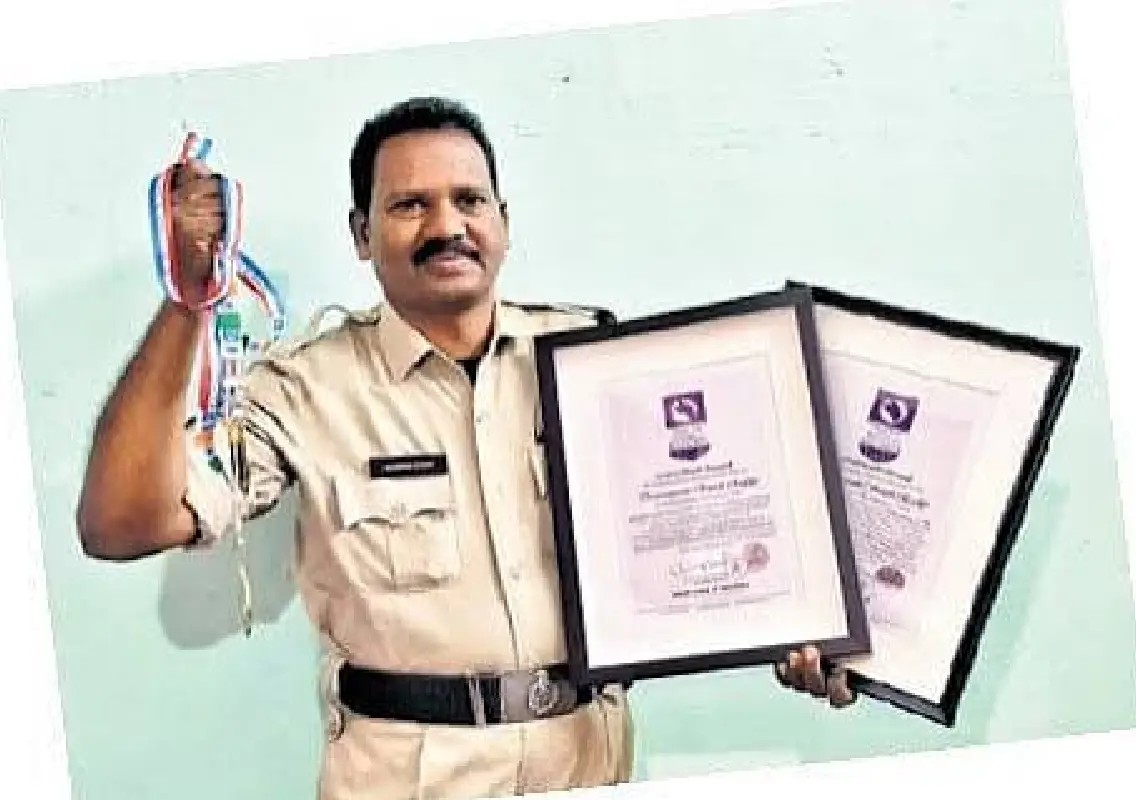


Tirupati : For Head Constable Thimmapuram Suresh Reddy, coins are much more than pieces of metal. They are fragments of history that offer a tangible connection to rulers, cultures and economies that shaped India over centuries.
Serving at Tirupati West Police Station, the 1998-batch police constable has spent nearly two decades building a collection that stretches from ancient dynasties such as the Mauryas and Satavahanas to the Vijayanagara rulers, Mughals, Nawabs and the British. His collection reflects not only the changing currency of different periods but also the political, cultural and economic history associated with them.
What began as a childhood hobby has gradually developed into a serious study of history and a personal mission to make the country’s past accessible to younger generations.
A childhood hobby becomes a lifelong passion
Suresh Reddy’s interest in collecting began when he was a school student. During Classes 6 and 7, he started collecting postage stamps. Within a couple of years, his attention shifted towards old one-paisa copper coins.
The hobby later went through a period of inactivity. However, after his transfer to Tirupati in 2004-05, Suresh revived his interest in collecting historical objects. As his collection expanded, so did his curiosity about the stories behind the coins.
Instead of simply accumulating old currency, he began researching the circumstances in which each coin was produced.
For him, understanding an old coin involves examining several details, including the ruler who issued it, the metal used, inscriptions and symbols. Such research often requires reading historical books, consulting libraries and verifying information before searching for the actual coin.
That approach has transformed his collection from a hobby into a form of historical documentation.
Coins that tell stories of different eras
Among the notable pieces in Suresh’s collection are coins associated with Vijayanagara rulers such as Sri Krishnadevaraya, Achyutaraya and Rama Raya.
His collection includes gold, silver and copper coins, along with postage stamps. It also reflects the rich historical influences of the Tirupati-Chittoor region, where Telugu, Tamil and Kannada cultures have intersected over generations.
Coins from the Vijayanagara period, including Varahas, as well as Company-period dabbulu and kasulu linked to the Nawab era, form part of the collection.
Each object provides a small but significant window into the period in which it circulated.
The material used in a coin, its inscriptions, symbols and the identity of the ruler who issued it can provide clues about political authority, trade, economic conditions and cultural influences.
For Suresh, this makes every coin an opportunity to ask questions about the past.
A source of strength during difficult times
Behind his passion is also a deeply personal story.
Suresh’s son was born with health problems affecting both kidneys. His wife, who had been working with a paramilitary organisation in Delhi, left her job to care for their son.
The difficulties at home brought considerable mental pressure to the family. During this period, Suresh found that his collection gave him something constructive on which to focus.
He describes the hobby as a stress buster — an activity that helped him keep his mind occupied while dealing with personal challenges.
What started as an interest in old coins therefore became more than a pastime. It became a source of emotional strength and a way of maintaining a sense of purpose during difficult circumstances.
More than monetary value
Suresh believes the importance of a historical coin cannot be measured simply by its age, rarity or monetary value.
Its real worth, he says, lies in the history it carries.
Holding an ancient coin can create a sense of travelling backwards through time, allowing a person to imagine the people, kingdoms and societies that once used it.
This perspective is particularly important in an era when younger generations increasingly encounter history through digital screens and online content.
While photographs and videos can bring historical events to life, an actual object from a bygone period can create a different kind of connection.
A centuries-old coin can be held, examined and studied. Its inscriptions and symbols can encourage questions about the people who created and used it.
Suresh hopes to use precisely that quality to encourage students to take a greater interest in history.
Taking history beyond cupboards
Suresh does not want his collection to remain hidden away in cupboards.
His ambition is to display the coins before the public, particularly students, so visitors can see tangible remnants of different historical periods and learn about the dynasties and rulers associated with them.
Such an approach could make history lessons more engaging by allowing students to encounter physical evidence rather than relying entirely on textbooks.
A coin bearing an inscription or symbol connected to a particular ruler can serve as a starting point for learning about that period’s politics, economy and culture.
The collection could therefore become a small travelling classroom — one in which history is introduced through objects rather than only through dates and names.
Preserving memories of India’s past
India’s history spans thousands of years and includes numerous kingdoms, empires and cultural traditions. Coins issued by different rulers form an important part of that historical record.
For collectors like Suresh, preserving these objects also means preserving stories that might otherwise remain distant from everyday life.
His collection brings together pieces connected to ancient Indian dynasties, medieval kingdoms, the Mughal period, regional Nawabs and the British era. Together, they provide a visual and physical timeline of changing political and economic systems.
The effort also demonstrates how an individual’s passion can develop into something with wider educational value.
A policeman with a historian’s curiosity
Suresh’s profession is law enforcement, but his long-running interest has made him a student of India’s past.
His journey shows how an ordinary childhood fascination can evolve into a meaningful lifelong pursuit when combined with patience, research and curiosity.
For him, the coins are not merely collectibles. They are reminders that history is not confined to books or museums. It can exist in objects that have passed from one generation to another and survived long after the people who used them are gone.
As he continues to expand and study his collection, Suresh hopes more young people will discover the stories hidden within these small pieces of metal.
In doing so, the Andhra Pradesh policeman is turning a personal hobby into an educational mission — helping a new generation see history not simply as something to read about, but as something that can be held, examined and experienced.