







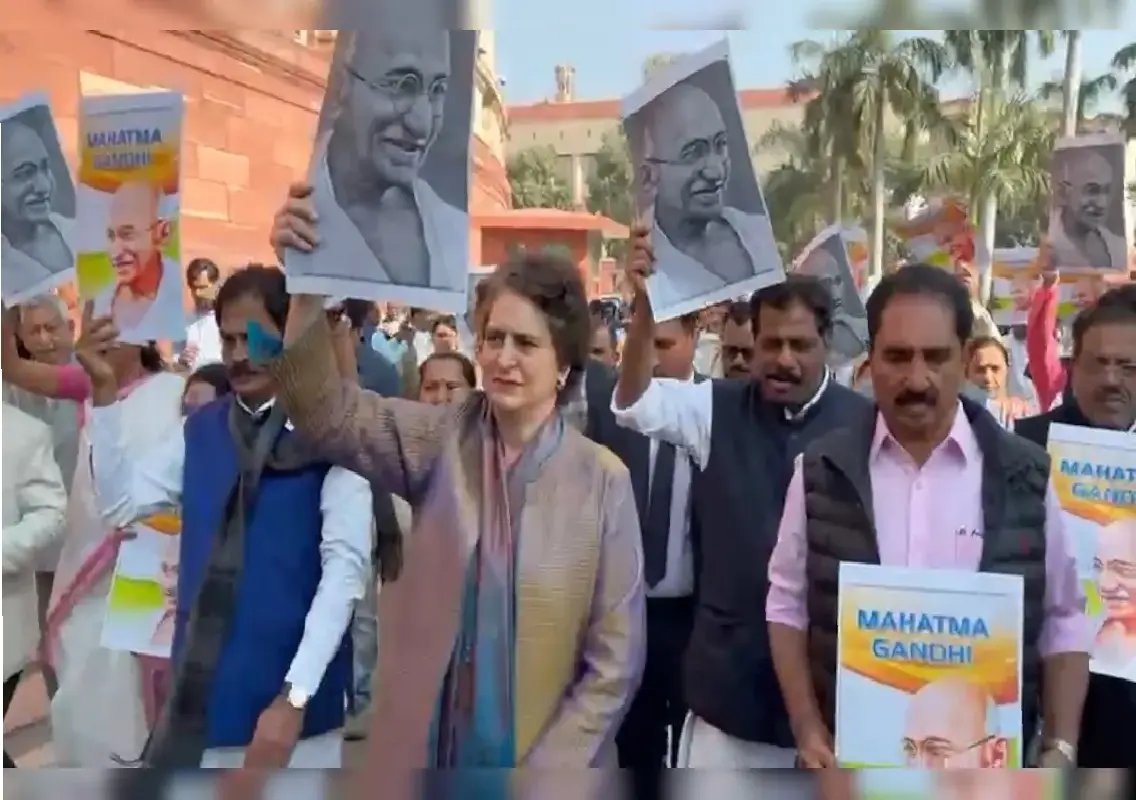


New Delhi: Senior Congress leader and Wayanad MP Priyanka Gandhi Vadra on Tuesday mounted a strong protest against the Centre’s proposed legislation to replace the Mahatma Gandhi National Rural Employment Guarantee Act (MGNREGA), calling the new Bill a serious dilution of a landmark welfare law and demanding its immediate withdrawal. The opposition protest unfolded both inside and outside Parliament, highlighting growing political confrontation over rural employment and social security.
The protest came as Union Agriculture Minister Shivraj Singh Chouhan sought the Lok Sabha’s permission to introduce the Viksit Bharat Rozgar and Ajeevika Mission (Gramin) Bill, 2025, popularly referred to as the G Ram G Bill. The proposed legislation aims to replace MGNREGA, a flagship rural employment scheme introduced in 2005 by the then UPA government, which guarantees 100 days of paid work annually to rural households.
Congress protests inside and outside Parliament
Congress MPs staged a demonstration within the Parliament premises, holding up photographs of Mahatma Gandhi, after whom the existing rural employment scheme is named. The symbolic protest underscored the party’s strong objection to removing Gandhi’s name from a law that it describes as transformative for rural India.
Raising objections under Rule 72(1) of the Rules of Procedure and Conduct of Business in the Lok Sabha, Priyanka Gandhi argued that the Bill weakens the very foundation of the right to employment. “MGNREGA has been successful in providing livelihood to rural India and strengthening the rural economy for 20 years. This is such a revolutionary law that when it was brought, all political parties supported it,” she said.
She added that no law affecting millions of poor people should be passed based on “someone’s whim, ambition and prejudice”.
Concerns over dilution of demand-based employment
Priyanka Gandhi flagged several provisions of the proposed Bill, particularly the shift from a demand-driven model to a system where funding allocations would be decided in advance by the Centre. Under MGNREGA, employment is provided based on demand raised at the local level, with funds released accordingly.
“The new Bill allows the Centre to decide funding beforehand. This undermines the very principle of demand-based employment,” she said, adding that the right to employment was being weakened in violation of constitutional values.
She also pointed out that MGNREGA empowers Gram Sabhas to assess local demand for work, depending on conditions such as droughts, floods or agricultural distress. According to her, the new Bill significantly reduces the role of Gram Sabhas, centralising decision-making and distancing the scheme from grassroots realities.
Impact on states and rural economy
Another major concern raised by the Congress leader was the reduction in the Centre’s contribution to the scheme. Priyanka Gandhi said the Centre’s share has been brought down to around 60 per cent for most states, placing a heavier financial burden on state governments.
“This will directly impact state economies, especially when many states are already waiting for their GST dues from the Centre,” she warned. She argued that rural employment schemes are critical safety nets during economic downturns and agricultural crises, and weakening them could have long-term consequences for rural livelihoods.
MGNREGA has been widely credited with stabilising rural incomes, reducing distress migration and creating durable assets across villages over the past two decades.
Opposition questions renaming and haste
Priyanka Gandhi also questioned what she described as the government’s “craze” to rename schemes, arguing that such changes come with administrative and financial costs. “Every time a name is changed, public money is spent. Why this unnecessary haste?” she asked, insisting that the Bill should not be passed without detailed discussion and consultation in Parliament.
Responding to a remark from the treasury benches invoking her family, she said, “Mahatma Gandhi is not from my family, but he is like my family member, and the entire country feels the same way.”
Senior Congress leader Shashi Tharoor also opposed the Bill, calling it “immoral” to remove Mahatma Gandhi’s name from a programme that symbolises dignity of labour and social justice.
Government defends Bill under Viksit Bharat vision
The government, however, has defended the proposed legislation, saying it aligns with its Viksit Bharat 2047 vision. Sources said the move from demand-based to normative funding would bring predictability and rational planning to the scheme.
“A demand-based model leads to unpredictable allocations and budgeting mismatches. Normative funding uses objective parameters, ensuring better planning while still guaranteeing employment or unemployment allowance to eligible workers,” a government source said.
BJP leader and former Minority Affairs Minister Mukhtar Abbas Naqvi dismissed the Congress’s objections, alleging that the real issue was the naming of the Bill. “They cannot tolerate the inclusion of Lord Ram’s name, which is why they are creating such a fuss,” he said.
Conclusion
The introduction of the G Ram G Bill has sparked a major political debate over the future of rural employment in India. While the government argues that the new framework will modernise and streamline the scheme, the Congress and other opposition parties see it as an attempt to weaken a hard-earned right to work. With strong objections raised in Parliament and protests gaining momentum, the fate of the Bill is likely to be a flashpoint in the ongoing winter session.