







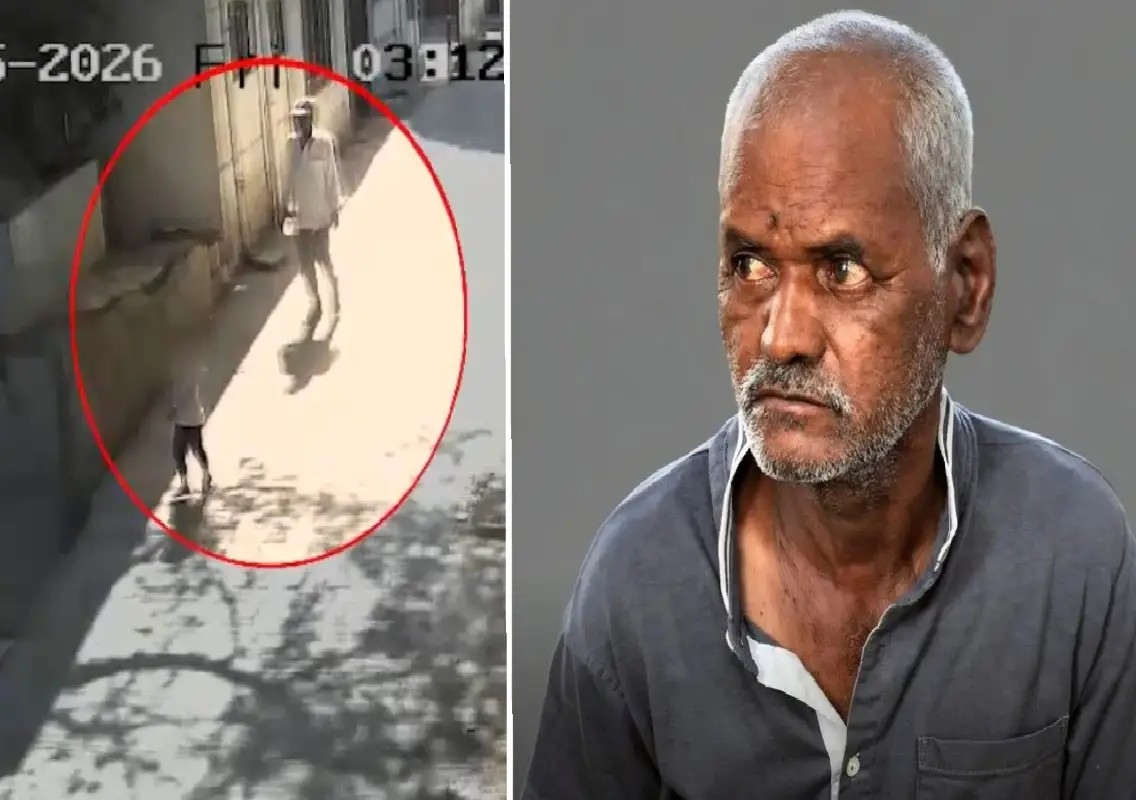


Pune: A court in Pune on Monday awarded the death penalty to a 65-year-old man convicted in the abduction and murder of a three-year-old girl, describing the offence as one that “shocks even the conscience of society” and categorising it as the “rarest of rare” case.
The verdict was delivered by the Pune District and Sessions Court, presided over by Judge S.R. Salunkhe, days after the accused, Bhimrao Kamble, was found guilty of charges including kidnapping, assault and murder.
Incident occurred in Nasrapur village
The incident took place on May 1 in Nasrapur village in Pune district. According to the investigation, the accused allegedly lured the child away from her home by offering snacks and showing her a newborn calf.
Investigators said the child was then taken to a shed near a cattle barn, where she was physically assaulted and later killed. The child was reported missing shortly afterwards, prompting an extensive search by her family and local residents.
Her body was later found during the search operation.
CCTV footage from the area reportedly showed the accused taking the child with him, which helped police identify and arrest him.
Court terms offence ‘rarest of rare’
During the sentencing hearing, the prosecution cited several Supreme Court judgments on capital punishment and argued that the case met the criteria for the “rarest of rare” category.
Agreeing with the prosecution’s submissions, the court observed that the nature of the offence left no room for leniency.
Judge Salunkhe noted that the crime involved severe cruelty against a helpless child and reflected complete disregard for human life and dignity.
In his observations, the judge said the offence was committed in an outrageous manner and had deeply disturbed not only the judicial conscience but also society at large.
The court further noted that the accused appeared to show no remorse during the trial proceedings and was aware of the legal consequences of his actions.
Investigation completed in record time
Pune Superintendent of Police Sandeep Singh Gill credited the swift investigation and coordinated efforts of the police and prosecution for securing the conviction and sentence.
According to the police, a Special Investigation Team (SIT) was formed immediately after the incident. Evidence was collected over approximately 15 days, and a detailed chargesheet of nearly 1,200 pages was filed before the court.
Officials said all 55 witnesses in the case came forward to testify, which significantly strengthened the prosecution’s case.
Gill said the investigation was carried out with sensitivity and urgency, and daily in-camera hearings contributed to the speedy disposal of the matter.
He also acknowledged the cooperation of witnesses and investigators who worked extensively to ensure that the case was brought to its conclusion.
Maharashtra government welcomes verdict
Devendra Fadnavis welcomed the court’s decision, stating that individuals responsible for such crimes have no place in society.
The Chief Minister praised the judiciary and the investigating agencies for their swift handling of the case and said the verdict reflected a strong commitment to maintaining law and order.
He also spoke to Pune SP Sandeep Singh Gill and Special Public Prosecutor Ajay Misar, congratulating them on the investigation and prosecution of the case.
The Maharashtra government noted that the speedy completion of both the investigation and the trial demonstrated the effectiveness of coordinated efforts by the police and prosecution.
Case highlights importance of child protection
The case has once again drawn attention to concerns regarding the safety and protection of children and the need for swift justice in crimes involving minors.
Legal experts say the verdict reinforces the judiciary’s position that offences involving extreme brutality against children will be dealt with sternly under the law.
The judgment also highlights the importance of prompt investigation, collection of evidence and cooperation from witnesses in ensuring justice in serious criminal cases.