


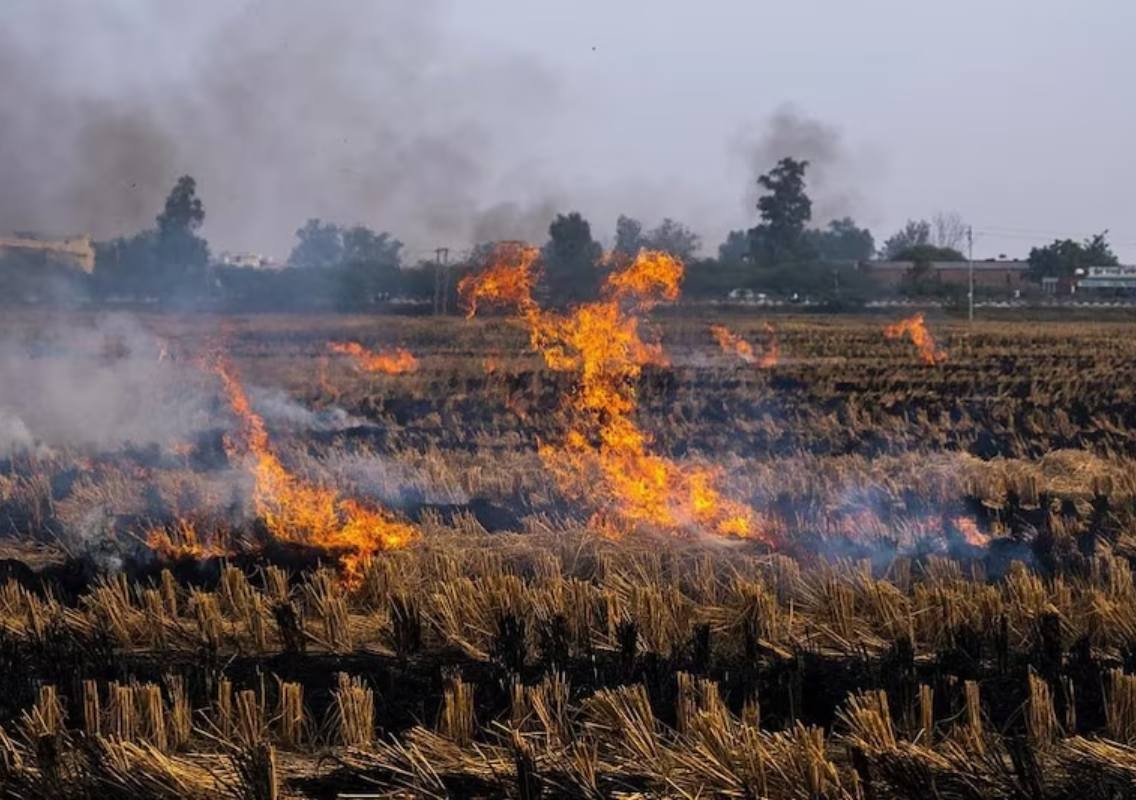


Chandigarh: Punjab recorded its sharpest single-day rise in stubble-burning incidents this season on Diwali, with 1,152 farm fires reported across the state on November 8. The surge took the cumulative number of reported incidents to 4,459, underlining the continuing difficulty in controlling crop residue burning even after around 91 per cent of the state’s paddy area had been harvested.
The latest figures, compiled under the Indian Space Research Organisation (ISRO) protocol, show that authorities have inspected 2,998 fields out of the 4,459 reported fire incidents. Of these inspected sites, 1,317 have been physically verified as cases of stubble burning.
The Diwali-day increase has raised fresh concerns about the effectiveness of measures introduced to discourage farmers from setting fire to crop residue. The southern and southwestern parts of Punjab, particularly districts in the Malwa region and the border belt, continue to account for a significant share of the reported incidents.
Tarn Taran has emerged as the worst-affected district, followed by Firozpur. The latest enforcement figures also indicate that although environmental compensation has been imposed in several cases, the recovery of penalties remains incomplete.
Tarn Taran tops district-wise farm-fire figures
Tarn Taran recorded 684 reported farm-fire incidents this season, the highest among Punjab’s districts. Of these, 306 were physically verified as stubble-burning cases. The district has also recorded the highest number of FIRs and the highest recovery of environmental compensation.
Firozpur ranked second, with 592 reported incidents. Authorities physically verified 247 of these as cases of stubble burning.
Other districts contributing substantially to the state’s farm-fire figures include Sangrur, Bathinda, Faridkot and Moga. Together, these areas reflect the concentration of incidents in southern and southwestern Punjab.
In comparison, Hoshiarpur, Pathankot, Rupnagar and SBS Nagar reported relatively fewer farm fires during the season.
The district-wise figures indicate that the problem is not evenly distributed across Punjab. Some areas continue to report a much higher number of incidents, making local monitoring and enforcement particularly important.
More than 1,300 sites physically verified
The latest data distinguish between reported fire incidents and cases physically verified by officials. While 4,459 incidents have been reported across Punjab, only 2,998 fields have been inspected so far.
Of the inspected fields, 1,317 have been physically verified as stubble-burning cases. This distinction is important because satellite-based fire reports and subsequent field inspections form separate stages of the monitoring process.
The ISRO protocol is being used to compile and track farm-fire incidents across the state. The inspection figures provide an indication of the progress made by enforcement teams in checking reported cases on the ground.
The Diwali-day spike has added to the cumulative figures at a time when the paddy harvesting season is nearing its end. With approximately 91 per cent of the paddy area already harvested, the continued occurrence of fires has highlighted the difficulty of ensuring compliance with restrictions on crop residue burning.
Fines imposed, but recovery remains incomplete
The enforcement data show a gap between environmental compensation imposed and the amount recovered from those held responsible in stubble-burning cases.
Authorities have imposed environmental compensation of Rs 62.55 lakh so far. However, only Rs 32.60 lakh has been recovered, representing around 52 per cent of the total amount imposed.
The difference indicates that a substantial portion of the penalties has yet to be collected. The figures also raise questions about the effectiveness of enforcement measures in ensuring that financial penalties translate into stronger compliance.
Action against supervisory officials has also remained limited. Proceedings under Section 14 of the Commission for Air Quality Management (CAQM) Act have been initiated against 18 officers so far. However, no charge sheets have been filed against them, according to the available figures.
The limited action against officials comes amid continued calls for stronger accountability at the district level. Monitoring and enforcement depend not only on identifying farm fires but also on ensuring that responsible departments and supervisory officers carry out their duties.
Farm fires rise despite earlier enforcement measures
The latest figures represent a significant increase from the position recorded earlier in the season.
Between September 15 and November 5, Punjab had reported 2,787 farm-fire incidents. Tarn Taran accounted for 586 of those cases, while Firozpur recorded 361.
At that stage, authorities had registered 710 FIRs in connection with stubble burning. Environmental compensation exceeding Rs 46 lakh had been imposed, while more than Rs 24 lakh had been recovered.
The latest figures show that the cumulative number of reported incidents has risen to 4,459, with Tarn Taran and Firozpur continuing to account for a substantial share.
The increase has come despite enforcement efforts and repeated reviews by authorities. The Commission for Air Quality Management had earlier held discussions with senior administrative and police officials from 12 districts to assess the situation.
During the review, the commission called for stronger monitoring and enforcement. It also stressed that nodal officers should be held accountable if farm fires continued because of failures in prevention and supervision.
The latest Diwali figures suggest that these measures have not yet been sufficient to prevent a sharp rise in incidents.
Harvest nearing completion, but stubble burning continues
The fact that around 91 per cent of Punjab’s paddy area has been harvested makes the latest spike particularly significant. Although most of the harvesting work is complete, farm fires continue to be reported in several parts of the state.
The concentration of incidents in districts such as Tarn Taran, Firozpur, Sangrur, Bathinda, Faridkot and Moga points to persistent challenges in managing crop residue in areas with substantial paddy cultivation.
Stubble burning remains a major concern because smoke and pollutants from agricultural fires can contribute to deteriorating air quality. The issue attracts particular attention during the post-monsoon period, when weather conditions can also influence the movement and dispersal of pollutants.
Authorities have been encouraging farmers to explore alternatives to burning crop residue, while enforcement teams monitor satellite alerts and inspect suspected sites. However, the latest figures indicate that the transition away from the practice remains difficult.
Diwali spike renews questions over enforcement
The report of 1,152 farm fires on a single day has renewed questions about the effectiveness of Punjab’s efforts to curb stubble burning. The rise is particularly notable because it occurred on Diwali, when the state was already approaching the end of its main paddy harvesting period.
Tarn Taran and Firozpur remain the worst-affected districts, while the gap between compensation imposed and recovered highlights shortcomings in enforcement follow-through. The limited proceedings against supervisory officials have also brought accountability into focus.
With the cumulative number of reported incidents reaching 4,459, the authorities face the challenge of strengthening field inspections, ensuring recovery of penalties and holding officials accountable where required.
The latest figures show that the stubble-burning season remains a significant concern for Punjab despite the progress of harvesting. Whether stronger monitoring and enforcement can prevent further incidents will be a key test in the remaining period of the season