







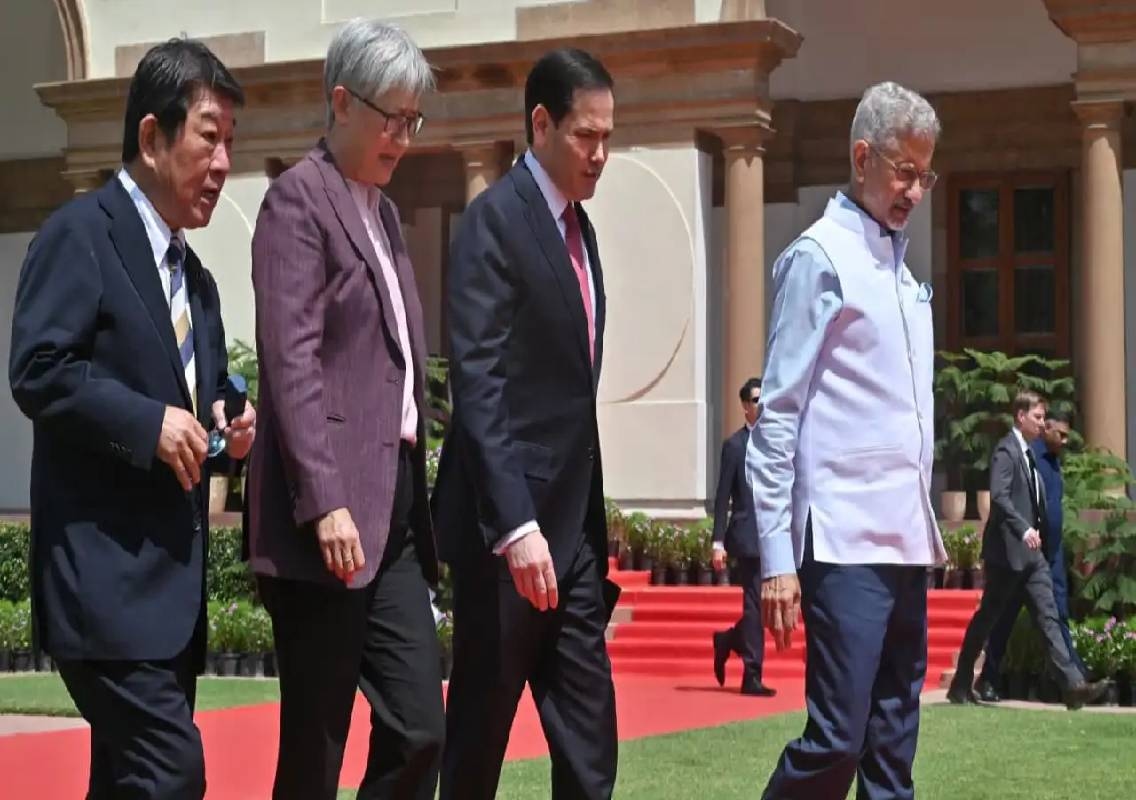


New Delhi: The Quad grouping comprising India, the United States, Australia and Japan unveiled major initiatives on maritime surveillance, critical minerals cooperation and Indo-Pacific energy security during the Quad Foreign Ministers’ Meeting held in New Delhi.
The meeting was attended by External Affairs Minister S. Jaishankar, US Secretary of State Marco Rubio, Australian Foreign Minister Penny Wong and Japanese Foreign Minister Toshimitsu Motegi.
The discussions focused on strengthening cooperation in the Indo-Pacific region, with emphasis on maritime security, strategic supply chains and energy resilience.
Maritime surveillance initiative announced
One of the key outcomes of the meeting was the decision to move forward with an Indo-Pacific Maritime Surveillance Initiative.
According to Jaishankar, the Quad countries agreed to work on a Common Operating Picture in the maritime domain to improve coordination and information-sharing across the Indo-Pacific region.
The grouping also discussed the possibility of establishing an expert panel on port infrastructure and collaborating on a pilot port project in Fiji.
Officials further said the Quad would enhance cooperation on undersea cable infrastructure, which is increasingly being viewed as strategically important for communication security and regional connectivity.
The maritime initiatives are aimed at improving monitoring capabilities and strengthening regional stability amid growing geopolitical competition in the Indo-Pacific.
India-US critical minerals framework gains focus
Another major takeaway from the meeting was the launch of the India-US Critical Minerals Framework.
The agreement is expected to strengthen cooperation in securing critical mineral supply chains that are essential for sectors such as semiconductors, electric vehicles, clean energy and advanced technologies.
Jaishankar noted that the Quad is also working with other like-minded countries in this area, signalling broader international collaboration on strategic mineral security.
Critical minerals have become an important geopolitical issue globally as countries seek to reduce dependency on concentrated supply chains and secure resources necessary for future industries.
Experts believe the framework could help India strengthen domestic manufacturing ambitions and improve access to key raw materials.
Indo-Pacific energy security initiative launched
The Quad ministers also announced a new initiative focused on Indo-Pacific energy security.
The programme will reportedly include cooperation in energy technology, policy coordination, market analysis, management systems and emergency response exercises.
The initiative comes amid continued global concerns over energy supply disruptions, price volatility and geopolitical instability affecting international markets.
Officials said the Quad aims to improve regional preparedness and resilience through coordinated approaches to energy challenges.
Quad’s growing strategic importance
The Quad has steadily expanded its role in recent years beyond traditional diplomatic engagement, increasingly positioning itself as a strategic platform for regional cooperation in the Indo-Pacific.
The grouping has launched multiple initiatives in areas such as maritime security, infrastructure development, connectivity, supply chains, disaster response and emerging technologies.
The latest meeting in New Delhi took place nearly a year after the previous Quad Foreign Ministers’ Meeting held in Washington DC.
Focus remains on Indo-Pacific stability
The Quad countries continue to stress their shared commitment to ensuring a free, open and inclusive Indo-Pacific region.
The discussions in New Delhi also built upon decisions taken during the 2024 Quad summit in Wilmington, United States, where leaders had announced expanded maritime security cooperation.
Analysts say the latest announcements reflect the Quad’s growing emphasis on practical collaboration and strategic coordination amid evolving geopolitical and economic challenges in the region.
As tensions and competition continue to shape the Indo-Pacific landscape, the grouping is expected to play an increasingly influential role in regional security and economic partnerships.