







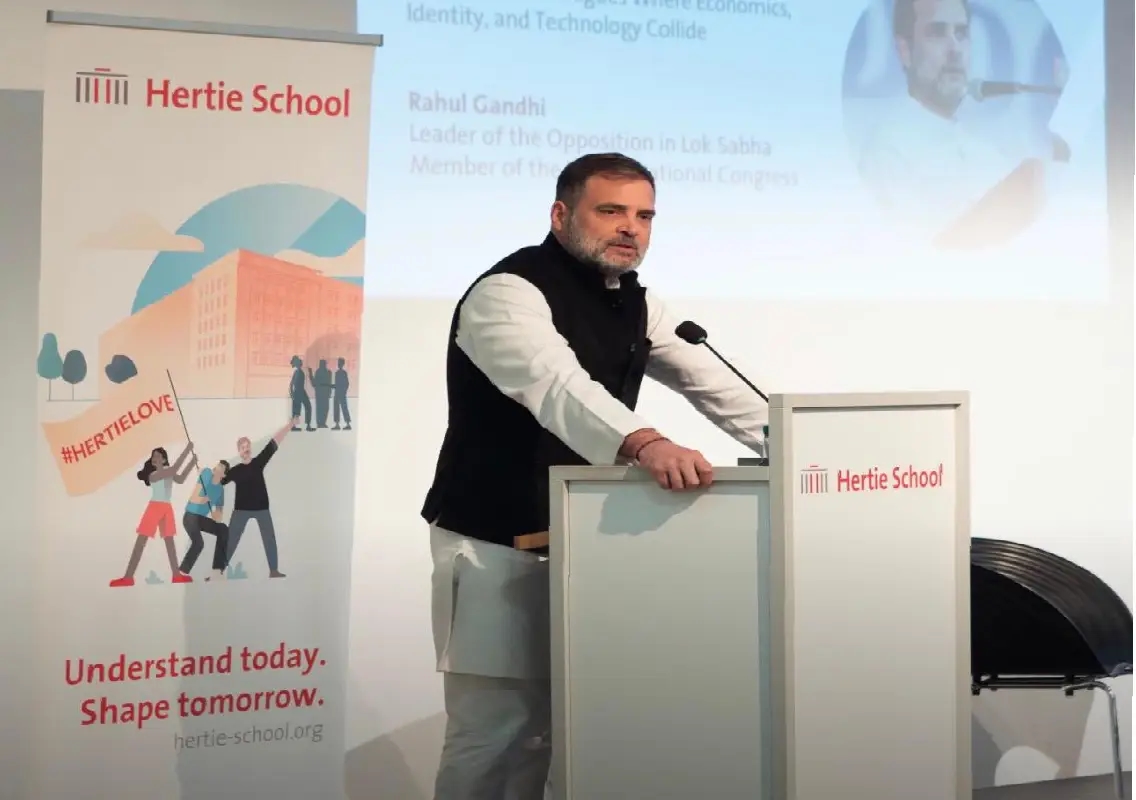


Leader of the Opposition in the Lok Sabha, Rahul Gandhi, on Tuesday said that merely questioning the conduct of elections in India is “not good enough” and asserted that the Opposition must build a concrete system of resistance to counter what he described as the capture and misuse of institutions by the ruling Bharatiya Janata Party (BJP). His remarks, delivered during an address at the Hertie School in Berlin, triggered a sharp political response from the BJP, which accused him of defaming India on foreign soil.
Speaking to students and academics, Gandhi alleged that India’s institutional framework is facing a “full-scale assault” and has been systematically weaponised to favour the BJP. He claimed that agencies such as the Central Bureau of Investigation (CBI), the Enforcement Directorate (ED) and intelligence agencies were no longer functioning independently.
Allegations of institutional capture
Rahul Gandhi said the Congress believes there is a fundamental problem with the electoral machinery in India, but stressed that focusing only on elections would not suffice. “It’s not good enough for us to say there is a problem in the elections. We will deal with it. We will create a method, a system of opposition resistance that will succeed,” he said.
He alleged that investigative agencies were selectively targeting opposition leaders while sparing those associated with the ruling party. “Look at the number of cases that the ED and the CBI have against BJP leaders and compare that with the cases against those who oppose them. You’ll find the answer,” Gandhi said, without citing specific figures.
According to him, the problem extended beyond elections to the broader functioning of democratic institutions. “There is an atmosphere in India where institutions are not performing the role that they should be performing,” he said.
BJP accused of using institutions for power
The Congress leader contrasted his party’s approach to institutions with that of the BJP. He said the Congress had helped build India’s institutional framework and never viewed it as its own political property. “That’s not how the BJP sees it. The BJP views the institutional framework of India as belonging to them, and they use it as a tool for building political power,” Gandhi said.
He also highlighted what he described as a vast financial disparity between the BJP and the Opposition. “Just look at the difference between how much money the BJP has and how much the opposition has. You’ll see a ratio of 30:1,” he claimed, arguing that this imbalance further undermines fair political competition.
INDIA alliance and ideological unity
Responding to questions on the opposition INDIA alliance, Gandhi said the grouping should not be viewed only through the prism of elections. He argued that the alliance was united by its opposition to the ideology of the Rashtriya Swayamsevak Sangh (RSS).
“All the parties of the INDIA alliance do not agree with the basic ideology of the RSS. None of them will tell you that they believe in the ideological position of the RSS. So we are very much united on that question,” he said.
At the same time, Gandhi acknowledged that tactical contests and differences among alliance partners would continue. He said such disagreements were natural in a diverse coalition but did not undermine unity on core ideological issues.
A broader battle beyond elections
Gandhi framed the political contest with the BJP as a struggle over India’s future direction rather than just electoral outcomes. “It’s a deeper battle now than simply elections. We are fighting a battle for an alternate vision of India,” he said, adding that unity among opposition parties was visible in Parliament, particularly on legislation they opposed.
BJP hits back strongly
The remarks drew immediate criticism from the BJP. Party president and Union Minister J.P. Nadda accused Rahul Gandhi of speaking against India abroad while Parliament was in session. “When Parliament is in session, Rahul Gandhi is in Germany giving speeches against India,” Nadda said, adding that the Congress leader was undermining the country’s image at a time when Prime Minister Narendra Modi was receiving global recognition.
BJP spokesperson Shehzad Poonawalla went further, accusing Gandhi of being on a “Defame India” tour. “He goes abroad, defames India and tells lies. He is not the Leader of the Opposition but the Leader of Propaganda,” Poonawalla said, alleging that Gandhi had praised China while criticising India.
Conclusion
Rahul Gandhi’s Berlin address has once again highlighted the deepening political divide between the ruling BJP and the Opposition over the state of India’s democracy and institutions. While the Congress leader insists that systemic resistance and an alternative vision are essential to counter what he sees as institutional capture, the BJP maintains that such statements abroad harm India’s global image. As both sides harden their positions, the debate over institutions, elections and democratic norms is likely to intensify in the run-up to future political battles.