







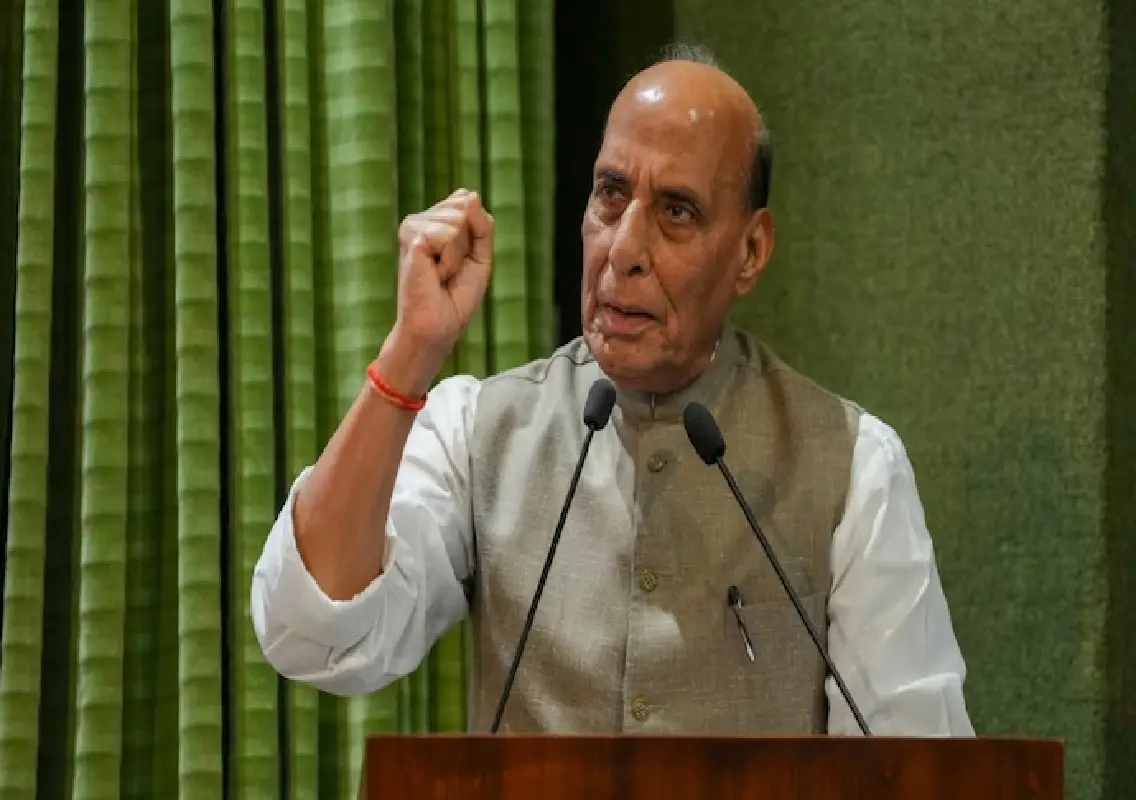


Defence Minister Rajnath Singh reaffirmed India’s commitment to maintaining an open, inclusive, and rules-based Indo-Pacific during his address at the ASEAN Defence Ministers’ Meeting Plus (ADMM-Plus) conclave in Malaysia on Saturday. His remarks come at a time when several countries have expressed growing concern over China’s increasing military assertiveness in the region.
Indo-Pacific must remain free from coercion
Emphasising the importance of a peaceful and stable Indo-Pacific, Singh said the region should remain “free from any form of coercion or hegemonic influence.” He stressed that maintaining freedom of navigation, adherence to international law, and respect for sovereignty are essential for ensuring regional stability and prosperity.
“The Indo-Pacific should be open, inclusive, and based on respect for international law. We must work collectively to ensure that the region remains free from coercion and conflict,” Singh said during his address.
Strengthening ASEAN-led regional security
Reiterating India’s long-standing support for the ASEAN centrality in the regional security framework, the Defence Minister stated that ASEAN’s leadership is crucial for peace, stability, and growth in the Indo-Pacific.
“India is committed to strengthening the ASEAN-led inclusive security architecture,” he said, adding that cooperation among regional stakeholders must focus on mutual trust, transparency, and peaceful dispute resolution.
He also highlighted India’s initiatives under the Act East Policy and Indo-Pacific Oceans Initiative (IPOI), which aim to enhance maritime cooperation, disaster resilience, and regional connectivity.
ADMM-Plus: A key multilateral defence platform
The ADMM-Plus serves as a crucial platform bringing together ASEAN’s 10 member countries — Brunei, Cambodia, Indonesia, Laos, Malaysia, Myanmar, the Philippines, Singapore, Thailand, and Vietnam — along with eight dialogue partners: India, China, Australia, Japan, New Zealand, South Korea, Russia, and the United States.
The forum facilitates dialogue and practical cooperation on defence and security issues, including counterterrorism, maritime security, cyber defence, peacekeeping operations, and humanitarian assistance.
India’s role in promoting regional stability
During his address, Singh underscored India’s commitment to international peacekeeping, capacity building, and humanitarian assistance in the Indo-Pacific. He reiterated that India’s vision of “Security and Growth for All in the Region (SAGAR)” aligns with ASEAN’s Outlook on the Indo-Pacific, both of which emphasise inclusivity and respect for sovereignty.
He also pointed out the importance of defence diplomacy and joint exercises in building mutual confidence and interoperability among partner nations. “Our shared objective should be to ensure that the Indo-Pacific remains a region of peace, stability, and development — not of dominance and confrontation,” Singh said.
Cooperation amid global challenges
Singh’s remarks also come in the backdrop of rising tensions in the South China Sea and broader strategic competition between major powers. While avoiding any direct reference to China, his emphasis on “freedom from coercion” and “inclusive security” echoed the shared concerns of several nations over unilateral military actions and territorial disputes.
He concluded by calling for greater collaboration in defence technology, capacity building, and maritime security, asserting that India is ready to work with all like-minded countries to uphold a rules-based international order.