








Situations and their management are discussed in MBA classes and the major stress is on a theory called Contingency Model which is also called Victims Theory. Assemblies of professors, while considering ‘situation’ as an area of human resource, have had plenty of discussions. Researcher and writer, Gary Yukl, has a chapter dedicated to this concept in his book ‘Leadership in Organisations’, especially discussing the Victims theory, referring to the chances of all humans to become victims of situations regardless of their capabilities or collective abilities or effective resourcefulness. Similarly, Fred Fiedler, the Austrian psychologist, in the 1960s, was the first to refer to the Contingency Model Theory of Effectiveness in his book, ‘New Approaches to Effective Leadership’.
This theory was not acceptable to a small group of discussants; I also joined them, though the larger number of participants believed in it. In the explication of situations as a part of resourcefulness of a human; in my recently published book titled ‘What is HR? And HRD?’, I have written a chapter on ‘situation’ as an area of human resource, enumerating it among twelve areas of human resource. I listed in it that situation can be seen from three dimensions. First of all, an individual can become the ‘victim’ of a situation. This is not necessarily because of the situation itself, but because the individual concerned may not have different areas of human resource to use at the moment or sometimes the issue is beyond human intervention. Secondly, it can be seen that some people are capable of manipulating any situation where they look for a win or benefit without taking into consideration the loss or the deprivation others associated may suffer. Therefore, the third and the most important point is ‘engineering’ the situation where a person will deal with a situation keeping in mind several chances of winning or benefitting, while taking into account various aspects affecting all others involved, even those who may not be known. Hence, a discussion on engineering situations as a strategy, method and technique in the action plans is worthwhile.
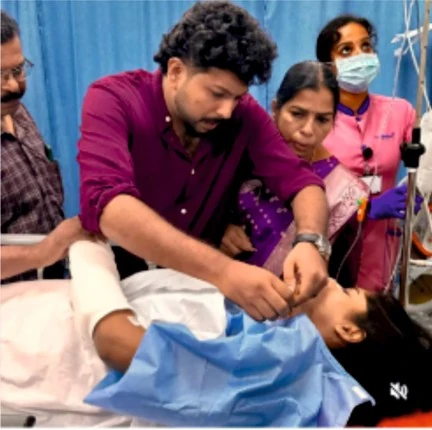
This is exemplified by an event that happened on 21 November 2025, at Cherthala in Alappuzha district of Kerala. The marriage of Sharon, an assistant professor in Mechanical Engineering in AVM Engineering College, and Avani, a teacher in the Bishop Moore School, both hailing from the district, was fixed for the muhurtham between 12.12 and 12.25 p.m. However, while travelling for some distance before the fixed time of the marriage, Avani met with an accident in which she suffered severe injuries including a serious one to her backbone. She was rushed to a hospital nearby and an immediate operation had to be conducted. Sharon reached the hospital with his parents and with the assistance of the hospital authorities, tied the Thaali on Avani, who was lying in the hospital bed, at the fixed muhurtham itself. After the ceremony in the ICU, Avani was immediately shifted to the operation theatre. While the marriage was taking place in the ICU, prayers were held in the auditorium; more than sixty kilometers away; and the arranged lunch was served to all invitees.
Sharon and Avani refused to become victims of a situation and got married by engineering the situation to not only their own advantage but also to the advantage of all those who associated and cooperated with them.
It happened in January 2024. Darshan Singh Brar from Karnal in Haryana, Eighty years old, was pronounced ‘dead’. His ‘body’ was being transported from Patiala to his house in Karnal, where sorrowful relatives had assembled and customary wood had been prepared for his cremation, food had also been laid out. But while travelling, when the ambulance fell in a pothole, it jumped high making the coffin including the ‘dead body’ move. The son had been holding on to the body from the time the village road began, and noticed that the dead body moved even after the pothole jump was over. Therefore, he immediately checked the pulse of the ‘dead body’ and discovered the beating of the heart. He returned with the body to the hospital where very soon, his father was breathing again. The doctor said that even if the ambulance reached the body five minutes later, Darshan Singh Brar could not have been revived.
The younger Brar refused to become a victim of the situation and steered the life of his father by engineering the situation to the advantage of both him and his family.
This happened on 09 March 2021 in Myanmar. Sister Ann Rose Nu Tawng kneeled and begged the army officers not to shoot the children and take her life instead. The heavily armed officers, two of them knelt down like her in supplication, obliged her, in spite of her being a Catholic nun, who hailed from the majority Buddhist country. Her act of bravery in the city of Myitkyina came to light as Myanmar struggles with the chaotic aftermath of the military’s overthrow of the civilian leader, Aung San Suu Kyi. People all over the world got the news and saw the picture, and were in praise of her for engineering the situation to save a group of youngsters from being killed.
Ann Rose’s courage helped her engineer the situation for the benefit of others and to her own satisfaction.
It is evident that the Contingency Model Theory, which believes that people become victims of situations and thereby contributes to the belief in fate or destiny, is neither logical nor rational. It is important that all, including the MBA students, are educated, that engineering a situation is more important than believing in fate and becoming victims of manipulations. More than anything else, it is necessary to explain to people the difference between being a victim or one who succeeds by manipulating and engineering situations only for one’s own advantage. Situation has to be viewed as a different phenomenon from circumstances and environment.
………………………………….
Prof. Sunney Tharappan, is Director of College for Leadership and HRD, Mangaluru. He trains and writes and lives in Mangaluru. Email: [email protected]