








Baby dove, pigeon chick, young rook, rook chick, squeaker, piper and squabs are all names of the young ones of pigeons; the last is considered the most proper. Nestlings, hatchlings and fledglings are common words associated with the usual and normal growth and development of young birds. A nestling is a young bird, unable to care for itself, though they can open their eyes, they cannot leave their nest and are entirely dependent on their parents for food. They have only pin feathers and are unable to walk or hop or fly. The hatchlings are those which are just a few days old and have fluffy feathers. Being helpless, they eagerly wait for food. Still different are the fledglings because they have grown their feathers and are capable of leaving the nest for short periods or short distances during the process of learning to fly, but they still depend on the parents for food.
When children are young and have holidays when schools close down for vacation, the best thing that can happen to them is a trip to their grandparent’s house, particularly to the mother’s house. The latter, a sort of a universal experience for children, is a freer place and the maternal grandparents are more approachable and even more generous. I still remember such holidays, where I had the freedom to play and even eat as I liked without following the code of discipline of my normal home. The best feature I liked in my mother’s house even more than the people in the house, who showered their affection on my sister and me was the proximity to pigeons aplenty in that house. They used to perch in a dovecote built for them in one corner of the open courtyard, a structure mounted on a pole, with pigeonholes from which the pigeons would poke their heads out. In the mornings, when paddy was strewn and spread over in the courtyard to feed them, all of them would come down to eat. It was a great pleasure to walk through them and feel friendly with them.
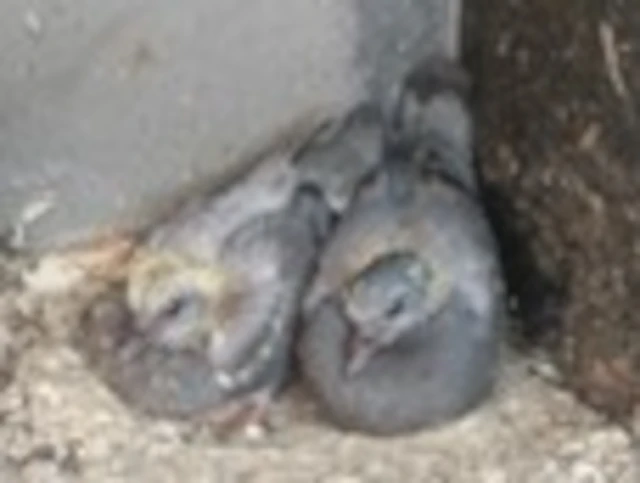
Recently, I had had plenty of troubles from a few pigeons which started nesting in one of my balconies by perching on top of the split part of the AC. I did not notice them for almost a month as this particular room was not regularly used for some time. After noticing the dirt on the floor, I asked a contractor to put a net for the balcony to avoid the pigeons. The house assistant was asked to clean the balcony after the net was fixed. He reported to me that he had noticed a couple of squabs, young ones, of pigeons, huddling in a box.
I asked the assistant not to disturb them and stood with him to remove the hooks of the net at the bottom keeping it rolled up above the balcony railings because I noticed a couple of pigeons sitting on top of an electric pole nearby. I presumed that they were the parents and definitely these squabs would die, if they are not allowed in to provide food for them. I also instructed the assistant not to touch the squabs to prevent infecting the young ones as well as to prevent him getting infected in any way.
One of the most interesting aspects of pigeons is their ways of feeding the squabs. What they feed the squabs is known as ‘crop milk’. This is a nutrient rich fluid secreted up by the parents on the lining of the crop, a patch in the bird’s throat, which is regurgitated to feed its young ones. It is a high protein, high fat substance given by the parents to the squabs. The other two birds who exhibit this behaviour are flamingos and emperor penguins. No other animals are known to have this imprint in their behaviour. Pigeon’s milk or bird milk or crop milk provides essential nourishments to the young birds. The most fascinating fact about this feeding system is that the feeding is done by both the male and female parents, something rare in the families of birds themselves. However, the crop milk lacks carbohydrates, unlike mammalian milk.
The parents of the two squabs used to come regularly and feed them and even stay with them at night. I kept for them a tub of water to drink from and I noticed that they even took bath in the tub. This attracted half a dozen or more other pigeons who started visiting the place more often to drink water and dirty the place more. I did not bother about this as I knew it would last only till the squabs started flying. I thought the parents would stay with the squabs during the day too. So, I rarely went to inspect the balcony as whenever I did it, both parents flew away. I kept some rice in a steel plate for the parents to eat. However, it was an unwise act because it attracted more pigeons and within a short period, the rice plate was empty. These activities continued for a few days more.
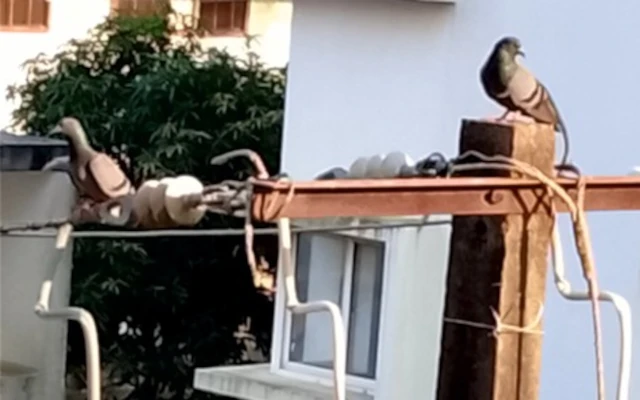
Very often, the parents would perch on the electric pole, sometimes even sleep. However, they were always there with the squabs at night. During the daytime, they would go and sit on top of the pole with their eyes fixed on the balcony and they came back after I closed the door of the balcony. Sometimes, I would watch them by peeping through the curtains of the window by the side of the room that led to the balcony.
It could be about three weeks when, one fine morning, I did not see those squabs. I do not know whether I was disappointed that I did not have the benefit of watching the excellent parenting done by the pigeons. Or is it that there were no more chances for a sort of grand parenting?
………………………………….
Prof. Sunney Tharappan, is Director of College for Leadership and HRD, Mangaluru. He trains and writes and lives in Mangaluru. Email: [email protected]