







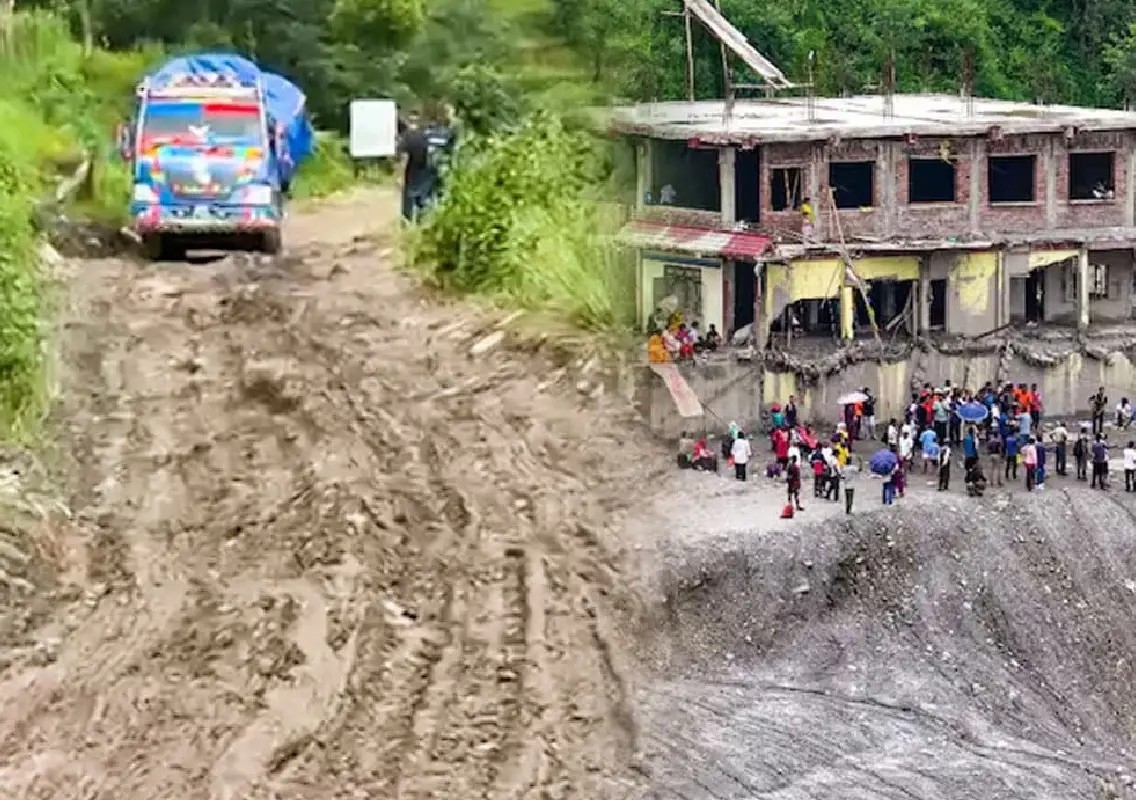


Rasuwa : Relief convoys are battling damaged roads, washed-out bridges and difficult mountain terrain to reach communities in Nepal’s flood-hit Rasuwa district, where large-scale destruction has severely disrupted transport and access to essential supplies.
The situation has made the delivery of humanitarian assistance a major logistical challenge. Roads and bridges were damaged or destroyed by the devastating Bhote Koshi River floods of August 26, leaving several affected areas difficult to reach by conventional transport. Nepal’s government says restoring road, electricity and telecommunications connectivity remains a priority alongside ongoing search, rescue and relief operations.
Relief vehicles are therefore having to negotiate temporary mountain routes and damaged stretches of road as volunteers, security personnel and other responders work to ensure that food and other essential materials reach people affected by the disaster.
Roads washed away by devastating floods
The floods caused extensive damage to Nepal’s transportation infrastructure.
According to Nepal’s official situation update, the disaster affected Rasuwa, Nuwakot, Dhading and other districts along the Bhote Koshi River. Houses, roads, bridges, hydropower facilities and other critical infrastructure were damaged.
The scale of the destruction has made access one of the biggest challenges facing relief workers.
In Rasuwa, several major road sections remain blocked. Reports on September 4 said the Trishuli-Mailung-Syafrubesi road section was completely blocked following flooding, while other major routes in the district had also been suspended.
For relief teams, reaching isolated communities has consequently become an operation requiring patience, coordination and considerable logistical effort.
Convoys navigate difficult terrain
With normal routes disrupted, relief vehicles have been moving cautiously through damaged and temporary routes.
The difficult journey is not simply about transporting supplies from one town to another. Drivers and relief workers must contend with unstable roads, landslides, damaged bridges and sections where the original road network has been washed away.
Every successful delivery can therefore represent a significant achievement for communities cut off from regular supply chains.
Government-coordinated relief operations have already used trucks, smaller vehicles and helicopters to transport essential supplies to Rasuwa, Nuwakot and Dhading. A logistics update reported that 37 trucks and 37 smaller vehicles had been used, alongside helicopter deliveries.
Volunteers and security teams work together
Relief operations have brought together government agencies, volunteers, security personnel and humanitarian organisations.
Nepal’s official situation report says the Nepal Army, Nepal Police and Armed Police Force have been fully mobilised alongside disaster-management authorities, provincial and local governments and other agencies.
Their responsibilities range from search and rescue to transporting supplies and helping restore damaged infrastructure.
The cooperation is particularly important in mountainous areas where access can change rapidly because of landslides, flooding and unstable terrain.
Thousands remain missing
The humanitarian operation is taking place amid an enormous search for people still missing following the disaster.
Nepal’s Ministry of Foreign Affairs said in its September 4 update that 13,093 people had been rescued, including more than 300 foreigners. Around 5,083 people remained missing, including approximately 600 foreigners from 35 countries, while 1,287 bodies had been recovered at that stage.
The figures continue to be updated as search and verification operations progress.
The disaster has therefore created simultaneous demands for rescue, relief distribution, medical assistance, infrastructure restoration and the identification of victims.
Two workers rescued after nine days
A major moment of hope came on September 4 when two workers were rescued alive from a tunnel at the Trishuli 3A Hydropower Project after being trapped for nine days.
Nepal’s government confirmed that the two workers were among those rescued during continuing operations at several hydropower projects. Tunnel rescue teams from India, China and South Korea have been working alongside Nepali forces.
The successful rescue demonstrated that operations could still produce survivors despite the scale of the disaster and the difficult conditions facing rescuers.
It also provided encouragement to families still waiting for information about missing relatives.
International support reaches Nepal
The relief effort has also received assistance from several countries and international organisations.
Nepal’s Ministry of Foreign Affairs said international support included assistance from India, China, the United Kingdom, Japan, the United States, Australia, South Korea and other countries, as well as organisations including the United Nations, World Bank and Asian Development Bank.
Specialised teams and equipment are being used for search and rescue operations, while Nepal has requested additional equipment including high-capacity drones, LiDAR systems, Bailey bridges, ground-penetrating radar and other technical resources.
Such assistance is particularly important because conventional access has been severely compromised.
Damage extends far beyond roads
The destruction caused by the floods is not limited to transportation infrastructure.
Nepal’s preliminary assessment has put total losses across physical infrastructure, human settlements, bridges, health, education, agriculture, energy, electricity and telecommunications at approximately NPR 387.54 billion, or about $2.6 billion.
The government has estimated that approximately NPR 7.95 billion, or around $53 million, will be required during the first four months for early recovery and initial rehabilitation.
The figures are expected to change as detailed assessments continue.
Communities face shortages and displacement
The destruction of roads has a direct effect on families who have lost homes, food stocks and access to basic services.
A preliminary assessment covering affected areas recorded thousands of households with damaged or destroyed homes and thousands requiring immediate shelter. Across the assessed areas, more than 3,300 households were displaced and more than 4,200 were identified as needing immediate shelter.
When roads disappear, access to food, drinking water, medicines and shelter materials becomes considerably more difficult.
This is why restoring transport links is as important as delivering immediate relief.
Helicopters provide a vital alternative
Where roads are completely inaccessible, helicopters have become an important part of the relief effort.
Aerial deliveries can reach locations that trucks cannot access, although the capacity of aircraft is limited compared with conventional road transport.
Helicopters are therefore being used alongside ground convoys rather than as a complete replacement for road networks.
The combination allows relief agencies to reach the most isolated communities while larger quantities of supplies can be moved whenever road conditions permit.
Restoring connectivity is a priority
Nepal’s government has identified the restoration of roads, electricity and telecommunications as a major priority.
The challenge is particularly severe in mountainous areas, where repairing a damaged road can require clearing landslides, rebuilding bridges and stabilising vulnerable slopes.
Temporary routes may provide an immediate solution, but long-term recovery will require rebuilding infrastructure capable of withstanding future extreme weather events.
The humanitarian effort continues
For relief workers, the work is far from over.
Search teams continue to look for missing people while authorities work to identify recovered bodies and reunite families with their loved ones.
At the same time, displaced communities need food, drinking water, shelter and medical assistance.
Nepal has also begun temporary burial procedures for recovered bodies after necessary forensic work, while DNA collection is being used to support identification efforts.
A difficult road to recovery
The images of relief convoys making their way through damaged mountain routes reflect the wider challenge facing Nepal.
The immediate emergency response is being conducted while the country’s transport and communication systems remain badly damaged.
Every repaired road and restored bridge can reopen a lifeline for communities that have been isolated since the floods.
For now, volunteers, security personnel, drivers and humanitarian workers continue to make difficult journeys through unstable terrain to deliver assistance.
Their efforts are providing more than supplies. They are helping maintain a vital connection between isolated communities and the wider relief operation.
Hope amid devastation
Nepal’s flood disaster has caused immense loss of life and widespread destruction, but the continuing rescue and relief operations have also produced moments of hope.
The rescue of two workers after nine days demonstrated what remains possible even under extraordinary circumstances. International teams, local responders and volunteers continue to work together despite dangerous conditions.
As relief convoys slowly reach Rasuwa and other badly affected areas, the immediate objective remains clear: save lives, support survivors and restore access.
The road to recovery will be long, but every convoy that reaches a stranded community represents another step towards rebuilding lives after one of Nepal’s most devastating natural disasters.