







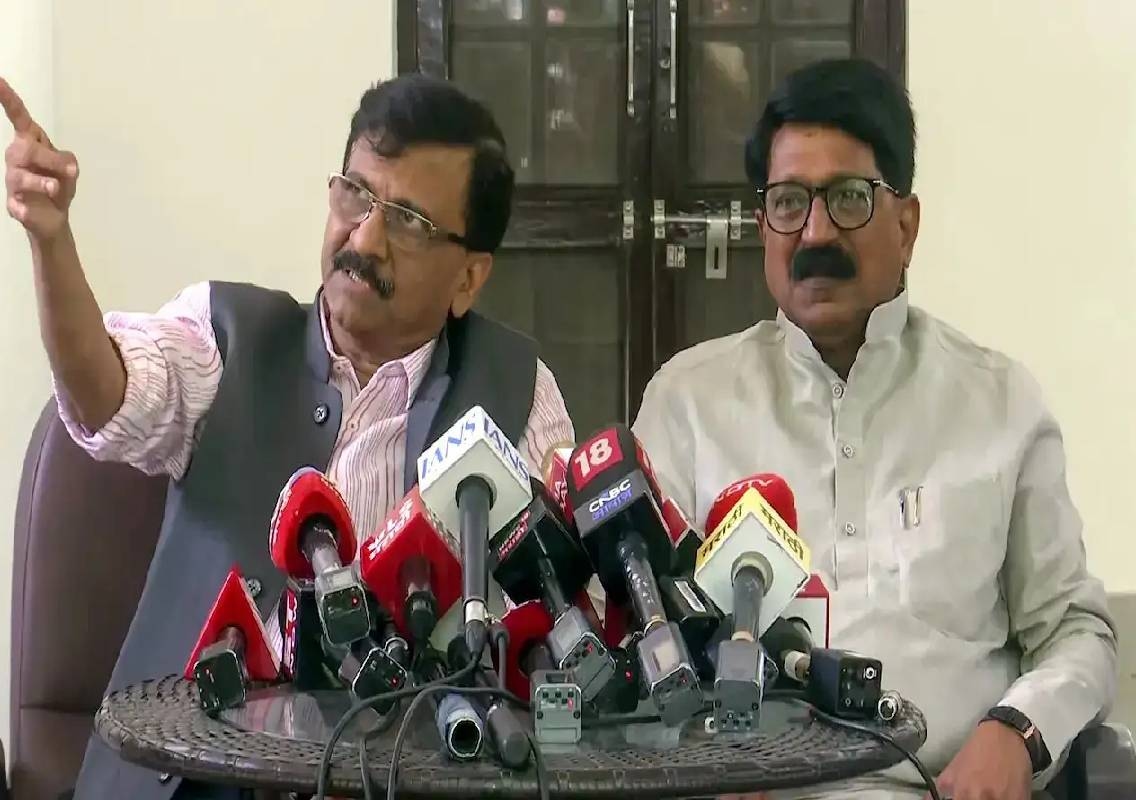


Mumbai: Shiv Sena (UBT) leader Sanjay Raut launched a sharp attack on party MPs allegedly in touch with the Eknath Shinde-led faction, accusing them of betraying the mandate of voters and engaging in political horse-trading.
In a series of strongly worded remarks on Friday, Raut alleged that several MPs had abandoned the party for monetary gains and said the Shiv Sena (UBT) would politically counter any attempts to weaken the organisation. His comments come amid reports that at least six Members of Parliament from the Uddhav Thackeray-led camp are considering switching allegiance to the rival Shiv Sena faction headed by Maharashtra Deputy Chief Minister Eknath Shinde.
The latest developments have reignited tensions within the party, nearly four years after the split that reshaped Maharashtra’s political landscape.
Raut’s sharp criticism of rebel MPs
Addressing reporters, Raut expressed anger over the reported defections and used strong language while referring to the MPs.
He claimed that some of the lawmakers were elevated to political prominence by the party despite having little standing beforehand.
According to Raut, mere criticism was insufficient for those who had allegedly betrayed the party’s trust and the mandate given by voters.
The Rajya Sabha MP alleged that the MPs were elected because of the party’s symbol, ideology and grassroots workers, and not because of their individual popularity.
His remarks reflected growing frustration within the Uddhav Thackeray camp as speculation surrounding possible defections continues.
Allegations of horse-trading
Raut accused the rebel MPs of entering what he described as an “auction market” and alleged that money was driving political decisions.
Without providing evidence, he claimed that some MPs had accepted offers worth Rs 40 crore to Rs 50 crore to switch sides.
He further alleged that financial inducements have become a widespread feature of Indian politics, extending from local bodies to Parliament.
According to Raut, such developments pose a challenge to democratic values and undermine the trust placed in elected representatives by voters.
The leaders allegedly involved in the discussions have not publicly responded to the specific allegations.
Doors of Matoshree still open
Despite his criticism, Raut adopted a conciliatory tone when discussing the future of the rebel MPs.
He stated that the doors of Matoshree, the residence of Shiv Sena (UBT) chief Uddhav Thackeray, remain open for those willing to return.
Raut said the party remains in contact with all the MPs and is aware of their whereabouts.
He suggested that those who believe they have made a mistake could return and hold discussions with the party leadership.
The statement indicates that Shiv Sena (UBT) is attempting to balance strong public criticism with efforts to prevent further erosion of its parliamentary strength.
Operation Tiger or Operation Wolf?
Responding to reports describing the alleged defections as “Operation Tiger”, Raut rejected the phrase and proposed an alternative label.
He argued that tigers do not hide and confront challenges directly, while those changing sides were behaving differently.
Referring to the rebel MPs as “wolves”, Raut said they should not be compared to tigers, which have long been associated with the Shiv Sena’s political identity.
The comments were another indication of the increasingly bitter rhetoric surrounding the ongoing political dispute.
Reflecting on Shiv Sena’s 60-year journey
Raut also reflected on the party’s six-decade political journey and its continued relevance in Indian politics.
He noted that very few political organisations have remained active and influential for 60 years.
According to him, opposition parties across the country have faced increasing challenges in recent years as political competition has intensified.
Raut argued that a strong opposition is essential for a healthy democracy and alleged that regional political parties are facing sustained pressure.
Claims of pressure on regional parties
The Shiv Sena (UBT) leader alleged that the Centre was pursuing a strategy aimed at weakening regional political parties.
He cited examples of leaders leaving various political organisations, including the Shiv Sena, Congress and other regional parties.
According to Raut, parties such as the Trinamool Congress, DMK, NCP and BRS have also faced similar challenges.
He claimed that regional identities and political movements are under pressure in an increasingly centralised political environment.
The ruling BJP has repeatedly rejected similar allegations made by opposition leaders in the past.
Show-cause notices issued
On the possibility of disciplinary action, Raut confirmed that show-cause notices had been issued to the concerned MPs.
He said the party would review their responses before deciding on further action.
At present, no MP has been formally expelled from the party.
The leadership is expected to evaluate the situation in the coming days as speculation over potential defections continues.
Conclusion
The latest remarks by Sanjay Raut highlight the growing tensions within Shiv Sena (UBT) amid reports of MPs moving closer to the Eknath Shinde-led faction. While the party has accused the rebels of betraying the public mandate and engaging in horse-trading, it has also left the door open for reconciliation. With disciplinary proceedings underway and political uncertainty continuing, the developments could have significant implications for the party’s future parliamentary strength and Maharashtra’s political landscape.