


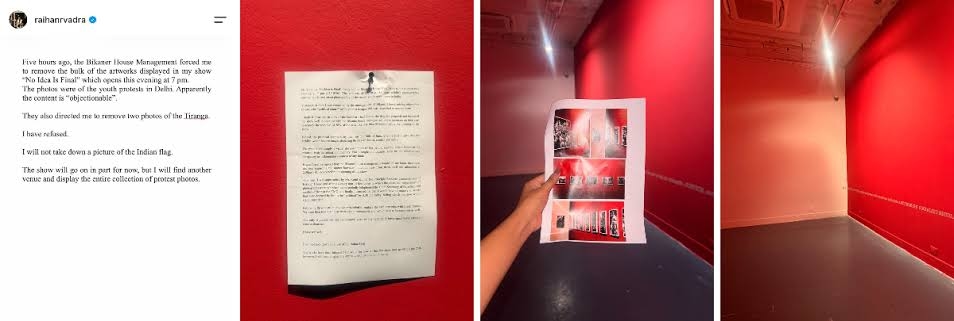


Thiruvananthapuram: Kerala Chief Minister V D Satheesan has offered to host artist and photographer Raihan Vadra’s exhibition, No Idea Is Final, in the state after several photographs depicting protests were reportedly removed from Bikaner House in New Delhi. The offer has triggered a political exchange, with the BJP accusing the Congress of double standards over democracy and the right to protest.
Satheesan invites Raihan Vadra to exhibit in Kerala
Kerala Chief Minister V D Satheesan on Thursday offered to host the entire exhibition by Raihan Vadra, son of Congress leader Priyanka Gandhi Vadra, following a controversy over the removal of several photographs from his show at Bikaner House in New Delhi.
In a post on X, Satheesan said Kerala would be happy and proud to host No Idea Is Final in its entirety, adding that there would be “no exclusions, no exceptions”. He tagged Raihan and Priyanka Gandhi in the post.
The invitation came amid allegations that the Bikaner House administration had asked Raihan to remove several photographs shortly before the exhibition was scheduled to open on October 22. The works reportedly included images of protests and photographs featuring the national flag.
The dispute has drawn attention to the boundaries between artistic expression and the policies governing exhibitions at public venues. It has also become a political issue, with Congress leaders criticising the removal of the photographs and the BJP defending the venue’s position on displaying political content.
Satheesan’s offer provides Raihan with a possible alternative venue for presenting the complete exhibition, although details about any proposed dates or arrangements in Kerala were not immediately available in the information provided.
Rajeev Chandrasekhar accuses Congress of double standards
Reacting to the chief minister’s invitation, Kerala BJP president Rajeev Chandrasekhar accused the Congress of applying different standards to the rights of politically connected individuals and ordinary citizens.
In his response on X, Chandrasekhar drew a comparison between the support being offered to Raihan and the treatment of young people who protest against the Kerala government. He alleged that Malayali youth face tear gas, gas grenades and physical assaults by police during peaceful demonstrations, while Raihan was receiving preferential treatment.
Chandrasekhar questioned whether democracy and individual rights mattered only when members of a politically influential family were involved.
His remarks shifted the debate beyond the circumstances surrounding the exhibition to the broader political contest between the BJP and Congress in Kerala. The BJP has used the chief minister’s invitation to question the state government’s approach to protests and political dissent.
The allegations about police action against protesters were made by Chandrasekhar as part of his political criticism. They should be understood as his claims rather than as independently established findings in the dispute over the exhibition.
The exchange also reflects the political sensitivity surrounding Raihan’s work because of his family background. While the controversy concerns photographs displayed at an art exhibition, both parties have linked the issue to larger questions about political influence, freedom of expression and the treatment of dissent.
What happened at Bikaner House?
Raihan’s solo exhibition, No Idea Is Final, was scheduled to be held at Bikaner House in New Delhi from October 22.
According to reports and statements attributed to Raihan, the venue’s administration asked him to remove several photographs shortly before the exhibition was due to open. The images reportedly included photographs of the national flag and pictures documenting protests over the preceding six months.
Raihan said he had submitted the exhibition proposal and layout to the Bikaner House management well in advance. He maintained that the photographs were intended to document protests rather than communicate a political message.
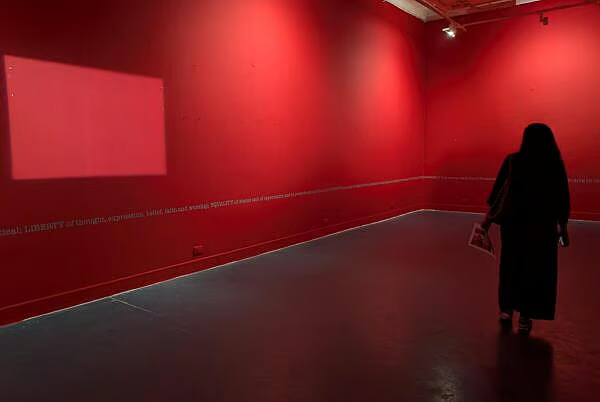
He also said he was informed that the exhibition could be cancelled if the disputed photographs were not removed by 5 pm on Wednesday. Media reports stated that the information reached him at around 3.30 pm, leaving his team with a limited period to respond.
The timing of the request became a central part of the controversy. Raihan expressed distress over the last-minute demand and said the exhibition would continue in a reduced form.
In an Instagram post, he indicated that the show would go ahead “in parts now”. His team reportedly placed blank frames where some of the removed photographs had been displayed. According to Raihan’s account, the administration subsequently instructed the team to take down those frames as well.
The episode prompted questions about the extent to which exhibition organisers can restrict works after approving a proposal and whether the venue’s policies were communicated clearly before the event.
Bikaner House cites its exhibition policy
Bikaner House issued a statement amid the controversy, explaining that the removal request was based on its management society’s policy.
The statement said certain photographs displayed as part of Raihan Vadra’s No Idea Is Final exhibition were found to be inconsistent with the policy of the Bikaner House Management Society. The administration therefore requested their removal.
It added that photographs considered consistent with the society’s policy continued to be displayed.
The statement did not, in the material provided, specify each photograph that was considered inconsistent with the policy or explain in detail how the disputed works breached its requirements.
A Bikaner House official reportedly said the administration was not authorised to comment further on the matter.
The venue’s explanation differs from Raihan’s account of the photographs as documentation of protests without an intended political message. The dispute therefore involves both the interpretation of the images and the rules governing what can be displayed at the venue.
The available statements establish that the management requested the removal of certain works and cited its policy as the reason. They do not, by themselves, settle the wider debate over whether the decision amounted to an unreasonable restriction on artistic expression.
Priyanka Gandhi condemns removal of photographs
Priyanka Gandhi Vadra strongly criticised the decision to remove the photographs, describing the move as ridiculous and accusing the authorities of suppressing the voices of young people.
She argued that those in power who fear artistic expression ultimately risk losing the very power they seek to protect. Her remarks framed the incident as a question of freedom of expression and the ability of young people to document events and express their perspectives through art.
The Congress leader’s criticism added a national political dimension to the dispute. Raihan’s exhibition had been planned as an artistic presentation, but the removal of photographs depicting protests quickly became a subject of debate involving senior political figures.
Congress leaders have questioned the decision to remove the works, while the BJP has defended the venue’s restrictions on political content.
BJP calls allegations fake news
BJP spokesperson Pradeep Bhandari also responded to the controversy on Thursday. He said Bikaner House policy did not permit the display of political content and rejected the allegations surrounding the removal of the photographs as “fake news”.
Bhandari also criticised Priyanka Gandhi, suggesting that she should find another way to “launch” her son into politics.
His comments further intensified the political exchange, portraying the dispute as an attempt by the Congress to give Raihan a political platform. The Congress, meanwhile, has presented the matter as a question of artistic freedom and the alleged suppression of young voices.
The competing responses illustrate how the controversy has expanded beyond the venue’s stated policy. Raihan has maintained that his photographs documented protests, while Bikaner House has said some works did not comply with its rules. The BJP has challenged the Congress’s interpretation, and Satheesan has offered to host the complete exhibition in Kerala.
Exhibition dispute becomes a political flashpoint
The controversy surrounding No Idea Is Final has brought together questions about artistic expression, venue regulations and political accountability. Raihan’s account focuses on the timing of the removal request and his contention that the photographs were documentary works. Bikaner House has cited its management policy, while Congress and BJP leaders have interpreted the episode through sharply different political lenses.
Satheesan’s invitation offers a potential way for the exhibition to be presented in Kerala without the exclusions that prompted the dispute. Whether the complete exhibition will be hosted in the state, and under what arrangements, remains to be confirmed.
For now, the disagreement continues to centre on whether the disputed photographs should be treated as political content restricted by a venue’s policy or as documentation that deserves space in an art exhibition. The final outcome may depend on the organisers’ next steps and any further clarification from the venue.