


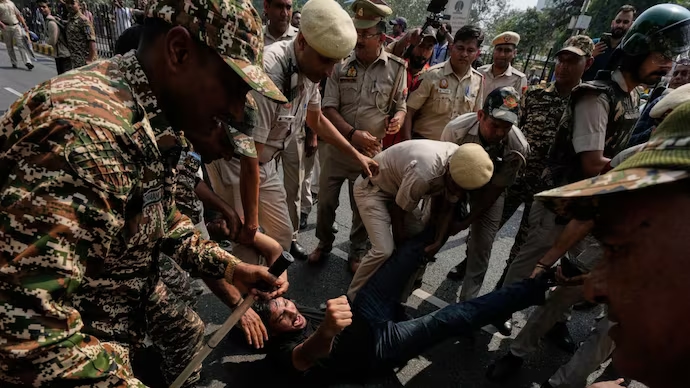


New Delhi: The Supreme Court on Sunday directed authorities to ensure that people gathering peacefully are not illegally detained, emphasising that any detention must follow the procedure established by law. The order came amid allegations of police excesses and illegal detentions during protests in Delhi demanding Chief Election Commissioner Gyanesh Kumar’s resignation over alleged irregularities in the Special Intensive Revision (SIR) of electoral rolls.
A bench of Justices Joymalya Bagchi and V Mohana also directed authorities to maintain normal Metro and railway services unless restrictions are necessary to address a public-order situation. It said internet services should remain undisturbed in accordance with the law and called for a review of barricading to facilitate the free movement of people and traffic.
The court issued notices to the Union Home Secretary, Delhi Police Commissioner and Delhi Metro Rail Corporation (DMRC) in contempt proceedings over alleged violations of its earlier directions concerning transport restrictions during the protests.
The bench also directed authorities to remove notices announcing Section 163 restrictions in and around the Supreme Court premises, if they had not already been removed. It stressed that lawyers must not be prevented from discharging their professional duties.
The special Sunday hearing followed petitions challenging police action during Saturday’s protests, including alleged detentions of political leaders, lawyers, journalists and members of the public. The pleas also raised allegations of assaults on advocates and mediapersons, restrictions on internet services and the closure of Metro stations.
Supreme Court stresses protection for peaceful protesters
The bench emphasised that people assembling peacefully and without weapons cannot be illegally detained and that any police action must comply with the procedure established by law.
The petitions raised concerns about alleged preventive detentions, particularly in areas beyond those covered by prohibitory orders under Section 163 of the Bharatiya Nagarik Suraksha Sanhita (BNSS), 2023.
Section 163 empowers authorities to issue directions to prevent potential disturbances and address urgent cases of nuisance or apprehended danger. However, the petitioners questioned whether the restrictions imposed during the protests were legally justified and whether individuals had been detained outside the areas covered by the orders.
The court sought responses from the government on allegations of illegal detention, excessive force and failures to comply with statutory duties.
The proceedings also brought attention to complaints from lawyers and journalists who alleged that they had faced obstruction or assault while covering or participating in the demonstrations.
The court’s directions underline that authorities must act within the law while managing public gatherings. The allegations remain subject to judicial consideration, and the issuance of notices does not amount to a final finding against the respondents.
Court questions restrictions on movement
During the hearing, senior advocate Kapil Sibal sought relief against restrictions that allegedly prevented people from reaching Delhi and the designated protest site at Jantar Mantar.
He raised concerns about disruptions to train services and the closure of Metro stations, arguing that citizens should be able to exercise their right to peaceful protest subject to lawful restrictions.
The bench directed authorities to review barricades in light of law-and-order requirements and traffic conditions. It also sought a map from DMRC showing which Metro stations had been closed and which remained operational.
The court’s intervention followed concerns that security arrangements had affected not only demonstrators but also commuters and other residents who were not participating in the protest.
The bench indicated that barricading and restrictions on movement should be assessed according to the prevailing circumstances rather than imposed in a manner that causes unnecessary public inconvenience.
Authorities are permitted to take appropriate measures to maintain public order, but those measures must comply with the law and the court’s directions.
Metro and railway services to operate normally
The Supreme Court directed that Metro and railway services should operate normally unless restrictions are required to address a public-order situation.
Solicitor General Tushar Mehta told the bench that all Metro stations had reopened by 10 pm on Saturday and that internet services had been restored.
The court nevertheless reiterated the need to maintain normal transport operations, subject to restrictions that are legally justified and necessary.
The petitions had challenged the closure of Metro stations and disruption of train services ahead of the CJP protest. One plea alleged that the authorities had violated an earlier Supreme Court order against a complete prohibition on Metro and railway services into Delhi.
The court’s directions sought to balance public safety with the need to preserve access to essential transport infrastructure.
It also asked authorities to review the arrangements affecting movement around the national capital and ensure that commuters were not subjected to unnecessary hardship.
Internet restrictions and access to courts
The bench said internet services should remain undisturbed in accordance with the law. The issue was raised in petitions that alleged restrictions on communication during the protest-related security operation.
The court’s directions did not remove the statutory powers available to authorities to impose lawful restrictions where necessary. Instead, they emphasised that such measures must have a legal basis and be consistent with the applicable legal framework.
The bench also addressed access to judicial institutions, directing authorities to remove notices announcing Section 163 restrictions in and around the Supreme Court premises if they had not already been taken down.
It stressed that lawyers should be able to reach courts and carry out their professional responsibilities without obstruction, subject to applicable law.
These directions came amid allegations that restrictions on movement and police action had affected lawyers, journalists and other members of the public.
Contempt proceedings name senior officials
The Supreme Court issued notices to the Union Home Secretary, Delhi Police Commissioner and DMRC in contempt proceedings arising from alleged non-compliance with its earlier directions on public transport restrictions.
The petitions alleged that the authorities had failed to follow the court’s order against a complete shutdown of Metro and railway services in connection with the protest.
The bench sought responses from the concerned officials and authorities on the allegations.
Contempt proceedings examine whether a court’s directions have been wilfully disobeyed. In this case, the Supreme Court has sought explanations; it has not yet made a final determination that contempt has occurred.
The authorities’ responses will be relevant to the court’s assessment of whether the earlier order was complied with and whether further directions or action are required.
Protests linked to demands over electoral roll revision
The demonstrations were organised amid controversy over the Special Intensive Revision of electoral rolls and demands for the resignation of Chief Election Commissioner Gyanesh Kumar.
The CJP protest, described by organisers as ‘Jantar Mantar 2.0’, prompted heightened security arrangements in Delhi ahead of the planned gathering.
Petitioners subsequently challenged the police response, alleging that preventive detentions, transport restrictions and the use of force went beyond what was necessary to maintain public order.
The court’s intervention addressed the legality and proportionality of those measures, including whether they complied with the earlier directions on public transport.
The claims concerning electoral roll revision and the conduct of the police remain separate issues. The Sunday hearing focused on the petitions challenging restrictions, detentions and alleged non-compliance with the Supreme Court’s directions.
Supreme Court to hear matter again on Tuesday
The Supreme Court is scheduled to hear the matters again on Tuesday, when the government and other respondents are expected to address the allegations.
The court will consider the responses concerning the alleged illegal detention of protesters, police conduct, transport restrictions and compliance with its earlier directions.
For now, the bench has directed authorities to protect peaceful assembly within the law, review barricading and maintain normal Metro and railway services unless restrictions are necessary for public order.
The next hearing is expected to provide further clarity on the authorities’ explanations and the court’s assessment of the issues raised in the petitions.