







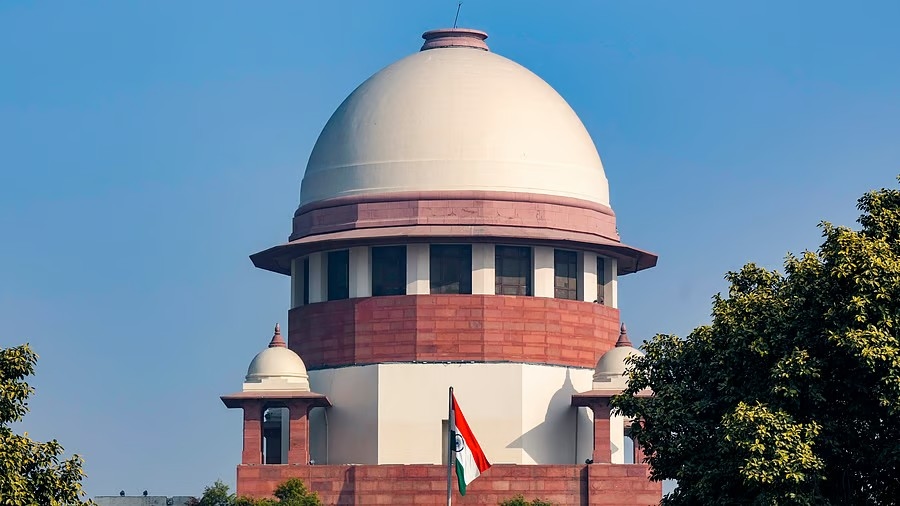


New Delhi: The Supreme Court has directed Bihar and Jharkhand to pay a one-time compensation of Rs 1 lakh each to eligible daily-wage employees and workmen of five erstwhile state-owned corporations, while also ordering interest on their long-pending salary, wage and provident fund dues.
A bench of Justices Vikram Nath and Sandeep Mehta issued the directions while dealing with a long-running dispute arising from the reorganisation of Bihar and the creation of Jharkhand under the Bihar Reorganisation Act, 2000.
The court also directed the two states to pay 12% simple interest per annum on delayed Employees’ Provident Fund (EPF) dues and 6% interest on delayed salary, wages and other monetary entitlements, calculated from the date the respective amounts became payable until the date of actual payment.
The compensation of Rs 1 lakh is to be paid in addition to amounts already determined and disbursed to the concerned daily-wage workers.
Dispute dates back to Bihar’s reorganisation
The case concerns employees and workmen of five state-owned inter-State corporations whose liabilities and service-related claims became disputed following the bifurcation of Bihar and creation of Jharkhand.
The corporations involved are the Bihar State Construction Corporation Ltd, Bihar State Industrial Development Corporation Ltd, Bihar State Electronic Development Corporation Ltd, Bihar State Forest Development Corporation Ltd and Bihar State Panchayati Raj Financial Corporation Ltd.
The litigation arose from questions over how the liabilities of these corporations should be divided between Bihar and Jharkhand and how employees’ outstanding claims should be settled.
The proceedings trace back to earlier litigation, including the Kapila Hingorani v State of Bihar matter. In May 2026, the Supreme Court considered the final report of a committee headed by former Supreme Court judge Justice Dinesh Maheshwari and accepted its recommendations to the extent specified in its order.
Following that order, Bihar and Jharkhand filed compliance affidavits reporting payments made to identified and verified employees and workmen.
However, some claims remained unresolved because certain employees could not be traced or because documents required for verification were unavailable.
Court rejects flat Rs 42.50 daily-wage calculation
One of the issues before the Supreme Court concerned the manner in which the dues of daily-wage workers were calculated.
The states had relied on a uniform daily wage of Rs 42.50 for calculating certain dues over a prolonged period dating back to 1992.
The Supreme Court rejected that approach, holding that the fact that workers were employed on a daily-wage basis could not justify treating their services as having the same fixed monetary value irrespective of when they worked.
The court noted that daily-wage employment is different from regular employment but said that this status cannot be used to disregard monetary entitlements that lawfully accrued from services actually rendered.
The ruling therefore requires the applicable dues to be determined in accordance with the mechanism previously approved by the court rather than through a uniform historical rate that does not account for the relevant period.
Rs 1 lakh compensation for eligible workers
The Supreme Court directed Bihar and Jharkhand to pay a one-time Rs 1 lakh to each concerned daily-wage employee or workman who was engaged by the relevant corporation during the applicable period.
The payment is separate from the principal dues that have already been determined and paid.
The court’s order also provides for interest on the outstanding amounts. EPF dues will attract 12% simple interest per annum, while salary, wages and other monetary entitlements will attract 6% simple interest per annum.
The interest is to run from the date on which the respective amounts became due and payable until the date on which they are actually paid.
The court said the interest serves to compensate for the deprivation of money that was legally due to the employees.
EPF treated as statutory benefit
The bench gave particular importance to provident fund dues, noting that an employee’s accumulated provident fund constitutes a statutory benefit.
The court held that such funds cannot be treated merely as an ordinary monetary claim that can be withheld without the legal consequences prescribed under the relevant law.
The direction for 12% interest on delayed EPF dues is therefore separate from the 6% interest ordered on delayed salary, wages and other monetary claims.
The distinction is significant because provident fund contributions represent statutory employee benefits rather than simply unpaid salary.
Over 2,000 workers have received dues
During the proceedings, the court was informed that 2,274 employees and workmen had been verified.
Of these, 2,074 had received their dues in full, while approximately 200 cases remained pending. The pending cases primarily involved employees who could not be traced or claims for which the required documentation was not available.
The Supreme Court has closed the general identification and verification exercise but has protected the underlying claims of untraced or unverified employees and their legal heirs.
Those claimants have been given 12 months from the date of the order to approach the designated nodal officer with the documents required for verification.
Once their claims are verified, the states have been directed to process them and disburse whatever amounts are found payable.
States ordered to publish claim details
The court has also directed Bihar and Jharkhand to improve transparency in the implementation of the payments.
The states have been asked to compile and publish updated details of employees and workmen whose dues have been paid or whose liabilities have otherwise been discharged.
For those whose claims remain pending, the states must indicate the reason for the pendency and specify the documents or steps required for processing the claim.
The relevant information is to be published on the official websites of the states’ Information and Public Relations departments as well as the departments concerned with the erstwhile corporations.
The court directed that the information be published within four weeks and subsequently updated to reflect further verification and payments.
Daily-wage status cannot erase lawful entitlements
The judgment addresses a dispute that has continued for more than two decades and involved employees whose service-related dues remained unresolved following Bihar’s reorganisation.
The court’s directions make clear that the nature of a worker’s employment cannot by itself be used to deny monetary benefits that accrued from services already rendered.
At the same time, the ruling does not equate daily-wage employment with regular government service. Instead, it focuses on ensuring that lawful dues are calculated fairly and paid with appropriate interest after prolonged delays.
The additional Rs 1 lakh compensation provides a separate monetary remedy for eligible daily-wage workers in the case.
Long-running dispute reaches conclusion
The Supreme Court has now disposed of the proceedings with directions covering payment of outstanding dues, interest, compensation, verification of unresolved claims and publication of records.
For Bihar and Jharkhand, the order sets out the mechanism through which the remaining liabilities of the five corporations are to be settled.
For affected daily-wage workers and their legal heirs, the ruling provides an additional compensation payment, interest on delayed dues and a further opportunity to pursue claims that remain unresolved because of verification or documentation issues.
The judgment brings a significant stage of the long-running dispute to a close while requiring the two states to complete the remaining payments and maintain public records of the implementation.