







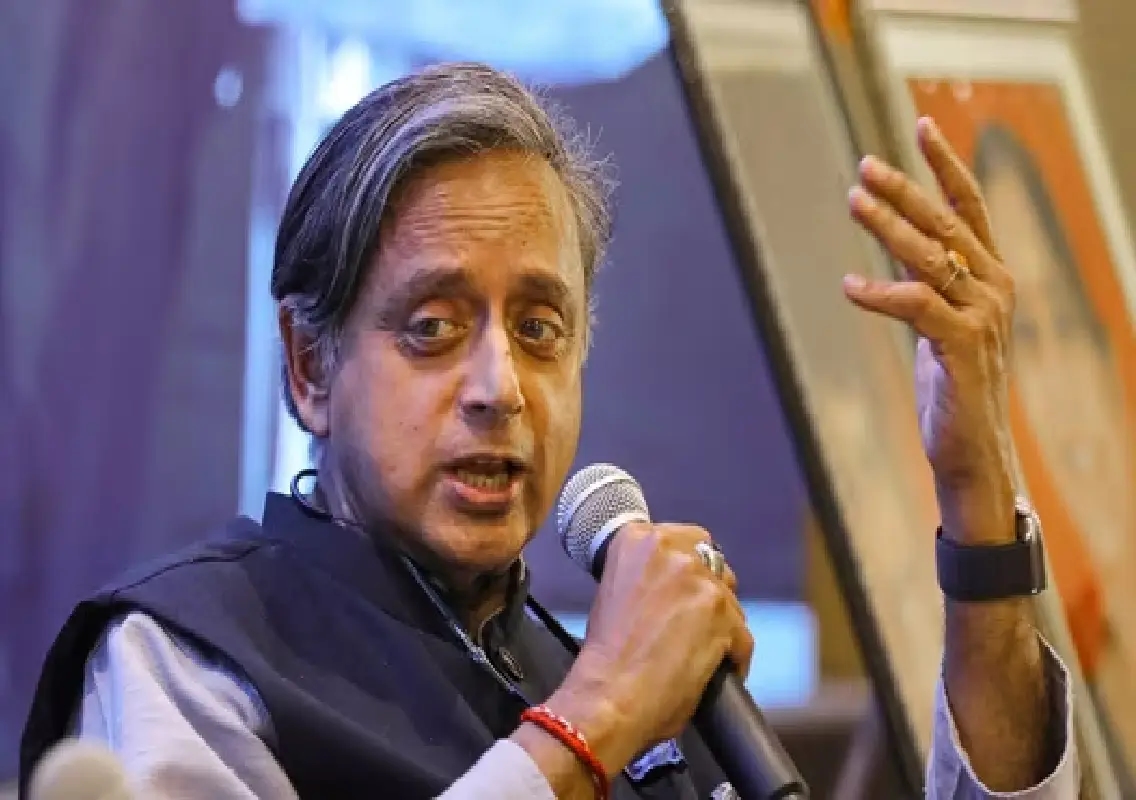


Kolkata: Senior Congress leader and former diplomat Shashi Tharoor on Thursday expressed strong disappointment that India remains among the few democracies that do not treat marital rape with the seriousness it warrants, despite having some of the world’s strictest anti-rape laws.
Tharoor was speaking at an event organised by the Prabha Khaitan Foundation in association with the FICCI Ladies Organisation, where he was asked about gaps in the country’s gender justice framework.
“Why should husbands be exempted?” asks Tharoor
Tharoor said he was “shocked” that Indian law continues to offer a blanket exception to husbands under the rape law, effectively condoning non-consensual sexual violence within marriage.
“I am shocked to find that India is one of the few democracies in the world where the case of a husband raping his wife without her consent is not treated with the seriousness it should have been,” he said.
He pointed out that while India’s anti-rape law is stringent, the retention of the marital rape exception “violates a woman without her consent.”
“Why should they (husbands) be exempted?” he asked, describing the exception as “violence against women” and fundamentally incompatible with modern legal principles.
Calls current law an outdated concept
According to Tharoor, the exemption is rooted in an outdated belief that marriage is a sacred institution whose internal dynamics are beyond legal scrutiny.
He argued that this thinking is no longer defensible.
“The current provision rests on an outdated assumption that marriage is a sacred sacrament and whatever happens within it cannot be classified otherwise,” he said.
He added that a proper law criminalising domestic rape is “massively necessary,” and lamented that even women ministers did not address the issue with urgency.
Marital rape among separated couples highlighted
Tharoor also noted that marital rape is not limited to fully functioning marriages.
“A lot of marital rape occurs among couples who are separated but not legally divorced,” he said. He cited cases where husbands living separately return and force themselves on their estranged wives.
“Nothing can be done because the law still considers them husband and wife,” he said, calling this legal impunity a “travesty of justice.”
“Marital rape is violence, not conjugal love”
Responding to a college student’s question during a ‘tea-a-tea’ interaction with his sisters Shobha Tharoor Srinivasan and Smita Tharoor, the Congress MP reiterated that non-consensual sex in marriage cannot be sheltered as part of conjugal rights.
“It is not part of conjugal love, it is violence,” he stressed, urging society to stand up for women’s rights. His remarks drew loud applause from the audience.
On global xenophobia and advice to Indian students
Tharoor also spoke about the growing resentment towards immigrants in the West, describing it as “overtly hostile.”
“There is hostility to migrants… not just in the West but worldwide,” he said, noting that this sentiment is rising in India as well.
His advice for Indian students aspiring to study abroad:
“Gain knowledge and then come back. Your city needs you. Your country needs you.”
On political life, language and diplomacy
Thanking his sisters for their “tremendous emotional support,” Tharoor said the key to public life is remaining authentic.
“There is no point in being a cookie-cutter politician,” he said. “I never said anything I did not believe in.”
Asked about his reputation for using rare English words, he responded:
“I like to think I am a communicator with people and there is no point in communicating if they don’t understand you.”
On whether he displays diplomatic restraint at home, he quipped that he is “not diplomatic at home,” adding that private life allows freedom from constant political scrutiny.
Conclusion
Tharoor’s strong critique of the marital rape exception adds to a growing national debate on whether India should criminalise marital rape—an issue pending before courts and Parliament for years. His remarks reaffirm the demand for reform to ensure women’s bodily autonomy and safety irrespective of marital status.