


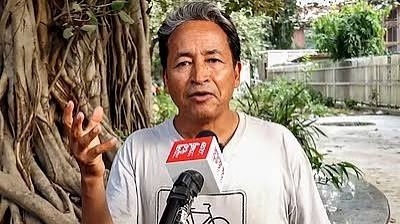


Mumbai: Climate activist and educationist Sonam Wangchuk has defended peaceful street protests as an essential feedback mechanism for governments, warning that suppressing dissent could deepen public anger and lead to wider unrest. Speaking at the India Film Project (IPF) Festival in Mumbai on Saturday, October 24, he urged authorities to listen to the concerns raised by demonstrators rather than focus on those delivering the message.
Wangchuk cited unrest in Nepal, Sri Lanka and Bangladesh as examples of what could happen when people are denied peaceful avenues to express their grievances. He argued that demonstrations should be allowed closer to centres of political power and described them as a pressure valve that can help governments identify public concerns and improve their functioning.
His remarks came amid controversy over restrictions on protests in New Delhi and the response to demonstrations called by the Cockroach Janta Party (CJP). The party had sought the resignation of Chief Election Commissioner Gyanesh Kumar over alleged irregularities in the Special Intensive Revision (SIR) of electoral rolls.
“You don’t kill the messenger. Take the message,” Wangchuk said, criticising the approach of targeting protesters instead of addressing the issues they raise.
Wangchuk says peaceful protests help governments perform better
Speaking at the festival, Wangchuk said peaceful demonstrations provide governments with direct feedback about public dissatisfaction. He argued that people should have opportunities to express their concerns without being pushed towards confrontation.
He pointed out that countries such as the United Kingdom, Norway and Sweden allow demonstrations outside their parliamentary buildings, placing protests within sight of the institutions that make political decisions.
Comparing this with the restrictions on protest locations in India, Wangchuk said even Jantar Mantar in New Delhi was too far from Parliament.
“In India, it was far from Parliament. Even when it was just Jantar Mantar in New Delhi, it was too far,” he said.
He described protests as a mechanism that can encourage governments to improve their performance when they pay attention to the concerns being expressed.
Wangchuk also argued that citizens should not have to seek permission simply to exercise their right to peaceful protest. He said regulatory requirements should primarily help authorities manage events and maintain public order, rather than prevent people from expressing dissent.
His comments highlighted the distinction between peaceful demonstrations and acts of violence, with the activist maintaining that the message conveyed by a protest should be considered separately from the actions of those participating in it.
CJP protest restrictions prompt criticism
Wangchuk’s remarks came amid a dispute over a protest called by the Cockroach Janta Party at Jantar Mantar. The party had demanded the resignation of Chief Election Commissioner Gyanesh Kumar over alleged irregularities in the SIR exercise.
The proposed demonstration and the authorities’ response drew criticism from Opposition leaders, who questioned the restrictions imposed on peaceful political gatherings.
Wangchuk referred to the consequences of preventing people from expressing their grievances through peaceful means, citing developments in Nepal, Sri Lanka and Bangladesh.
“Look what happens when protests are not allowed. That is the example of Sri Lanka, Bangladesh, Nepal, when peaceful venting of energy is not allowed,” he said.
The activist’s argument was that restrictions on demonstrations could make it harder for governments to understand the scale of public dissatisfaction. He called for authorities to engage with the issues raised rather than respond primarily through arrests and security measures.
His comments formed part of a wider debate over the balance between public order and the right to assemble peacefully.
Criticism of paramilitary deployment
Wangchuk also criticised the deployment of paramilitary personnel to manage domestic protests, arguing that security forces should be able to concentrate on protecting India’s borders.
He said such forces, which come under the Ministry of Home Affairs, were increasingly being used for internal security duties while concerns remained about the situation along the country’s borders.
“We have started using paramilitary forces frequently for internal security, but our borders must be safe. Paramilitary forces should be the ones protecting the borders,” he said.
Wangchuk claimed that China was gradually moving into areas along the Ladakh border when personnel and attention were diverted elsewhere, particularly during winter. These remarks reflected his concerns about border management; the claims were his assessment and were not independently established by the statements made at the festival.
He argued that border protection should receive priority and suggested that paramilitary forces should be placed under the Ministry of Defence.
“If the MHA wants to target civilians, then borders should be handed over to the Ministry of Defence,” he said.
The comments linked his criticism of the government’s response to protests with his broader concerns about national security and the allocation of security personnel.
Ladakh should have a greater say in its governance
Wangchuk also renewed his demand for greater democratic participation by the people of Ladakh in decisions affecting their region.
He said residents should have a meaningful role in determining how their land, natural resources and local institutions are managed, arguing that people living in a region are best placed to understand its ecology and the consequences of administrative decisions.
“And going by that principle, I say Ladakh should have a say in how Ladakh is managed. That is all we are saying, basically,” he said.
The activist said local residents or their elected representatives should be involved in decisions with long-term implications for future generations.
He also criticised the region’s administrative arrangement following the 2019 reorganisation of Jammu and Kashmir, comparing Ladakh’s governance to that of a former colony administered by a viceroy from New Delhi.
Wangchuk acknowledged that administrators from outside the region might have good intentions but argued that they might not fully understand Ladakh’s distinctive ecology and local requirements.
“Just as I would be the most unfit person to become the leader or chief minister of Maharashtra, similarly, somebody from Delhi will not be the fittest and best caretaking person for Ladakh,” he said.
His remarks reflect the continuing debate over political representation, constitutional safeguards and the role of local communities in determining Ladakh’s future.
HIAL land allotment dispute adds to tensions
Wangchuk’s comments came as the Ladakh administration defended its decision to cancel the land allotment to the Himalayan Institute of Alternatives, Ladakh (HIAL), an institution associated with the activist.
The administration said the allotment had lapsed because outstanding dues had not been paid and the lease deed had not been executed. It also cited what it described as Wangchuk’s disregard for the law.
Wangchuk has disputed the handling of the matter and alleged that government-linked media activity had been directed at him and his institute whenever he raised concerns about injustices in Ladakh.
In a separate statement, he said he had made repeated written appeals and contacted officials to seek timely execution of the land lease. The administration’s position and Wangchuk’s allegations represent competing accounts of the dispute, with the disagreement centred on the allotment and the process followed by the authorities.
The controversy has added another dimension to the activist’s ongoing criticism of Ladakh’s administrative arrangements and his demand for greater local participation in governance.
Wangchuk’s earlier detention and hunger strike
Wangchuk was detained preventively in September 2025 following violent protests in Ladakh. He was held under the National Security Act until his release in March 2026.
The detention followed unrest in the region amid demands for greater constitutional safeguards and political representation. Wangchuk has continued to advocate for a larger role for local communities in decisions affecting Ladakh.
He also referred to his earlier 26-day hunger strike in support of the CJP’s demand for the resignation of then Union Education Minister Dharmendra Pradhan over alleged irregularities in the National Eligibility-cum-Entrance Test (NEET).
Wangchuk said the government risked damaging its relationship with the public if it took actions that people considered unnecessary or unjustified.
“If you do things that need not be done, then people will go against you. This will only hurt the government. Do what is right,” he said.
Call for dialogue rather than suppression
Wangchuk’s remarks at the Mumbai festival brought together several issues that have featured in his public interventions: peaceful protest, the deployment of security forces, border protection and the demand for greater local control over Ladakh’s affairs.
His central argument was that demonstrations should be treated as an opportunity for governments to understand public concerns. He warned that preventing peaceful expression could increase frustration rather than resolve the underlying grievances.
At the same time, his comments on paramilitary deployment and alleged developments along the Ladakh border reflected his view that domestic security operations should not divert attention from national security priorities.
The HIAL land dispute and the restrictions surrounding the CJP’s proposed protest have further sharpened the debate over how authorities respond to criticism and dissent.
Wangchuk’s appeal was directed at the principle of listening to peaceful protesters, even when their demands challenge government decisions. As the debate over protest rights and Ladakh’s governance continues, his message was that addressing grievances is essential to maintaining public trust.