







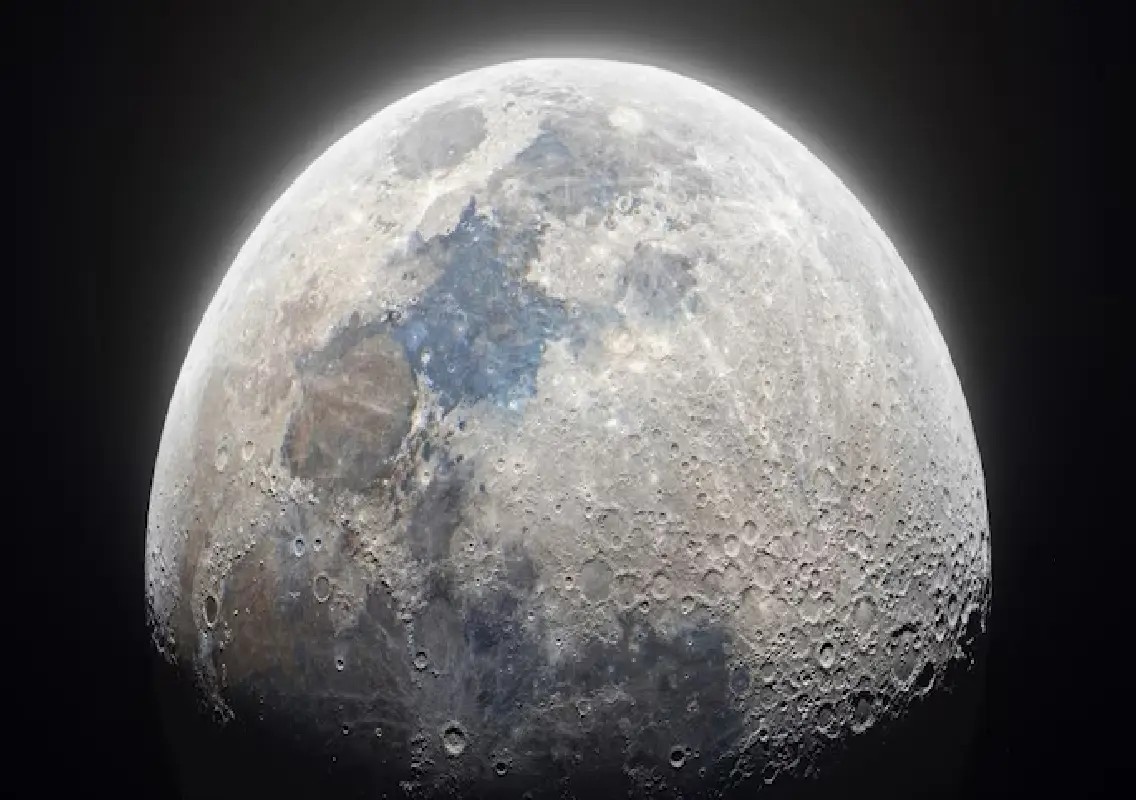


New Delhi: A discarded upper stage of SpaceX’s Falcon 9 rocket is believed to have impacted the Moon near the Einstein Crater at around 12.05 pm IST on Wednesday. While tracking data strongly indicates that the impact occurred, official confirmation is expected after lunar orbiters analyse the site over the coming hours and days.
The rocket stage had spent 19 months drifting through space after launching the Blue Ghost-1 and Hakuto-R Mission 2 lunar landers in January 2025.
Rocket stage completes unplanned lunar impact
The object that likely struck the Moon was the upper stage of the Falcon 9 rocket, not the entire launch vehicle.
Measuring about 12 metres in length and weighing approximately 4,500 kilograms, the stage was used to send Firefly Aerospace’s Blue Ghost-1 and ispace’s Hakuto-R Mission 2 landers towards the Moon on January 15, 2025.
After completing its mission, the stage was left in a high-energy orbit between the Earth and the Moon.
Why it took 19 months to reach the Moon
The discarded rocket stage remained in an unstable orbit for nearly 19 months.
During this period, gravitational forces from the Earth, Moon and Sun, together with the effect of solar radiation pressure, gradually altered its trajectory.
Although the stage had been passivated by SpaceX—meaning its remaining fuel was vented and the vehicle was made safe—a controlled disposal burn was not possible because of its high-energy trajectory.
Eventually, these gradual orbital changes placed it on a collision course with the Moon.
Impact expected to create fresh crater
Scientists estimate that the rocket stage struck the lunar surface at around 8,700 kilometres per hour.
The collision is expected to have released energy equivalent to roughly three tonnes of TNT, creating a crater estimated to be 20 to 30 metres wide.
The impact is also expected to eject more than one million kilograms of lunar soil, or regolith, into the surrounding area.
Unlike Earth, the Moon has virtually no atmosphere, allowing objects to strike the surface without slowing down significantly.
Orbiters to confirm impact site
Multiple spacecraft orbiting the Moon are expected to observe the impact site in the coming days.
NASA’s Lunar Reconnaissance Orbiter and South Korea’s Danuri spacecraft are expected to compare before-and-after images to identify the newly formed crater and determine its exact dimensions.
India’s Chandrayaan-2 orbiter, which continues to operate around the Moon, may also capture images of the impact location.
Scientific importance of the impact
Researchers say the event offers a rare scientific opportunity because the rocket stage’s mass, speed, trajectory and expected impact time were known well in advance.
Unlike natural meteorite impacts, this controlled dataset allows scientists to study crater formation, debris distribution and methods of accurately locating impacts on the lunar surface.
The observations could also contribute to future lunar seismology studies and improve understanding of the Moon’s surface properties.
Awaiting final confirmation
Although orbital tracking strongly suggests that the Falcon 9 upper stage has struck the Moon, scientists are awaiting photographic confirmation from lunar orbiters.
The confirmation is expected once spacecraft pass over the impact site and compare fresh imagery with earlier observations.
Conclusion
The likely impact of SpaceX’s Falcon 9 upper stage marks an unusual and scientifically valuable event. Beyond creating a new lunar crater, the collision provides researchers with a rare opportunity to study a precisely predicted artificial impact, helping improve future lunar exploration and scientific investigations.