







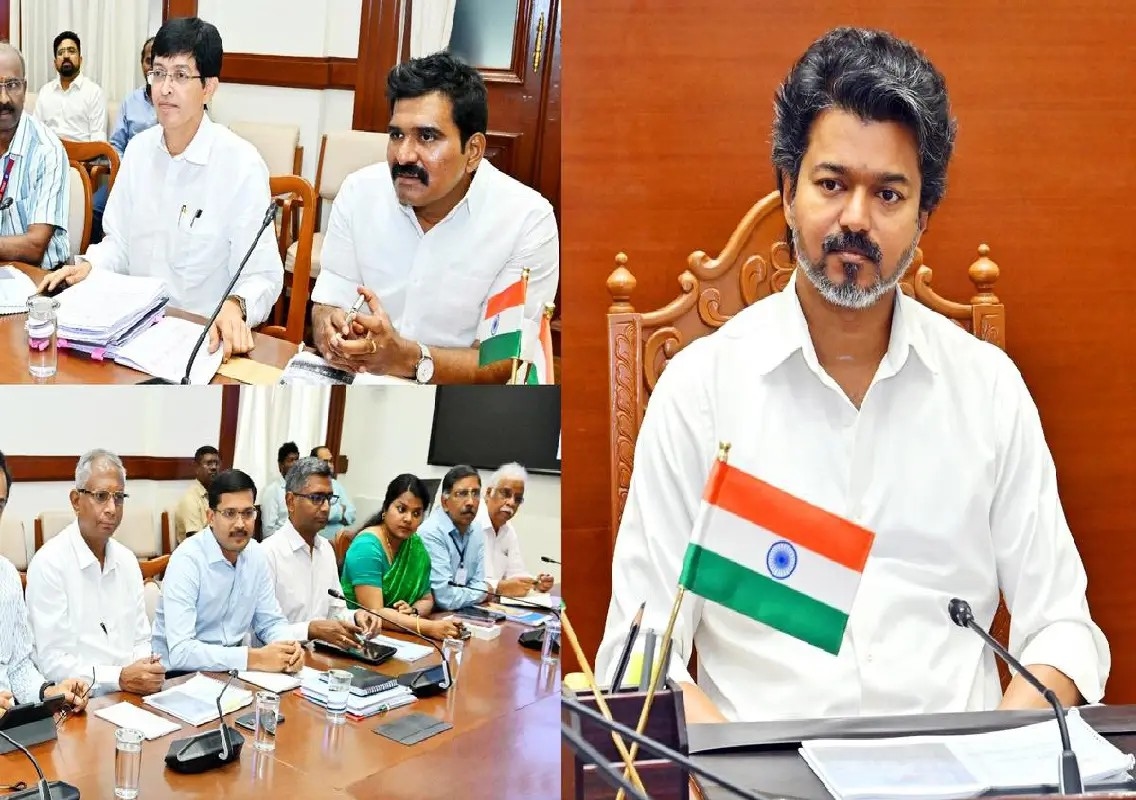


Chennai: Tamil Nadu Chief Minister C Joseph Vijay has announced a major push to strengthen the State’s power infrastructure by approving the establishment of 231 new substations at an estimated cost of ₹15,032 crore and directing the recruitment of 15,058 workers for maintenance and repair activities.
The decisions were taken during a review meeting of the Energy Resources Department held at the Secretariat in Chennai on Tuesday. The initiatives are aimed at improving electricity distribution, reducing power interruptions and preparing the State to meet growing energy demands in the coming years.
Chief Minister reviews power sector performance
Chairing the high-level meeting, Chief Minister Vijay reviewed the functioning of the Energy Resources Department and assessed the State’s power generation, transmission and distribution systems.
According to an official release, Tamil Nadu currently has sufficient power availability through its own generation capacity and procurement arrangements, ensuring that there is no overall power shortage in the State.
However, officials informed the meeting that consumers in certain urban areas, particularly Chennai, continue to experience intermittent power disruptions due to ageing infrastructure, underground cable faults, increased electricity consumption, maintenance activities and accidental damage caused during road excavation works undertaken by various agencies.
The Chief Minister directed officials to take immediate steps to address these issues and ensure reliable power supply to consumers.
₹15,032 crore project for new substations
As part of the State Government’s infrastructure expansion programme, 231 new substations will be established across Tamil Nadu at a total cost of ₹15,032 crore.
Officials stated that the project is expected to significantly strengthen the electricity distribution network, improve load management and reduce the incidence of voltage fluctuations and supply interruptions.
The substations will play a crucial role in supporting future growth in electricity demand arising from urbanisation, industrial expansion and increasing household consumption.
In addition to the newly announced projects, work is already underway on the establishment of 121 substations at a cost of ₹10,109 crore.
The combined investments are expected to enhance the resilience and efficiency of Tamil Nadu’s power infrastructure over the coming years.
Special focus on Chennai power network
Recognising the recurring complaints related to power interruptions in Chennai, the State Government has planned projects worth ₹2,275 crore specifically for the capital city.
Officials explained that many disruptions in Chennai are linked to ageing underground cable networks and increasing electricity demand in rapidly developing residential and commercial areas.
The proposed investments will focus on upgrading distribution infrastructure, replacing outdated equipment and strengthening monitoring systems to improve reliability.
The government expects these measures to provide a long-term solution to recurring power-related issues in the city.
Recruitment of over 15,000 workers approved
To improve maintenance and response capabilities, the Chief Minister directed the appointment of 15,058 workers dedicated to repair and maintenance activities.
The recruitment drive is expected to strengthen field operations and enable faster resolution of power-related complaints across the State.
Officials noted that an expanded workforce will help improve preventive maintenance, reduce equipment failures and ensure timely restoration of supply during outages.
The appointments are also expected to support the implementation of ongoing infrastructure projects and improve service delivery standards.
Additional repair teams and monitoring systems deployed
The government has already taken several measures to improve operational efficiency within the electricity distribution network.
According to the official release, 77 Fuse-Off Call (FOC) centres have been established to address consumer complaints more effectively. Seven additional repair teams have also been deployed to strengthen field-level response mechanisms.
The electricity department has further introduced 125 repair vehicles, 10 high-level monitoring teams and two specialised underground cable fault-detection units to assist in identifying and rectifying faults more quickly.
These initiatives are expected to reduce response times and minimise inconvenience to consumers during outages.
Complaint redressal system to be enhanced
The State Government is also working to improve customer service through technology-driven complaint management systems.
Officials said public complaints are currently monitored around the clock through the Minnagam platform using telephone and social media channels.
To further streamline grievance redressal, a WhatsApp-based complaint service will soon be integrated into the existing complaint management system, enabling consumers to report issues more conveniently.
The Chief Minister stressed the importance of responding promptly to complaints and ensuring efficient communication with consumers.
Renewable energy and future planning
Apart from addressing immediate infrastructure requirements, the government is also preparing for Tamil Nadu’s long-term energy needs.
The Energy Resources Department is developing plans involving renewable energy projects, Battery Energy Storage Systems (BESS), new thermal power stations and hydroelectric projects.
Officials said these initiatives are intended to ensure energy security while supporting the State’s economic growth and sustainability objectives.
The integration of renewable energy and advanced storage technologies is expected to play a key role in meeting future demand while reducing dependence on conventional power sources.
Senior officials attend meeting
The review meeting was attended by several senior government officials, including Energy Resources and Law Minister R Nirmalkumar, Chief Secretary M Saikumar, Tamil Nadu Power Distribution Corporation Limited (TNPDCL) Chairman and Additional Chief Secretary J Radhakrishnan, and Additional Chief Secretary (Finance) M A Siddique.
Officials discussed strategies to improve power distribution, strengthen infrastructure and enhance consumer services across the State.
Conclusion
Tamil Nadu’s decision to establish 231 new substations and recruit more than 15,000 workers represents one of the State’s largest recent investments in power infrastructure. With a focus on improving reliability, addressing urban power disruptions and preparing for future demand, the initiative is expected to strengthen electricity services and support the State’s long-term development goals.