







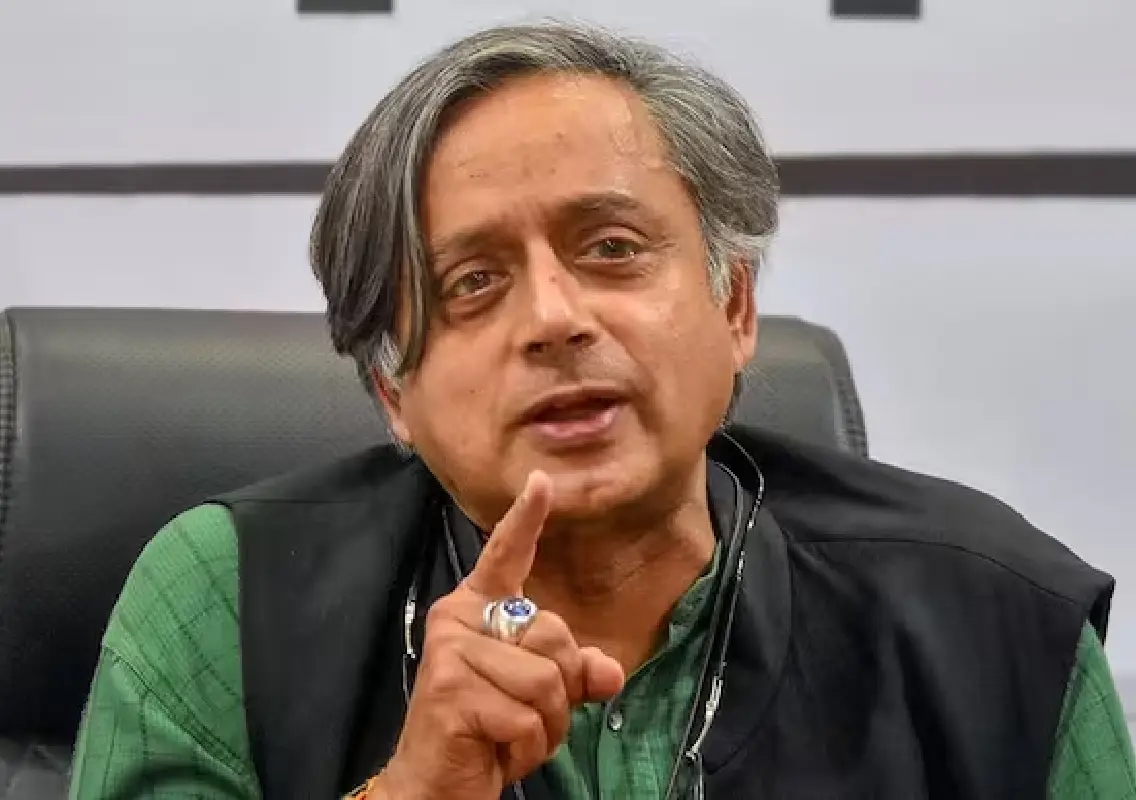


A cordial meeting between US President Donald Trump and New York City Mayor-elect Zohran Mamdani has triggered a political flutter in India, after senior Congress leader Shashi Tharoor praised the two American leaders for demonstrating democratic maturity. His remarks, directed at India’s own political climate, prompted a swift response from BJP spokesperson Shehzad Poonawalla, who used the moment to criticise the Congress high command.
The Trump–Mamdani interaction, held at the White House after a fiercely contested mayoral election marked by sharp public disagreements, has been widely viewed in the United States as a symbolic reset following months of acrimonious campaigning. The two leaders were seen adopting a warm tone, exchanging pleasantries and addressing the press together — a gesture that stood in striking contrast to the polarised nature of the race.
Tharoor calls it “how democracy should work”
Reposting a video of Trump and Mamdani’s media interaction on X, Tharoor praised their willingness to set aside electoral hostility for the larger public good. “This is how democracy should work. Fight passionately for your point of view in elections, with no rhetorical holds barred. But once it’s over, and the people have spoken, learn to cooperate with each other in the common interests of the nation you are both pledged to serve,” Tharoor wrote.
The Thiruvananthapuram MP went on to add that he hoped to see similar conduct in India and that he was “trying to do my part”. His message was interpreted by many as an implicit critique of the frequent post-poll acrimony in Indian politics.
BJP counters, invokes Rahul Gandhi
Responding to Tharoor’s remarks, BJP’s Shehzad Poonawalla seized the opportunity to target the Congress leadership. In a post on X, he wrote, “Once again, Shashi Tharoor reminds Congress to put India First, not Parivar. To behave democratically and not like sore losers. But will Rahul Gandhi get the message? One more fatwa loading against Shashi?”
Poonawalla’s remarks echoed a recurring BJP allegation — that the Congress functions to protect the interests of the Gandhi family rather than national priorities. His statement also suggested that Tharoor’s repeated departures from the party line may provoke internal reprimands.
Internal Congress tensions resurface
Tharoor’s comments come at a time when he has repeatedly found himself at odds with sections of his party. Just days earlier, his praise for Prime Minister Narendra Modi’s speech at a media event had sparked internal criticism. Congress leader Sandeep Dikshit questioned why Tharoor remained in the party if he believed BJP’s policies were more effective. AICC spokesperson Supriya Shrinate echoed the sentiment, saying she saw “no reason to praise the PM’s speech”.
On November 9, the Congress officially distanced itself from Tharoor’s earlier praise for veteran BJP leader L. K. Advani. The party remarked that Tharoor “speaks for himself”, adding that his continued presence as a member of the Congress Working Committee (CWC) reflected the party’s democratic and liberal ethos. The controversy arose after Tharoor defended his birthday greetings to Advani, arguing that an individual’s decades of public service should not be reduced to a single controversial episode.
Tharoor cited examples from Congress history, noting that Jawaharlal Nehru’s legacy cannot be judged solely by the 1962 China conflict, nor Indira Gandhi’s by the Emergency. He argued that the same principle of holistic assessment should apply to other political figures, including Advani.
Trump–Mamdani meeting reverberates in Indian debate
The original meeting that set off this political chain reaction has attracted widespread attention in the US. Trump and Mamdani, who were fierce critics during the mayoral race, appeared side by side, taking questions from the media and emphasising their commitment to governance.
Tharoor’s focus on the interaction underlined his long-standing view that political disagreements should not hinder cooperation in democratic systems. His comments, however, once again placed him at the centre of a political controversy in India — and added another layer to ongoing debates over dissent, internal democracy, and ideological coherence within the Congress.
Conclusion
As reactions continue to pour in, the episode has once again highlighted deepening fractures within the Congress, particularly around individual leaders’ public statements. Tharoor’s praise — framed as a lesson in democratic conduct — has been interpreted variably as constructive advice, political provocation, or internal rebellion. Meanwhile, the BJP has capitalised on the moment to sharpen its attacks on the Congress leadership. Whether the Congress chooses to formally respond or ignore the episode will determine how the internal dynamics evolve in the days ahead.