







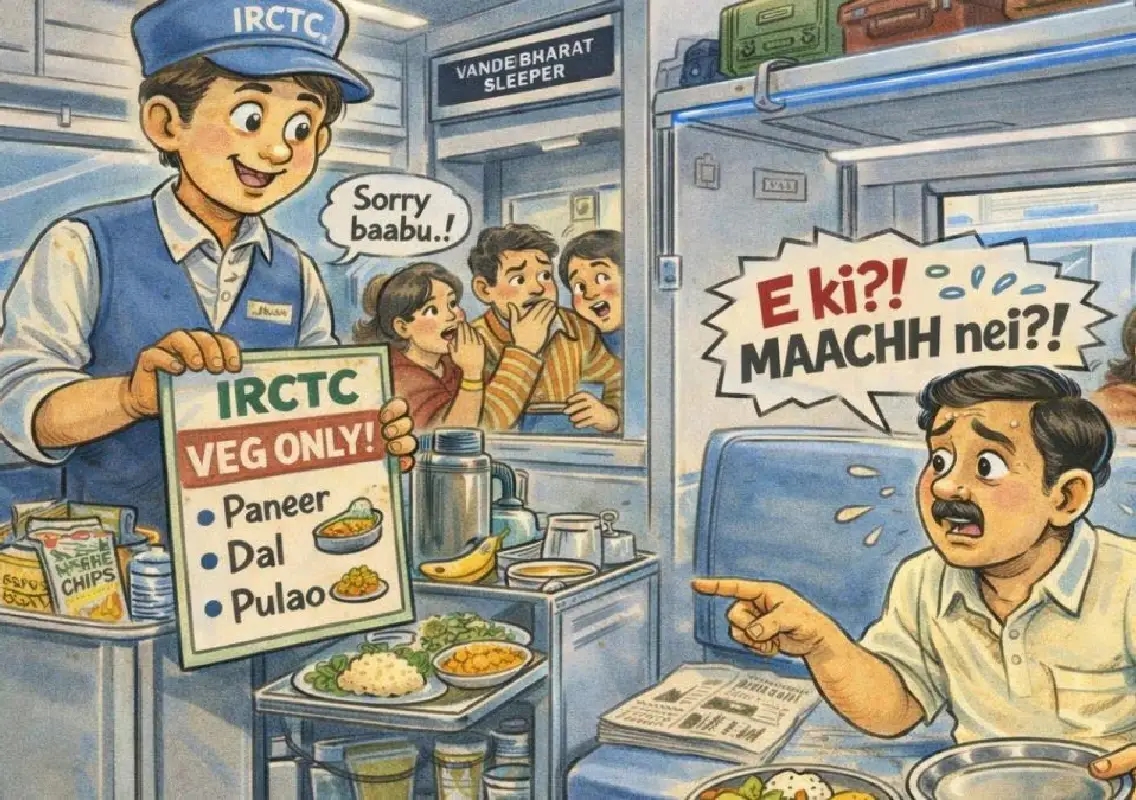


West Bengal’s ruling Trinamool Congress (TMC) has accused the BJP-led Centre and Prime Minister Narendra Modi of “policing people’s plates” after the newly launched Vande Bharat Sleeper train between Howrah and Kamakhya reportedly offered only vegetarian food.
‘From votes to plates’, alleges TMC
In a strongly worded post on X, the TMC criticised the Centre for what it described as cultural imposition. “First they policed our votes. Now they’re policing our plates,” the party said, referring to the absence of non-vegetarian food options on a route connecting West Bengal and Assam—regions where fish and meat form an integral part of everyday diets.
The party alleged that while the Centre highlighted the launch of the new Vande Bharat Sleeper service for Bengal, it did not disclose changes to onboard food offerings. “What he didn’t mention is that on the Vande Bharat train running from Bengal to Assam, fish and meat have been taken off the menu,” the TMC said.
Cultural identity and food habits
Pointing to the cultural significance of non-vegetarian food in both states, the TMC said the move reflected an attempt to impose uniform food habits. The party linked the issue to what it called a broader ideological pattern, citing past controversies involving remarks about fish-eating Bengalis, restrictions on fish in parts of Delhi, and alleged assaults on street vendors selling non-vegetarian food.
“Today it’s what we eat. Tomorrow it’s what we wear, who we love, how we live,” the party said, adding that Bengal would not accept lessons on identity from those who “neither understand nor respect it”.
Vande Bharat Sleeper details
Prime Minister Narendra Modi flagged off India’s first Vande Bharat Sleeper on January 17 from Malda in West Bengal. The fully air-conditioned overnight train aims to improve connectivity between eastern India and the Northeast.
According to the Ministry of Railways, the Howrah–Kamakhya Vande Bharat Sleeper received an overwhelming response, with tickets selling out within hours. The train began its maiden commercial run from Kamakhya on January 22 and from Howrah on January 23. It operates six days a week, completes the journey in about 14 hours, and has 16 coaches with a total passenger capacity of 823.
Political row amid strong demand
Railway officials said the demand reflects growing passenger preference for modern trains offering faster travel, enhanced safety and better comfort. However, the food menu controversy has added a political dimension to the train’s otherwise successful launch, with the TMC reiterating its opposition to what it calls cultural homogenisation.