










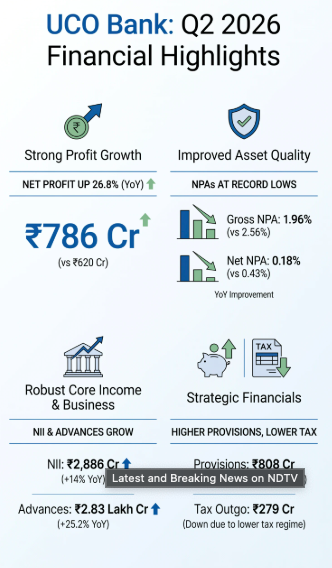
Kolkata: State-owned UCO Bank reported a 26.8% year-on-year increase in standalone net profit to Rs 786 crore for the quarter ended September 2026, compared with Rs 620 crore in the corresponding quarter last year. Growth in core income and a lower tax outgo supported the increase in profitability, even as provisions rose and operating performance weakened sequentially.
The bank’s net interest income (NII), which represents the difference between interest earned and interest expended, increased 14% to Rs 2,886 crore from Rs 2,533 crore a year earlier. Operating profit rose 16.1% year-on-year to Rs 1,872 crore from Rs 1,613 crore.
UCO Bank also reported an improvement in asset quality, with both gross and net non-performing asset ratios declining from their year-ago levels. However, higher provisions and a sharp fall in other income compared with the June quarter affected its sequential performance.
The results presented a mixed picture, with stronger annual profitability and improved asset quality alongside higher credit-loss provisioning and lower quarterly operating profit.
UCO Bank Q2 profit rises 26.8% year-on-year
UCO Bank’s standalone net profit increased to Rs 786 crore in the September quarter from Rs 620 crore in the same period last year.
The improvement was supported by growth in net interest income and a reduction in the bank’s tax expense. Tax outgo fell to Rs 279 crore from Rs 405 crore a year earlier after the bank opted for the lower tax regime under Section 115BAA from the 2026-27 financial year.
Pre-tax profit, however, rose at a slower pace. It increased 3.9% to Rs 1,065 crore, indicating that the rise in net profit was partly influenced by the lower tax burden rather than operating growth alone.
On a sequential basis, net profit increased approximately 20% from Rs 656 crore in the June quarter.
The June-quarter result had been affected by a one-time charge of Rs 1,237 crore arising from the remeasurement of deferred tax assets following the bank’s adoption of the new tax regime. This provides important context when comparing the latest profit figure with the preceding quarter.
Net interest income crosses Rs 2,800 crore
UCO Bank’s net interest income increased 14% year-on-year to Rs 2,886 crore in the September quarter, compared with Rs 2,533 crore a year earlier.
NII is a key measure of a bank’s core lending performance. It reflects the difference between the interest income generated from loans and investments and the interest expense paid on deposits and borrowings.
The increase indicates that the bank generated higher net interest income than in the corresponding quarter of the previous financial year.
Operating profit also recorded annual growth, rising 16.1% to Rs 1,872 crore from Rs 1,613 crore.
However, operating profit declined 33% sequentially. Other income nearly halved to Rs 888 crore from Rs 1,686 crore in the June quarter.
One factor behind the fall was a decline in recoveries from written-off accounts. Such recoveries dropped to Rs 301 crore in the September quarter from more than Rs 1,000 crore in the previous quarter.
The sequential decline in other income illustrates why quarterly comparisons can differ significantly from year-on-year trends, particularly when recoveries and other non-interest income fluctuate.
Asset quality improves further
UCO Bank reported a further improvement in its asset quality during the September quarter, with both gross and net non-performing asset ratios declining.
Gross NPAs stood at 1.96% of gross advances at the end of September, compared with 2.08% in the June quarter and 2.56% a year earlier.
Net NPAs declined to 0.18% from 0.25% in the preceding quarter and 0.43% in September 2025.
Gross NPAs represent loans on which borrowers have stopped making scheduled repayments for the prescribed period. Net NPAs reflect the remaining bad-loan exposure after accounting for eligible provisions.
The lower ratios indicate that the proportion of stressed loans relative to advances declined during the period.
The bank’s provision coverage ratio rose to 98.36%, compared with 96.99% a year earlier. The ratio measures the extent to which a bank has made provisions against its gross non-performing assets.
A higher coverage ratio indicates that a greater proportion of identified bad loans is covered by provisions, although it does not eliminate the possibility of future credit losses.
Provisions rise as expected credit-loss buffer expands
Despite the improvement in reported asset quality, UCO Bank increased its provisions during the quarter.
Provisions and contingencies, excluding tax, rose to Rs 808 crore from Rs 588 crore in the year-ago quarter and Rs 235 crore in the June quarter. Provisions for bad loans stood at Rs 444 crore.
A substantial part of the increase was associated with forward-looking expected credit-loss provisions. The bank’s expected credit-loss provision balance rose to Rs 1,607.6 crore as of September 30, compared with Rs 1,037.6 crore at the end of June.
Expected credit-loss provisioning is intended to account for potential future losses based on assessments of credit risk rather than waiting until every loss has materialised.
The increase in this provision balance suggests that the bank strengthened its buffer against anticipated credit losses. However, the figures alone do not establish that the quality of its loan book deteriorated during the quarter.
The rise in provisions also helps explain why the bank’s pre-tax profit growth was more modest than its increase in net profit.
Advances grow 25.2%, deposits rise 14.4%
UCO Bank recorded growth in both advances and deposits during the September quarter.
Advances increased 25.2% year-on-year to Rs 2.83 lakh crore, while deposits rose 14.4% to Rs 3.50 lakh crore.
Advances represent loans and other credit extended by the bank, while deposits comprise funds placed by customers in savings, current and term deposit accounts.
The faster growth in advances compared with deposits is a development that banks typically monitor alongside liquidity, funding costs and credit risk. Sustaining loan growth requires an adequate and stable funding base, particularly when lending expands faster than customer deposits.
The latest figures indicate that UCO Bank continued to expand its lending activity while also increasing its deposit base.
The quality of that expansion will depend on the bank’s ability to maintain repayment standards, manage funding costs and ensure that new lending generates adequate returns relative to risk.
Capital adequacy remains above year-ago level
UCO Bank’s capital adequacy ratio stood at 18.85% at the end of September, compared with 17.89% a year earlier. It was, however, slightly lower than the 19.03% recorded at the end of June.
The common equity tier-1 ratio, which measures a bank’s highest-quality regulatory capital against its risk-weighted assets, stood at 17.06%.
Capital adequacy is an important indicator of a bank’s capacity to absorb losses while continuing to meet regulatory requirements. The ratio is assessed alongside asset quality, profitability and the risks associated with lending.
The year-on-year increase in UCO Bank’s capital adequacy ratio indicates that its reported capital position was stronger than it had been a year earlier. The modest sequential decline will remain relevant as the bank expands advances and manages credit risk.
Half-year net profit rises 17.5%
For the six months ended September 2026, UCO Bank reported a 17.5% increase in net profit to Rs 1,442 crore from Rs 1,227 crore in the corresponding period of the previous financial year.
The half-year performance reflects the bank’s overall earnings trajectory across the first two quarters of the financial year.
The increase in NII and the improvement in asset-quality ratios were among the key developments during the period. At the same time, provisioning requirements and fluctuations in other income remain important factors influencing the bank’s earnings.
The first-half results therefore provide a broader view than the September-quarter figures alone, particularly because the June quarter included a significant one-time charge linked to deferred tax assets.
UCO Bank shares fluctuate after results
UCO Bank shares initially rose after the results were announced but subsequently pared their gains.
The stock climbed as much as 3.5% to Rs 24.80 apiece on the National Stock Exchange before giving up the advance. At 1.48 pm, it was trading 0.05% lower at Rs 23.91, while the benchmark Nifty 50 was up 1.8%, according to the figures provided.
The share-price movement reflected the market’s response during the trading session, but it does not by itself establish how investors assessed each component of the results.
The bank’s higher annual profit, stronger NII and lower NPA ratios were accompanied by higher provisions, lower sequential operating profit and a sharp decline in other income compared with the June quarter.
These contrasting factors are relevant when evaluating the bank’s earnings performance and financial position.
What UCO Bank’s Q2 results indicate
UCO Bank’s September-quarter results showed an increase in annual profitability, continued growth in core interest income and a further reduction in reported bad-loan ratios.
Net profit rose 26.8% to Rs 786 crore, NII increased 14% to Rs 2,886 crore and gross NPAs declined to 1.96%. The provision coverage ratio also improved from a year earlier.
However, the rise in provisions, lower other income and decline in operating profit on a sequential basis highlight the factors that could influence future earnings.
The bank’s ability to sustain profitability will depend on continued growth in core income, control over credit costs, stable funding and effective management of its expanding loan book.