







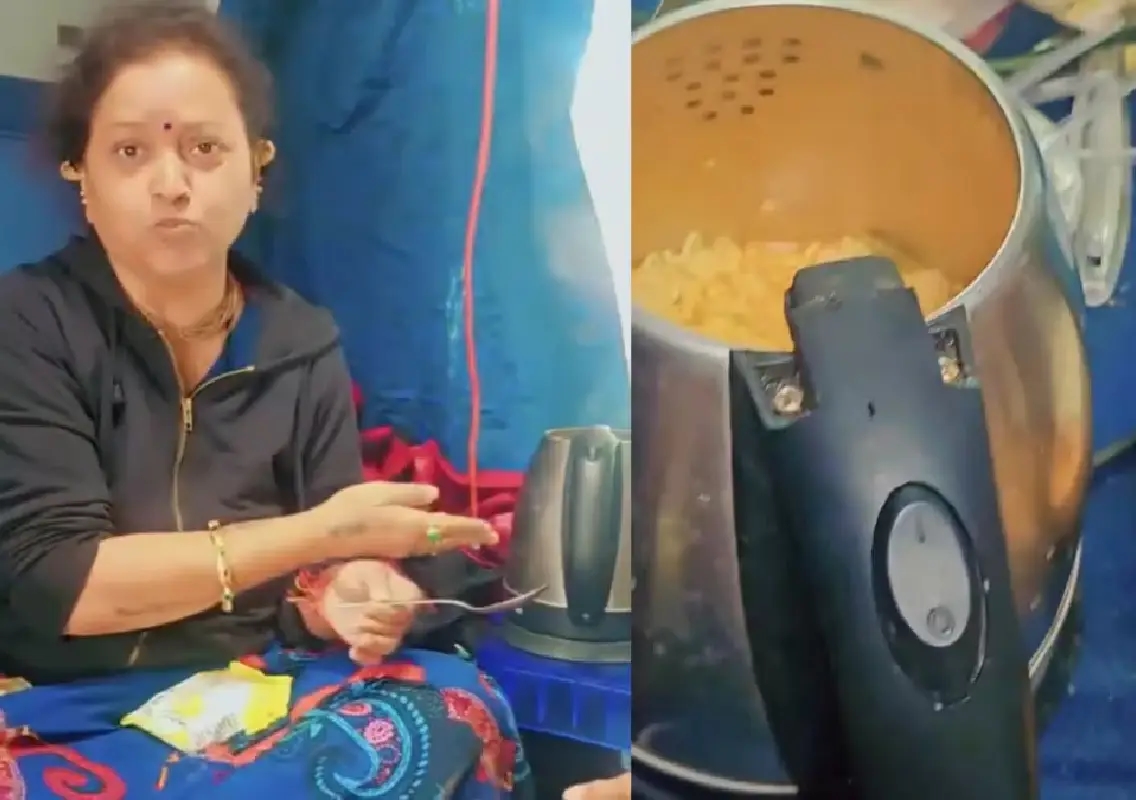


For many families travelling by train, the journey is incomplete without food. From home-packed favourites like thepla, mathri, paratha-sabzi, litti-chokha and puri-sabzi to station staples such as chhole bhature, idli-dosa, biryani and tea-coffee, food is intertwined with the charm of long-distance rail travel. However, a recent incident has stirred debate after a Maharashtrian woman was seen cooking Maggi inside a train compartment, triggering concerns over safety and civic discipline.
Woman cooks Maggi in AC coach using an electric kettle
A video circulating widely on social media shows the woman preparing instant noodles using an electric kettle that she plugged into the power socket of an AC coach. While cooking Maggi in a kettle is commonly associated with hostel life, seeing it inside a moving train caught many passengers off-guard. In the clip, she is seen smiling and enjoying the moment while posing for the camera.
Though the idea of a hot bowl of Maggi on a train ride may seem comforting, experts and railway enthusiasts raised alarms about potential fire hazards. They pointed out that such devices can overload the circuit, especially in older coaches, increasing the risk of short circuits and fire.
Social media divided over safety and etiquette
The video prompted a flurry of reactions online. One user, who originally shared the clip, wrote, “This is a major safety hazard and can cause fire, endangering the lives of all onboard. That’s why we cannot have good things. Many will misuse the facilities and then be proud of it. Most lack civil sense.”
Another user countered the argument, asking, “How? DC electricity is supplied in trains. You can charge laptops, so how is this dangerous?” Others highlighted inconsistencies in rules and enforcement onboard.
A third user recalled an earlier experience: “Many years ago, on a train ride from Chennai to Tatanagar, a family performed pooja and burnt agarbatti and camphor. I told the TC, and he warned them. That was before the era of the internet. Nothing has changed since; people still lack all sense.”
One commenter criticised the disregard for rules: “Amazing. People can’t follow basic guidelines but will proudly risk an entire train for hot water.”
Conversation on banned items and onboard safety
The video also renewed discussion about what items passengers are allowed to carry. Many social media users questioned why kettles are not banned inside trains if they pose a potential threat. Others argued that travellers often assume that purchasing a ticket entitles them to behave however they please inside a compartment.
Some users suggested that the Indian Railways should upgrade power outlets in coaches to safely support higher current devices and run awareness campaigns regarding what passengers can and cannot plug in.
The Indian Railways maintains a list of banned items to ensure onboard safety, and passengers are encouraged to familiarise themselves with these guidelines to avoid risks to themselves and others.
Conclusion
While the viral video may appear harmless to some, the ensuing debate underscores a larger issue—balancing convenience with safety in public transport. As trains continue to modernise, both the authorities and passengers share responsibility for ensuring safe and considerate travel. Incidents like these serve as reminders that even seemingly small actions can have significant consequences when hundreds of lives are aboard a single train.