


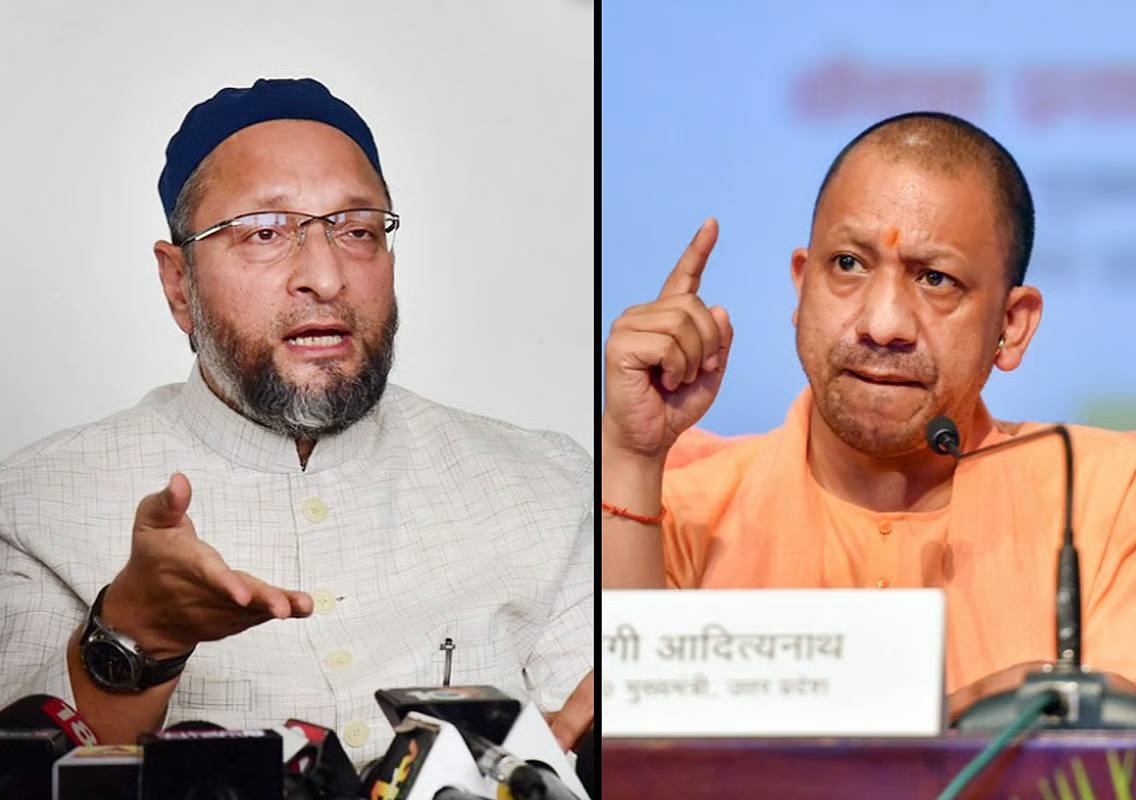


Lucknow: Uttar Pradesh Chief Minister Yogi Adityanath on Sunday criticised AIMIM chief Asaduddin Owaisi over his remarks about strengthening Muslim political representation in the state, saying there was no place in Uttar Pradesh for people who, according to him, had no agenda for its development.
Yogi also rejected Owaisi’s comments about the possibility of a Muslim becoming Chief Minister of Uttar Pradesh and a woman wearing a burqa becoming Prime Minister. He said such aspirations would never be fulfilled and accused the AIMIM leader of pursuing an agenda that was against India, Hindus and the country’s constitutional values.
The exchange follows Owaisi’s reference to Abdul El-Sayed’s victory in the Michigan Senate election in the United States. Using the result as an example of Muslim political representation, Owaisi said that the “Abdul” of Uttar Pradesh would no longer bow before others but would become an MLA.
The remarks have brought questions of political representation, religious identity and electoral strategy in Uttar Pradesh into the political debate ahead of the state’s next Assembly election.
Yogi Adityanath says Owaisi has no place in Uttar Pradesh
Yogi responded to Owaisi’s statements by questioning the AIMIM chief’s political agenda in Uttar Pradesh.
“Owaisi will bring an agenda that is anti-India, anti-Hindu and against the country’s constitutional values. Such an agenda seeks to weaken India’s unity. That is why people like Owaisi have no place in Uttar Pradesh,” the Chief Minister said.
Yogi also addressed Owaisi’s remarks about the possibility of a Muslim Chief Minister in the state and a burqa-clad woman becoming Prime Minister.
“Owaisi’s wish will never be fulfilled. That is why he will never come to power,” he said
The Chief Minister’s comments were directed at Owaisi’s political messaging and the AIMIM’s efforts to expand its presence in Uttar Pradesh. His allegations about the party’s agenda were political claims made during the event and were not accompanied by evidence establishing that the party was acting against the Constitution.
Yogi draws Congress and Samajwadi Party into the debate
Yogi also targeted the Congress and the Samajwadi Party, arguing that their political approaches were similar to those of the AIMIM.
He suggested that the three parties should come together, alleging that they were unconcerned about India’s interests and were using issues of faith and identity for political purposes.
The Chief Minister’s comments brought the Congress and Samajwadi Party into a debate that began with Owaisi’s remarks about Muslim political representation.
The two parties have their own political positions and electoral strategies in Uttar Pradesh. Their responses to Owaisi’s comments also reflected differences over how Muslim representation and electoral participation should be discussed.
Congress spokesperson Surendra Rajput said the victory of Indians abroad, regardless of their names or religious identities, should be a matter of pride. Samajwadi Party spokesperson Ashutosh Verma also welcomed El-Sayed’s victory, noting his Egyptian origin and his candidature as a Democratic Party representative.
What did Owaisi say about ‘Abdul’ becoming an MLA?
Owaisi’s remarks came after Democrat Abdul El-Sayed won the Michigan Senate election in the United States on November 4, defeating Republican candidate Mike Rogers.
El-Sayed became the first Muslim elected to the US Senate, according to reports by the Associated Press and other American media organisations.
Referring to the result, Owaisi said Muslims in Uttar Pradesh should develop an independent political identity rather than remain confined to supporting other parties.
“Abdul succeeded as a senator in Michigan. After I spoke, did Abdul become an issue or not? The BJP used to say that Abdul fixes punctures. In a democracy, Abdul became a senator. Now, Abdul in UP will not bow down before anyone but will become an MLA,” Owaisi said while addressing reporters.
The reference to “Abdul” was intended to challenge a stereotype that Owaisi said had been used to describe Muslim men. He presented El-Sayed’s electoral success as an example of how a person from a Muslim background could win a major democratic election.
Owaisi also urged Muslims to stop merely spreading the carpet for other political parties, using the expression to argue that they should seek a more active role in electoral politics and develop their own political leadership.
Who is Abdul El-Sayed?
Abdul El-Sayed is an American politician and former public health official from Michigan. He contested the US Senate election as a Democrat and defeated Republican Mike Rogers in the November 2026 contest.
His victory made him the first Muslim elected to the US Senate. El-Sayed is the son of Egyptian immigrants and had previously served in public health administration in Michigan.
Owaisi cited the result to make a broader point about political representation, arguing that Muslim candidates should be able to seek elected office rather than depend entirely on established political parties.
The Michigan election, however, took place in a different political and electoral setting from Uttar Pradesh. El-Sayed’s victory does not, by itself, indicate how voters in Uttar Pradesh might respond to a similar political appeal.
Congress and Samajwadi Party respond to Owaisi
Owaisi’s comments also prompted reactions from opposition parties in Uttar Pradesh.
Congress spokesperson Surendra Rajput said El-Sayed’s victory should be celebrated irrespective of his name or religious identity. His response focused on the electoral achievement rather than treating it as a victory belonging exclusively to one community.
Samajwadi Party spokesperson Ashutosh Verma also welcomed the result and pointed out that El-Sayed was of Egyptian origin and had contested the election as a Democratic Party candidate.
The responses reflected different ways of interpreting the Michigan result. While Owaisi used it to argue for a stronger Muslim political identity, the Congress and Samajwadi Party representatives emphasised the candidate’s victory in a democratic election.
Political representation becomes a point of contention
The exchange between Yogi and Owaisi has brought the question of Muslim political representation into the wider discussion about Uttar Pradesh politics.
Owaisi has argued that Muslims should seek a more direct role in electoral politics and field candidates who can represent their interests. His reference to El-Sayed was intended to show that candidates from minority communities can win elections in democratic systems.
Yogi, meanwhile, criticised the AIMIM chief’s political messaging and rejected his comments about a Muslim Chief Minister in Uttar Pradesh. He also linked Owaisi’s position to broader concerns about national unity and constitutional values.
The two leaders therefore approached the issue from sharply different political positions: Owaisi focused on representation and independent political participation, while Yogi questioned the AIMIM’s agenda and its place in the state’s political landscape.
What lies ahead for AIMIM in Uttar Pradesh?
The remarks add to the political debate surrounding the AIMIM’s efforts to expand its presence in Uttar Pradesh. The party has sought to build support by raising issues related to Muslim representation and participation in electoral politics.
Its ability to translate that messaging into electoral support will depend on factors including candidate selection, local organisation, alliances and voter preferences across constituencies.
The exchange also places the responses of larger parties such as the Congress and Samajwadi Party in focus, particularly as they navigate questions of minority representation and political alliances.
For now, the dispute remains centred on Owaisi’s use of El-Sayed’s Michigan victory as an example of Muslim political representation and Yogi’s criticism of the AIMIM chief’s ambitions in Uttar Pradesh. Their contrasting statements have brought the debate over identity, representation and electoral politics back into the state’s political conversation.