







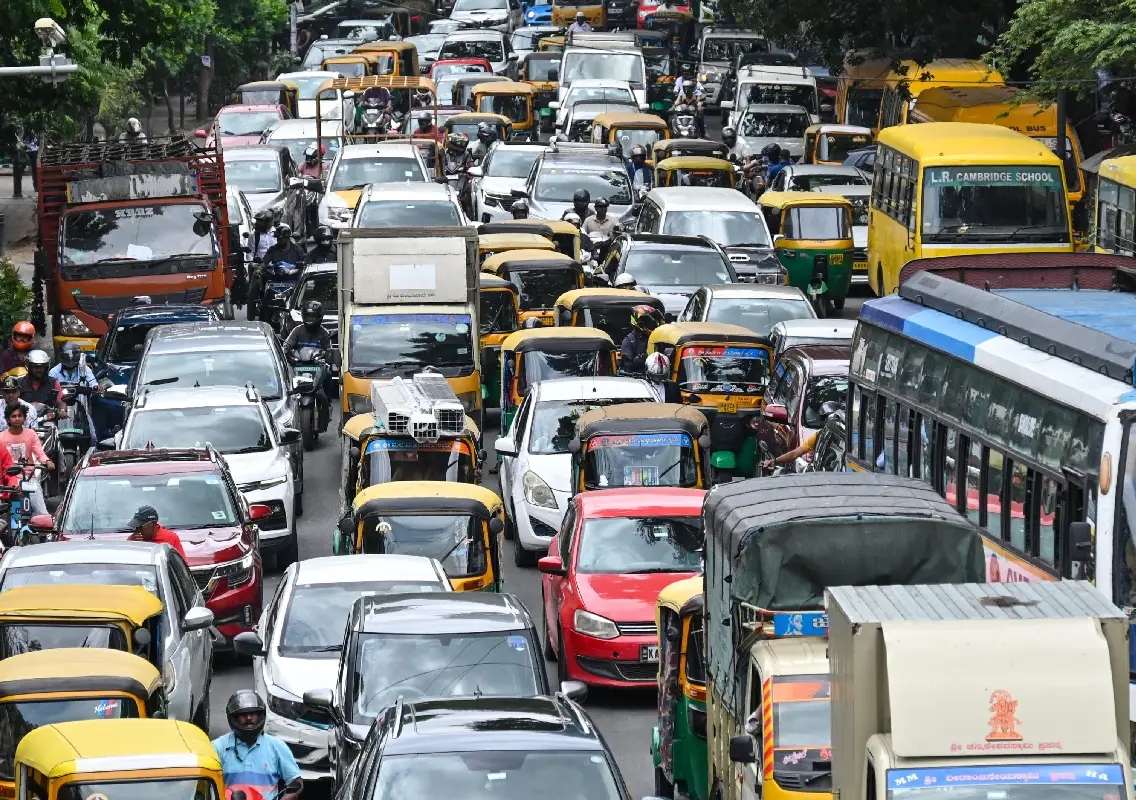


Bengaluru’s persistent traffic congestion has once again come under scrutiny, this time over a controversial decongestion study that has raised serious questions about accountability and urban planning standards.
⚠️ Copy-paste allegations spark concern
The study, commissioned by the Bruhat Bengaluru Mahanagara Palike (BBMP) at a cost of ₹5.5 crore, is facing criticism after reports revealed that nearly 60% to 75% of its content may have been directly lifted from a 2022 report by the Bangalore Metro Rail Corporation Limited (BMRCL).
This revelation has triggered public concern over the use of taxpayer money, with critics pointing out that such duplication undermines the purpose of commissioning new studies meant to address Bengaluru’s evolving traffic challenges.
🧾 Pattern of oversight failures
This is not an isolated case. A previous tunnel road project report had also come under fire for including irrelevant traffic data from cities like Malegaon and Nashik in Maharashtra, highlighting lapses in due diligence.
Together, these incidents suggest a troubling pattern in the planning and execution of major infrastructure studies, raising questions about the effectiveness of oversight mechanisms.
🏙️ Outdated data adds to the crisis
Urban planners emphasise that while referencing earlier studies is common practice, simply replicating them without adapting to current realities is counterproductive. Bengaluru’s traffic patterns, population density, and commuting habits have changed significantly in recent years.
Compounding the issue, the city’s Comprehensive Mobility Plan is reportedly being revised as it relied on travel data from 2014–15, now considered outdated for a rapidly expanding metropolis.
🔍 Need for stronger planning integrity
Experts argue that Bengaluru’s mobility crisis cannot be resolved with outdated assumptions or recycled reports. The absence of an updated Comprehensive Development Plan has further contributed to fragmented planning across agencies.
The controversy also brings attention to the role of the Bengaluru Metropolitan Land Transport Authority (BMLTA), which was established to streamline and coordinate urban transport planning but now faces questions over its oversight.
🚦 A critical moment for Bengaluru
As Bengaluru continues to grow, the need for credible, data-driven, and forward-looking urban planning has become more urgent than ever. Observers stress that infrastructure investments must be backed by original research and rigorous validation.
Without strengthening planning processes and ensuring accountability, the city risks addressing future challenges with outdated solutions, potentially deepening its already severe traffic crisis.