







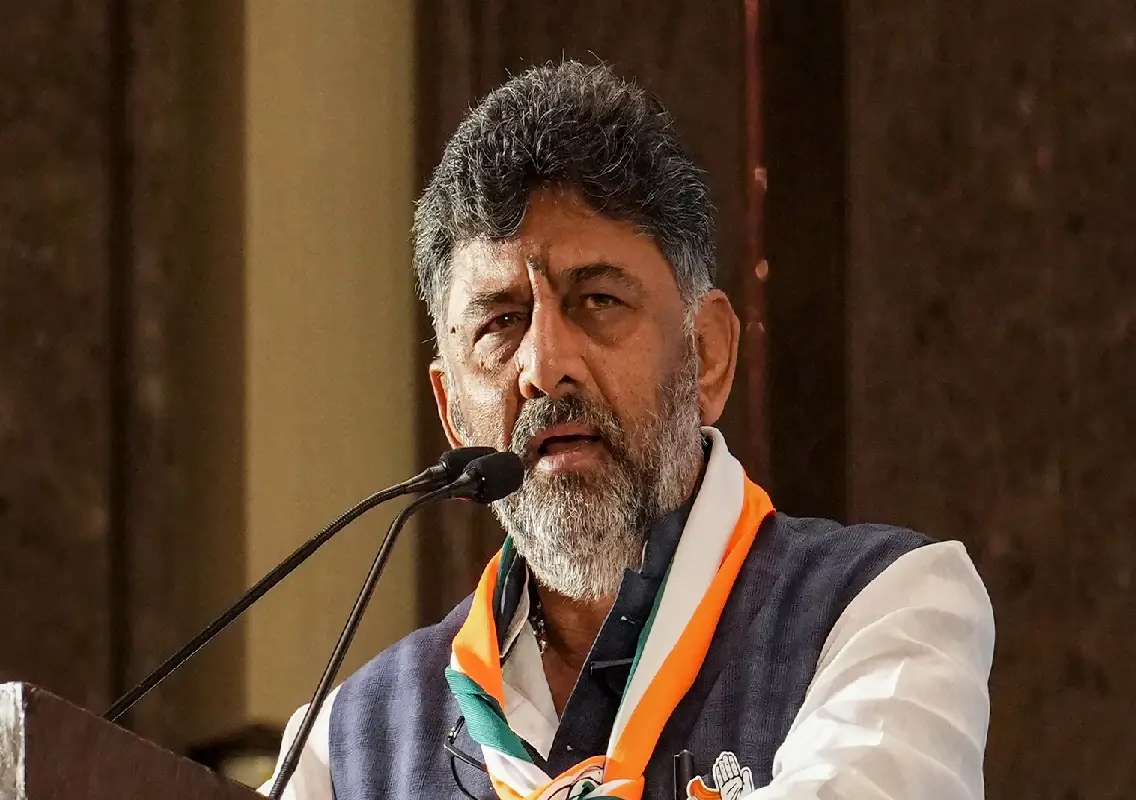


Bengaluru: Deputy Chief Minister DK Shivakumar on Thursday inaugurated the second loop of the Hebbal flyover, a long-awaited infrastructure addition aimed at easing chronic traffic congestion at one of the city’s busiest junctions. The newly opened loop is expected to significantly improve vehicular movement, particularly for passengers travelling to Kempegowda International Airport and for residents of surrounding localities who routinely face bottlenecks at the Hebbal interchange.
Speaking after inaugurating the project, Shivakumar said the government had moved swiftly in response to repeated complaints from commuters about severe traffic snarls at Hebbal. He said better planning, coordination among agencies, and time-bound execution had helped deliver tangible relief at a junction that sees some of the highest daily traffic volumes in the city.
Relief at a long-congested junction
The Hebbal flyover junction has for years been a major choke point, handling traffic from multiple directions, including the airport road, Bellary Road, Outer Ring Road, and surrounding residential and commercial areas. Frequent congestion at the junction has resulted in long delays, especially during peak hours, often spilling over to adjoining arterial roads.
Officials said the second loop is designed to streamline traffic flow by segregating airport-bound vehicles from local traffic. With the new loop in place, vehicles heading towards the airport and other key corridors are expected to move more smoothly, reducing travel time and easing pressure on the existing flyover structure.
Shivakumar said feedback from commuters would be closely monitored to assess the impact of the new loop and to identify any further improvements required. He added that addressing traffic congestion remains a priority for the state government.
Role of BDA and major infrastructure push
Highlighting the contribution of the Bangalore Development Authority (BDA), which recently completed 50 years of its formation, Shivakumar said the agency is currently executing several large-scale and historic infrastructure projects across the city. He said the BDA continues to play a central role in shaping Bengaluru’s urban growth despite financial and logistical challenges.
Among the major projects underway is the 120-km-long Bengaluru Business Corridor (BBC). Shivakumar said land acquisition for the ambitious corridor project is in progress and that a farmer-friendly compensation model has been adopted. Under this model, farmers whose land is acquired will receive 35% of developed commercial land, in addition to monetary compensation. Provisions have also been made for developing small townships to support affected families.
He said such measures were aimed at balancing infrastructure development with the interests of landowners and reducing resistance to large projects.
Upcoming projects around the Hebbal corridor
The Deputy Chief Minister also outlined a series of upcoming infrastructure projects planned in and around the Hebbal corridor to further ease congestion and improve connectivity. These include a proposed 1.5-km-long tunnel road, a new flyover near Mekhri Circle, and an elevated road connecting Tumakuru Road to KR Puram along the Outer Ring Road.
According to Shivakumar, these projects are part of a broader vision to decongest key traffic corridors and provide seamless east-west and north-south connectivity across the city. He reiterated that despite the lack of financial support from the Centre for some projects, the state government remains committed to investing in Bengaluru’s infrastructure.
New Year security arrangements praised
Referring to the recent New Year celebrations, Shivakumar said the city was able to safely bid farewell to 2025 and welcome 2026 due to robust security arrangements. He praised Home Minister G Parameshwara and the home department for ensuring that there were no untoward incidents during the celebrations, despite large crowds across the city.
He said coordinated efforts by the police and other agencies helped maintain law and order and ensured public safety during a high-alert period.
Review of skydeck and other BDA projects
Later in the day, Shivakumar, who also holds the Bengaluru Development portfolio, inspected the proposed skydeck project site near Nadaprabhu Kempegowda Layout. He also reviewed ongoing work on a railway underpass near Challaghatta and several other BDA-led road projects.
Senior officials briefed him on the Rs 500-crore skydeck project, including details related to land availability, design feasibility, airspace restrictions, and tentative timelines. The proposed 250-metre-tall skydeck is envisioned as a major city landmark and a new tourist attraction.
Land and airspace challenges
The skydeck project has seen multiple changes in location and implementing agencies over the years due to land-related and regulatory challenges. Addressing complications involving the Karnataka Industrial Areas Development Board (KIADB) and Nandi Infrastructure Corridor Enterprises (NICE), Shivakumar said the government would explore alternative land parcels if litigation becomes an obstacle.
Taking a firm stance, he said the government had only sought a no-objection certificate (NOC) from NICE for a required land parcel, which has not been granted so far. He asserted that the project would not be stalled indefinitely and added that land under BDA control has already been finalised.
Shivakumar also flagged airspace limitations, stating that the city faces a “funnel problem” due to restricted airspace. He clarified that the skydeck would be constructed only at a location approved by the Airports Authority of India (AAI), ensuring compliance with aviation safety norms.
Conclusion
The inauguration of the second loop of the Hebbal flyover marks a significant milestone in the state government’s efforts to tackle traffic congestion at critical junctions. Coupled with a pipeline of ambitious infrastructure projects, the government aims to improve mobility, reduce travel times, and enhance the overall quality of urban life. While challenges related to land, funding, and regulation persist, the administration has reiterated its commitment to pushing forward projects that reshape the city’s infrastructure landscape.