







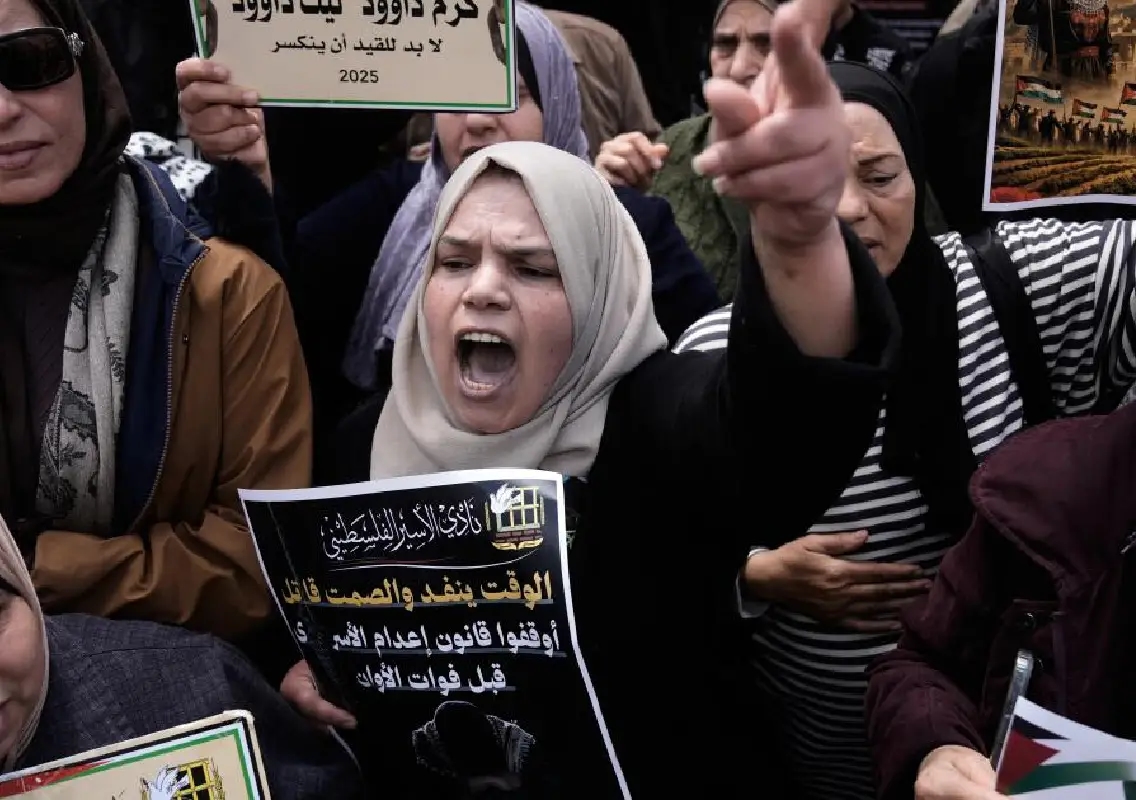


A newly passed law in Israel mandating the death penalty for certain lethal attacks has triggered fear and widespread concern among Palestinians in the occupied West Bank.
The legislation, approved by Israel’s parliament, makes capital punishment—specifically execution by hanging—the default sentence for individuals convicted of attacks deemed as “negating Israel’s existence.”
Families fear for jailed relatives
Families of Palestinian prisoners have expressed deep anxiety, fearing their loved ones could face execution without fair trials. Protests were reported in cities like Ramallah, where relatives demanded the repeal of the law.
Many argue that the measure disproportionately targets Palestinians, as the legal definition used in the law makes it unlikely to be applied to Jewish Israeli citizens.
Legal and human rights concerns
Legal experts and rights groups have raised serious concerns, stating that the law may violate international humanitarian law, including provisions under the Fourth Geneva Convention.
The legislation requires executions within 90 days of sentencing and does not provide for clemency, though judges may opt for life imprisonment in unspecified “special circumstances.”
Human rights organisations have also pointed to the high conviction rate in military courts handling Palestinian cases, raising questions about due process and fairness.
Supreme Court challenge likely
Experts believe the law is likely to be challenged and potentially struck down by Israel’s Supreme Court. Critics argue it conflicts with both international obligations and fundamental legal principles.
Meanwhile, international bodies, including the United Nations, have criticised the move, warning of its implications for human rights and justice.
Wider political context
The law comes amid heightened tensions in the region and ongoing scrutiny of Israel’s policies in Palestinian territories.
Supporters argue the measure will act as a deterrent against attacks, while critics maintain that capital punishment does not effectively reduce violence and could further inflame tensions.
The development has intensified global debate over justice, security, and human rights in one of the world’s most sensitive conflict zones.