







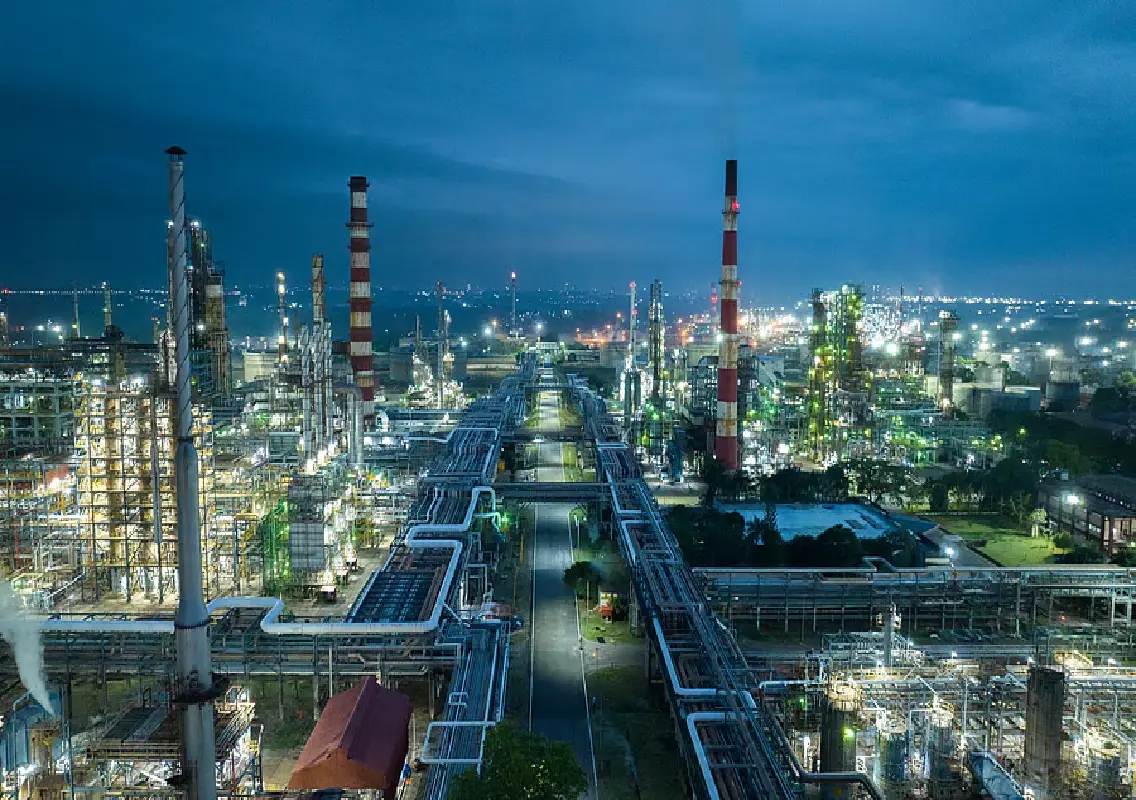


Mangaluru: Growing fears surrounding the ongoing Iran–US–Israel conflict have raised concerns at Mangalore Refinery and Petrochemicals Limited (MRPL), the state’s only oil refinery. While refinery operations are continuing normally for now, officials say the possibility of the war continuing for another month could create challenges in securing crude oil supplies.
Sources at MRPL said the refinery currently has enough crude oil stock to continue refining operations for about 10 days. In addition, around 53,000 metric tonnes of crude oil is stored at the underground storage facility of Indian Strategic Petroleum Reserves Limited (ISPRL) located at Permude. This reserve is expected to provide some buffer if supply disruptions persist.
According to government sources, the refinery currently has adequate crude stocks and operations remain stable despite tensions in West Asia, dismissing claims that MRPL units had shut down due to shortages.
Dependence on Gulf crude
India imports a significant share of its crude oil from Gulf countries such as Saudi Arabia, Iran, Iraq, Qatar and Bahrain. Nearly one-third of India’s crude imports pass through the Strait of Hormuz, one of the most crucial maritime routes for global oil transport.
Reports indicate that Iran has closed or restricted access to the Strait of Hormuz amid the escalating conflict, creating uncertainty in global oil supply chains. The strait is responsible for carrying roughly one-fifth of the world’s crude oil shipments, making it a critical chokepoint in international energy trade.
The disruption of shipping routes in the Gulf region has affected the movement of oil tankers, with very few vessels currently operating in the conflict-affected zone. As a result, refiners across Asia are finding it difficult to secure replacement crude cargoes.
Alternative sources and higher transport costs
In anticipation of such geopolitical crises, India has diversified its crude oil sourcing strategy in recent years instead of depending heavily on a single region. Countries such as Russia, the United States, Nigeria and Venezuela are considered potential alternative suppliers.
However, importing crude oil from these countries involves significantly higher transportation costs due to longer shipping distances. With Gulf shipments disrupted, demand for crude from alternative suppliers could increase, leading to higher prices in global markets.
Industry observers also note that even if the conflict ends immediately, it will take time for oil supply chains to stabilise. Ships must return to ports, load crude oil, and resume their regular routes, which could delay the restoration of normal supply.
Port operations and shipping situation
Officials at New Mangalore Port said that shipping operations have not yet been directly affected by the conflict. Vessels from Africa and the United States are continuing to arrive as usual because the Suez Canal remains operational.
Coal shipments from South Africa and Indonesia are continuing to arrive without disruption, while edible oil imports from Indonesia and Malaysia are also proceeding normally. Iron ore exports to China are ongoing as scheduled.
However, exports of certain products to Middle Eastern countries have temporarily been suspended due to the uncertainty caused by the conflict. Authorities said that even if the situation stabilises soon, it may take around two weeks for shipping traffic to return to normal due to port scheduling systems and limited docking capacity.
Conclusion
While MRPL currently has sufficient crude oil stocks to sustain operations in the short term, prolonged disruption in the Middle East could pose challenges for crude supply chains. Officials remain cautiously optimistic but acknowledge that if the conflict continues for several weeks, refiners across the region may face increasing pressure to secure alternative sources of crude oil.