







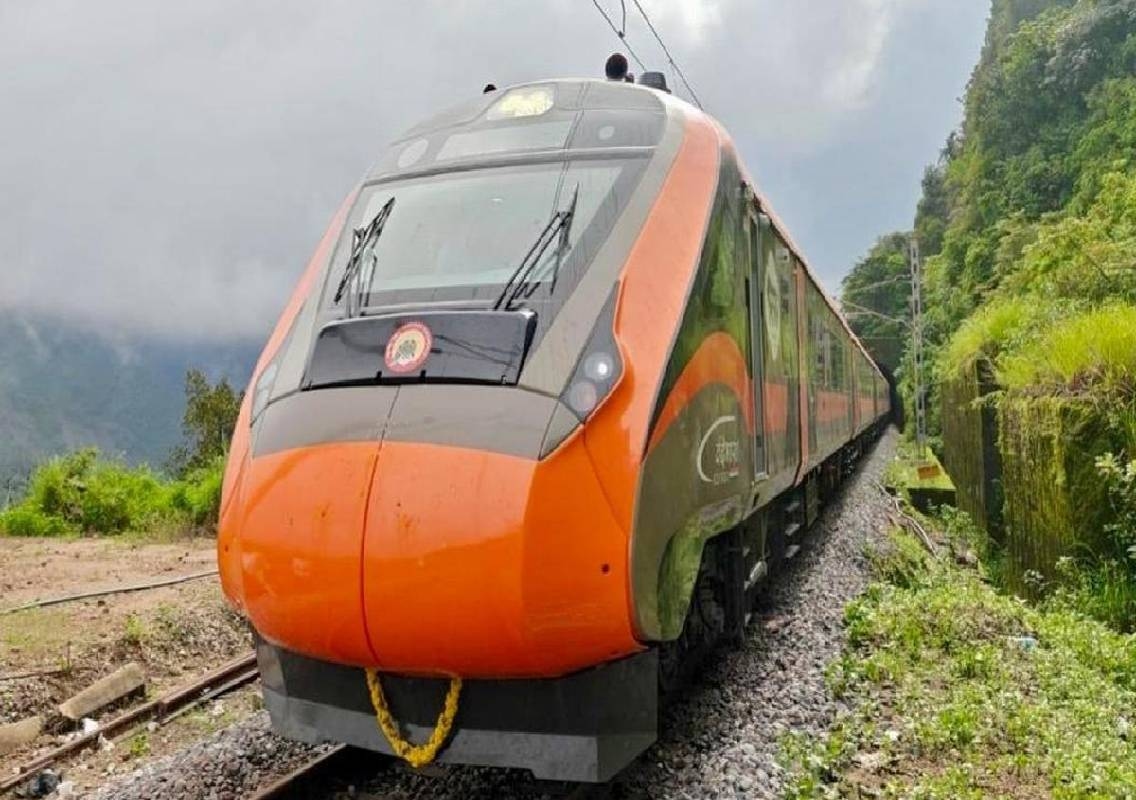


Mangaluru: The trial run of a Vande Bharat Express on the challenging Sakleshpur–Subrahmanya Road ghat section has been completed, marking a major step towards introducing the much-awaited Bengaluru–Mangaluru service. However, regular operations are still dependent on South Western Railway (SWR) receiving a suitable 16-car rake.
The trials were conducted by the Mysuru division of SWR with technical experts assessing the train’s performance, braking and safety on the demanding Western Ghats stretch. The proposed service is expected to significantly improve rail connectivity between Bengaluru and coastal Karnataka.
Trial run clears major hurdle
The Vande Bharat trial runs were conducted on the Sakleshpur–Subrahmanya Road section, which is considered one of the most technically challenging stretches on the Bengaluru–Mangaluru railway route.
The trials began in August and involved a specially equipped Vande Bharat rake fitted with an Automatic Emergency Braking (AEB) system. The system is important because the ghat section has a prescribed speed limit of 30 kmph due to its steep gradient.
The successful trials have helped railway authorities assess whether the semi-high-speed train can safely negotiate the difficult terrain.
Western Ghats section poses challenges
The Sakleshpur–Subrahmanya Road stretch extends for around 55 km and passes through the Western Ghats.
The route features steep gradients, numerous tunnels, bridges and sharp curves, making train operations particularly challenging.
The section has a gradient as steep as 1 in 50, while the route includes 57 tunnels, 226 bridges and 108 sharp curves. These geographical conditions have been among the key reasons for the delay in introducing Vande Bharat services between Bengaluru and Mangaluru.
Special braking system used
A major feature of the rake used for the trials was its Automatic Emergency Braking system.
The system was incorporated to ensure that the train can automatically respond if it exceeds the prescribed speed on the ghat section.
The train used for the trials was specially manufactured and modified for the challenging route. Earlier reports said the rake was equipped with the braking technology because conventional banker locomotives cannot be attached to Vande Bharat trains.
Railway officials monitor performance
Railway officials and experts from the Research Designs and Standards Organisation (RDSO) were involved in assessing the train during the trials.
The tests focused on parameters including braking, acceleration, stability and overall operational performance.
South Western Railway General Manager P. Ananth also inspected the trial run and reviewed operational and safety aspects of the route. He also examined infrastructure and passenger amenity works at Sakleshpur and Subrahmanya Road railway stations.
Regular service awaits new rake
Despite the successful trial, the Bengaluru–Mangaluru Vande Bharat is not expected to begin regular service immediately.
According to the report, SWR is awaiting a new 16-car Vande Bharat rake for regular operations.
This means the completion of the ghat-section trials represents an important technical milestone, but the availability of the appropriate rake remains a key requirement before commercial operations can begin.
Bengaluru-Mangaluru connectivity
The proposed Vande Bharat service has been eagerly awaited by passengers in Bengaluru and coastal Karnataka.
A direct semi-high-speed train would provide a faster rail connection between the state capital and Mangaluru, benefiting business travellers, students, tourists and other passengers.
The route would also strengthen connectivity between the coastal region and the interior parts of Karnataka.
Journey time expected to improve
The proposed Bengaluru–Mangaluru Vande Bharat service is expected to reduce travel time compared with some existing train services.
Earlier railway discussions indicated that the journey could take around seven hours or less, depending on the final schedule and operating conditions.
The final timetable, stopping pattern and launch date will depend on railway authorities and the availability of the required rake.
Electrification opened the way
The completion of electrification of the Sakleshpur–Subrahmanya Road ghat section was another important step towards introducing electric trains on the route.
The 55-km stretch was electrified in December 2025, removing a major infrastructure hurdle for electric train operations between Bengaluru and Mangaluru.
The subsequent Vande Bharat trials were aimed at addressing the remaining technical and safety challenges associated with operating the train through the Western Ghats.
Safety remains a priority
The difficult terrain means safety remains central to the proposed service.
The ghat section’s steep gradients and sharp curves require careful speed control, while the tunnels and bridges add to the operational complexity.
The AEB-equipped rake and the detailed trial programme were therefore important in establishing whether Vande Bharat can safely operate on the route.
Stations also being upgraded
Alongside the train trials, railway authorities are working on passenger infrastructure at Sakleshpur and Subrahmanya Road railway stations.
The stations are undergoing redevelopment under the Amrit Bharat Station Scheme, with improvements planned for passenger facilities, platforms and surrounding areas.
The infrastructure work is expected to complement the proposed introduction of the new service.
Coastal Karnataka awaits launch
The successful trial has increased expectations among passengers in Mangaluru and other parts of coastal Karnataka.
The Bengaluru–Mangaluru Vande Bharat has been discussed for several months, but technical challenges on the Western Ghats section had delayed its introduction.
With the trial run now completed successfully, the focus has shifted towards the next steps, particularly the availability of the 16-car rake and final approval for regular operations.
Conclusion
Mangaluru: The Vande Bharat trial run on the Sakleshpur–Subrahmanya Road ghat section has been successfully completed, clearing a major technical hurdle for the proposed Bengaluru–Mangaluru service.
The trials tested the train’s performance and safety on the challenging Western Ghats stretch, which has steep gradients, tunnels, bridges and sharp curves. The specially equipped rake used an Automatic Emergency Braking system to meet the operational requirements of the section.
However, regular service is still awaited as South Western Railway requires a new 16-car rake for commercial operations. The final launch date and timetable are expected to be announced after the required rake and other operational clearances are in place.