







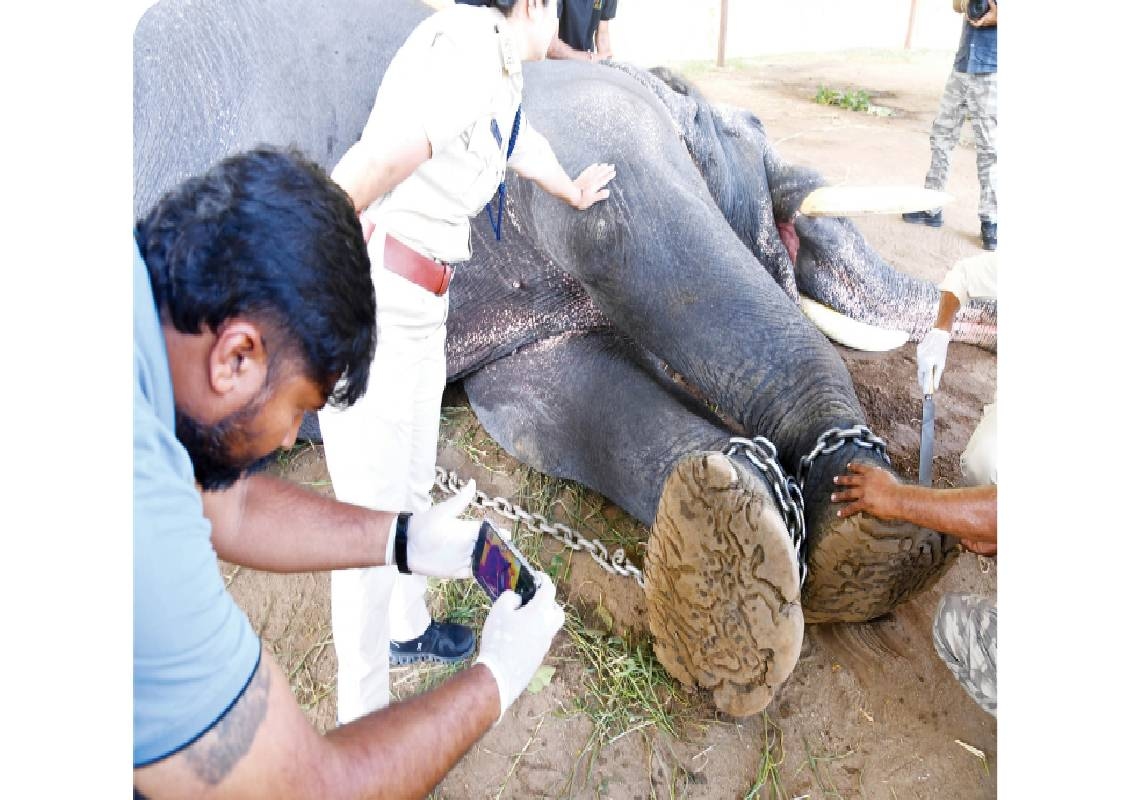


Mysuru: With the 2026 Dasara festivities approaching, the Forest Department has intensified health monitoring of the 12 elephants taking part in the grand Jumboo Savari, with special attention being given to their feet during daily training on city roads.
After every training session, the elephants’ feet are examined using metal detectors and thermal scanners to identify nails, metal fragments and possible injuries that may not be visible to the naked eye. The precautionary exercise has become an important part of the daily care routine as the elephants walk several kilometres on asphalt and concrete roads.
The Forest Department is taking these measures to minimise the risk of foot injuries ahead of the Jumboo Savari procession scheduled for October 21.
Dasara elephants cover 5 km during daily training
The Dasara elephant team follows a route of around 5 km during its regular training sessions.
The elephants begin from the Mysuru Palace and proceed through Chamaraja Wadiyar Circle, Krishnaraja Wadiyar Circle, Sayyaji Rao Road, Ayurveda Circle, Old RMC, Bamboo Bazaar, Highway Circle and Nelson Mandela Road, before reaching the Torchlight Parade Grounds at Bannimantap.
The route is part of the preparation for the Jumboo Savari, during which the lead elephant and other members of the squad have to negotiate a similar urban environment while carrying out the procession.
Walking repeatedly on city roads presents a different challenge compared with the forest environment where the elephants normally move on natural surfaces.
Magnet trolley removes sharp objects from road
The Forest Department has introduced an additional precaution to remove potentially dangerous objects from the training route.
A jeep pulls a magnet trolley ahead of the elephants while they walk. The trolley is designed to collect iron objects lying on the road, including nails, pins and other sharp metal fragments.
According to the Forest Department, nearly half a kilogram of sharp iron pieces and nails is collected every day from the Palace-Bannimantap route.
The exercise reduces the possibility of the elephants stepping on sharp metal objects during their training. However, officials recognise that smaller objects can remain undetected or may not be picked up by the trolley.
Metal detectors used on all four feet
Once the elephants complete their training session, they are given water and allowed to rest before the detailed foot inspection begins.
The inspection is conducted under the guidance of Conservator of Forests Dr Ravishankar and Deputy Conservator of Forests Dr I.B. Prabhugowda.
Veterinary doctor Dr Adarsh and Range Forest Officer Yashma Machamma lead the foot examination using metal detectors.
All 12 Dasara elephants are made to lie down during the procedure. Each elephant’s four feet are individually scanned for metallic objects.
If an iron fragment is detected inside a foot, forest and veterinary personnel carefully remove it and treat the affected area.
The procedure is intended to identify problems at an early stage and prevent a minor injury from becoming more serious during continued training.
Thermal scanning helps detect hidden injuries
The foot-care process does not stop with the metal detector examination.
The elephants’ feet are subsequently checked using thermal scanners. Thermal imaging can help identify abnormal areas associated with inflammation or injury that may not be immediately visible externally.
This is particularly relevant for elephants undergoing repeated walking and training on hard urban surfaces.
The combination of metal detection and thermal scanning therefore allows officials to check both for foreign objects and possible underlying problems.
City roads pose additional challenge
Dasara elephants normally spend much of their time in forest environments, where their feet are exposed to soil, stones and other natural surfaces.
According to the report, walking on forest terrain naturally helps keep the skin of their feet harder. However, repeated walking on concrete and asphalt roads can soften the feet and increase their vulnerability.
Under these conditions, even relatively small objects such as nails, needles, pins, nuts and bolts can cause injuries if they become lodged in the foot.
The daily inspection is therefore particularly important during the weeks when the elephants are being trained intensively for the Dasara procession.
Training prepares elephants for Jumboo Savari
The daily route training is part of the larger preparation for the Jumboo Savari on October 21.
The elephants have to become accustomed not only to the distance but also to the urban surroundings, traffic-related sounds, crowds and the different surfaces encountered along the procession route.
The training also helps forest officials monitor the animals’ physical condition as the festival approaches.
Foot health is especially important because any injury could affect an elephant’s ability to participate in the procession and undergo further training.
Preventive care remains central to Dasara preparations
The Forest Department’s approach combines preventive measures on the road with veterinary monitoring after each training session.
The magnet trolley removes a significant quantity of potentially dangerous metal objects before the elephants pass through. The subsequent metal-detector check provides another layer of protection in case sharp objects remain on the route.
Thermal scanning then allows veterinary personnel to look for signs of problems that may not be externally visible.
Together, these measures form part of the wider health and welfare programme for the Dasara elephant squad.
12 elephants under close monitoring
All 12 elephants participating in the 2026 Dasara festivities are subjected to the foot-checking procedure.
The monitoring becomes particularly important as the festival draws closer and training continues on city roads.
Forest officials are also providing other forms of health and grooming care to the elephants during their stay in Mysuru. Regular veterinary observation allows officials to respond quickly if an animal develops an injury or other health issue.
The foot-scanning exercise is consequently not just a one-time examination but part of the daily training routine.
Elephant safety ahead of Mysuru Dasara
The 2026 Mysuru Dasara festivities are scheduled to culminate in the Jumboo Savari, making the health of the elephant squad a major part of the preparations.
While the elephants’ training is necessary to prepare them for the procession, their daily movement through the city also exposes their feet to surfaces and objects that are different from those found in their natural habitat.
The Forest Department’s use of magnet trolleys, metal detectors and thermal scanners is aimed at reducing these risks.
With sharp metal objects reportedly being removed from the training route every day, officials are continuing close monitoring to ensure that the elephants remain fit and healthy as they undergo preparations for one of Mysuru’s most prominent annual celebrations.