







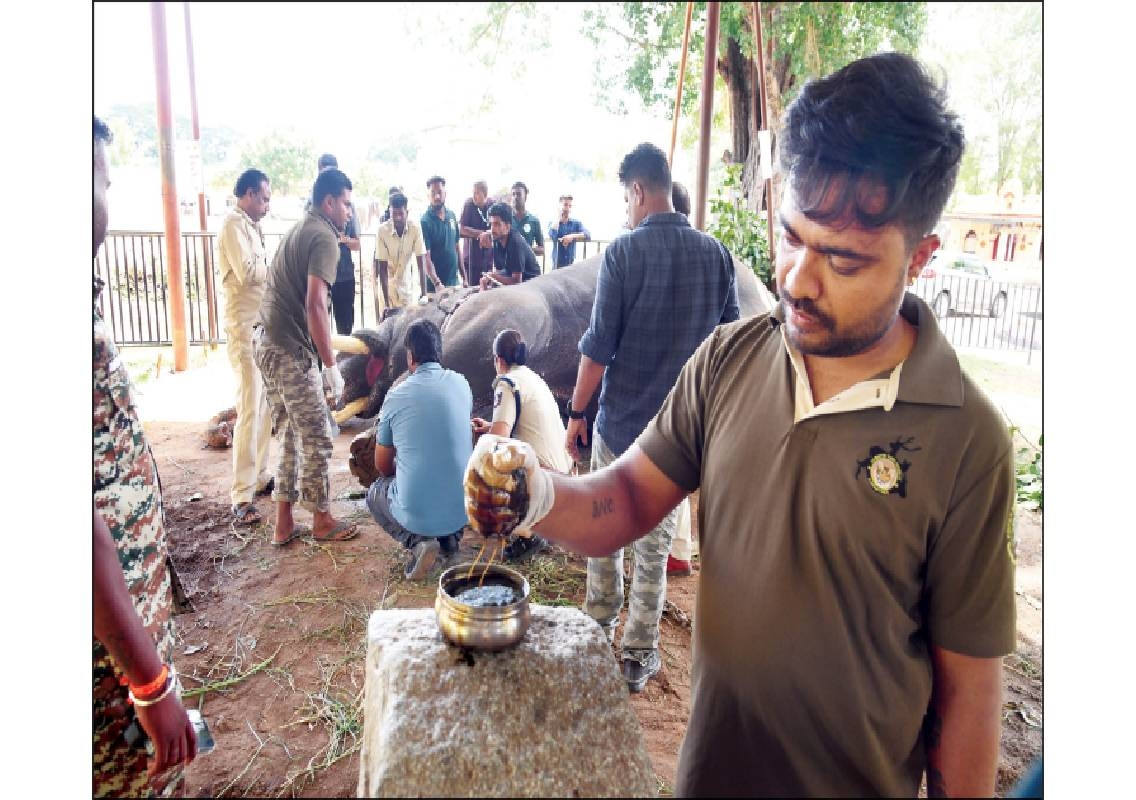


Mysuru: As the 2026 Dasara festivities approach, the Forest Department has stepped up the health and grooming routine for the 12 elephants taking part in this year’s celebrations. Along with regular training and veterinary checks, the elephants are being given special oil massages and nail care to help them remain comfortable and healthy during the intensive preparation period.
Neem oil and castor oil are being used as part of the grooming routine. Neem oil is applied particularly around the gaps between the elephants’ feet and their hooves, while castor oil is applied to their heads and foreheads to provide a cooling effect.
The elephants are also receiving detailed nail care. Forest officials and elephant handlers inspect their feet and trim nails that are bent, sharp or overgrown. The nails are then filed to smoothen the edges before being given a polished finish.
The additional care comes as the elephants continue their daily training on Mysuru’s roads ahead of the Jumboo Savari on October 21.
Neem oil applied to protect elephant feet
The feet of the Dasara elephants receive particular attention because the animals are walking regularly on hard urban surfaces during their training.
According to the report, the elephants are bathed every day, after which neem oil is thoroughly applied in the gaps between their feet and hooves. The treatment is intended to help prevent insect infestation and bacterial infections.
The foot-care routine is important because the elephants spend considerable time walking on asphalt and concrete roads during the Dasara training period. Their feet are naturally adapted to forest terrain, where they regularly encounter soil, stones and other natural surfaces.
The Forest Department is therefore combining routine grooming with preventive care to reduce the possibility of foot-related problems during the weeks leading up to the festival.
Castor oil used for cooling
Castor oil is also being used as part of the elephants’ grooming routine.
The oil is applied to their heads and foreheads, with the treatment intended to provide a cooling effect during the intensive training sessions.
The elephants are undergoing regular movement through the city as they become accustomed to traffic, crowds, noise and the urban environment that they will encounter during the Jumboo Savari.
The grooming routine is consequently being carried out alongside their physical training rather than being treated as a separate activity.
Special attention given to elephant nails
Nail care is another important part of the daily maintenance of the Dasara elephants.
Forest officials and handlers carefully inspect the gaps between the elephants’ feet and examine their nails for abnormalities. Bent, sharp or overgrown nails are trimmed using special cutters.
After trimming, the nails are filed to smoothen their edges. They are then given a polished finish and painted as part of the elephants’ grooming.
The procedure helps keep the nails in proper condition while also giving the elephants a well-maintained appearance for the festival.
Regular inspection also allows handlers to identify possible problems at an early stage.
Foot care becomes crucial during city training
The 12 Dasara elephants are undergoing daily training as part of preparations for the October 21 procession. The official Mysuru Dasara website states that the elephants undergo around six weeks of preparation after entering the Palace premises, including daily walks along the procession route.
The official list includes Mahendra, Dhananjaya, Ekalavya, Prashantha, Gopi, Sriram, Srikanta, Lakshmi, Kaveri, Roopa, Sugreeva and Chaitra.
The Forest Department has also been conducting detailed checks of the elephants’ feet after their training sessions. Metal detectors and thermal scanners are used to identify metal fragments and possible injuries.
A magnet trolley is pulled ahead of the elephants during training to collect nails, pins and other sharp metal objects from the road.
Elephants face different conditions on city roads
The change from forest terrain to city roads means the elephants need additional care during the Dasara training period.
The official Dasara website notes that the elephants are gradually trained to become accustomed to crowds, musical performances and vehicle movement while walking along the city procession route. The lead elephant is also progressively trained to carry the full 750-kg golden howdah.
Continuous walking on concrete and asphalt can affect the condition of the elephants’ feet. This makes regular examination, cleaning and grooming important.
The Forest Department’s foot-care measures therefore complement the daily training programme.
12 elephants preparing for Dasara 2026
The Forest Department has selected 12 elephants for the 2026 Dasara celebrations.
According to the official Mysuru Dasara website, the elephants entered Mysuru Palace on August 28 after the formal Gaja Payana began from Veeranahosahalli in Nagarahole on August 26.
The elephants represent different forest camps and have varying ages and weights. Srikanta is listed as the heaviest elephant in the squad at 5,860 kg, while Chaitra, at 2,988 kg, is the lightest among the 12.
The squad includes experienced Dasara elephants as well as animals with fewer years of participation.
The Forest Department will announce the elephant selected to carry the golden howdah after the training period.
Grooming complements veterinary monitoring
Oil application and nail care form part of a broader health-monitoring system for the Dasara elephants.
Veterinary teams are closely monitoring the animals during their stay in Mysuru. Their diet has also been adjusted to provide the energy and nutrition required for training and the procession.
The official Dasara website says the elephants receive a high-calorie, protein-rich food mix including rice, ragi, jaggery, coconut, horse gram and green fodder.
Regular bathing, oil application, nail trimming and foot inspections are therefore being carried out alongside feeding and physical training.
Preparations intensify ahead of Jumboo Savari
The grooming activities come at a crucial stage of the Dasara preparations. The 2026 Mysuru Dasara celebrations will be held from October 11 to 21, with the Jumboo Savari scheduled for Vijayadashami on October 21.
For the elephants, the weeks before the procession involve increasingly intensive training. They need to remain physically fit while becoming accustomed to the sounds, crowds and road conditions associated with the festival.
The Forest Department’s emphasis on foot care, nail maintenance and cooling treatments is intended to keep the animals comfortable throughout this period.
With daily training continuing and the main procession approaching, the elephants are receiving close attention from their handlers, forest officials and veterinary teams. The combination of traditional grooming practices and modern health monitoring is being used to prepare the 12-member elephant squad for the final stages of Mysuru Dasara 2026.