







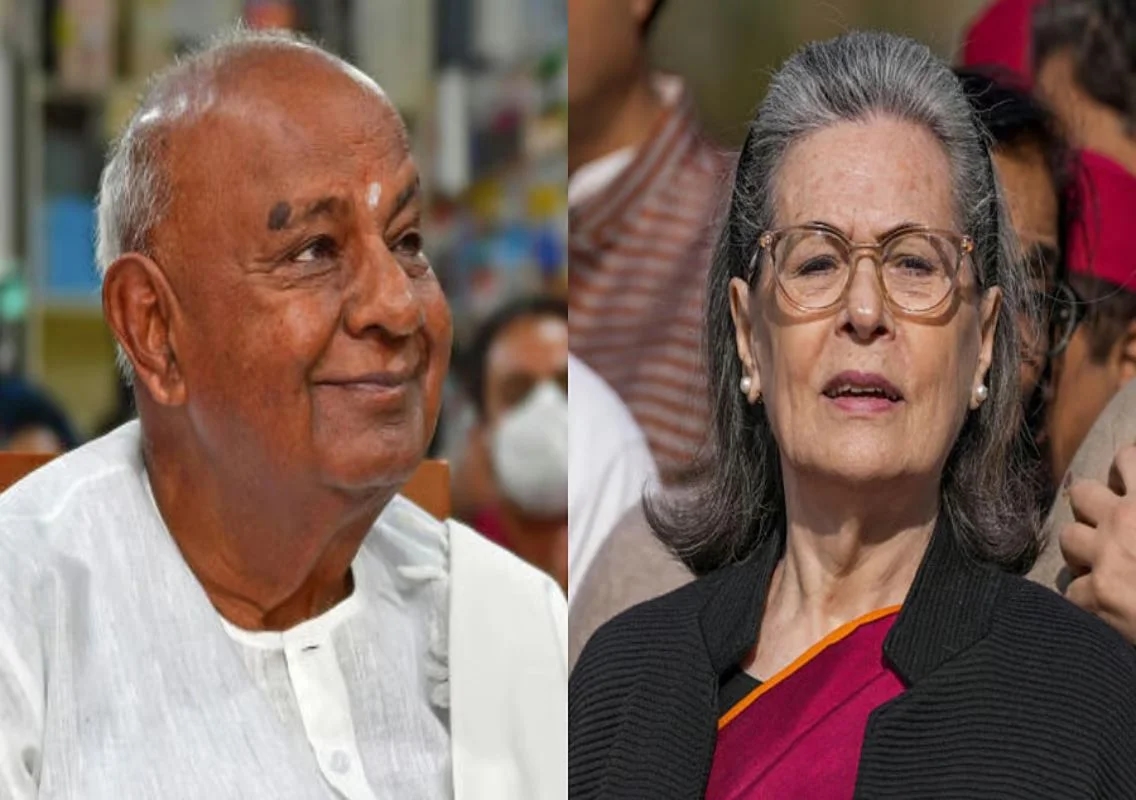


New Delhi: Congress parliamentary party chairperson Sonia Gandhi has issued a brief response to former Prime Minister H D Deve Gowda regarding his concerns over disruptions in Parliament, stating that she has “noted” his observations while also extending greetings on the eve of Ugadi.
In her concise three-line reply, Gandhi acknowledged receiving Deve Gowda’s letter dated March 16 and said she had read it carefully. “I have read it carefully and noted your concerns,” she wrote, adding, “I extend my greetings to you on the eve of Ugadi.”
Deve Gowda flags ‘chaos’ in Parliament
Deve Gowda, a Janata Dal (Secular) Rajya Sabha MP, had earlier written a detailed letter expressing concern over what he described as increasing disorder in Parliament, particularly attributing it to opposition parties.
He said he was “greatly disturbed by a certain chaos” that had been “unthinkingly” introduced inside Parliament and its premises. The veteran leader alleged that Congress parliamentarians, led by the Leader of Opposition, had been responsible for provoking repeated disruptions.
According to him, recent sessions have witnessed excessive slogan-shouting, display of placards, and instances of name-calling, which he said undermined the dignity of parliamentary proceedings.
Concerns over protest culture
In his letter, Deve Gowda also criticised the growing trend of protests within Parliament, including dharnas and blockades, calling them “unprecedented”.
He emphasised that during his long political career, he had never resorted to entering the Well of the House to stage protests, even under extreme provocation. He attributed his conduct to the values instilled by earlier generations of political leaders.
“In my long exposure, I have never witnessed Parliament in such chaos and casualness,” he said, adding that such behaviour goes against the principles of parliamentary democracy.
Appeal for restraint
The former Prime Minister urged Sonia Gandhi to intervene and advise her party members, as well as other opposition leaders, to adopt a more restrained approach in their protests.
He stressed that while dissent is a vital part of democracy, it must be expressed in a manner that does not weaken institutional frameworks built over decades.
“I believe that the opposition must protest as much as it wants, but that protest has to be framed in a way that does not dismantle what we have built together in over 75 glorious years,” he said.
Ugadi greetings amid political exchange
Despite the serious tone of the correspondence, Gandhi’s reply included a cordial note, extending Ugadi greetings to Deve Gowda. The festival marks the beginning of the Hindu New Year and is widely celebrated in states such as Karnataka, Andhra Pradesh, and Telangana, as well as in parts of Tamil Nadu and Kerala.
The exchange reflects a blend of political disagreement and personal courtesy, characteristic of interactions among senior leaders.
Ongoing debate over parliamentary conduct
The issue of disruptions in Parliament has been a recurring topic of debate in recent years, with both ruling and opposition parties accusing each other of undermining legislative functioning.
Frequent adjournments, protests, and disruptions have often stalled proceedings, impacting the passage of key legislation and limiting productive debate.
Political observers note that calls for restoring decorum in Parliament have come from leaders across party lines, highlighting concerns about the long-term health of democratic institutions.
Conclusion
Sonia Gandhi’s brief yet measured response indicates acknowledgement of Deve Gowda’s concerns without directly engaging in the broader criticism. As debates over parliamentary conduct continue, the exchange underscores the need for balancing robust opposition with institutional respect.
The inclusion of Ugadi greetings also reflects the enduring tradition of civility in Indian politics, even amid sharp differences.