







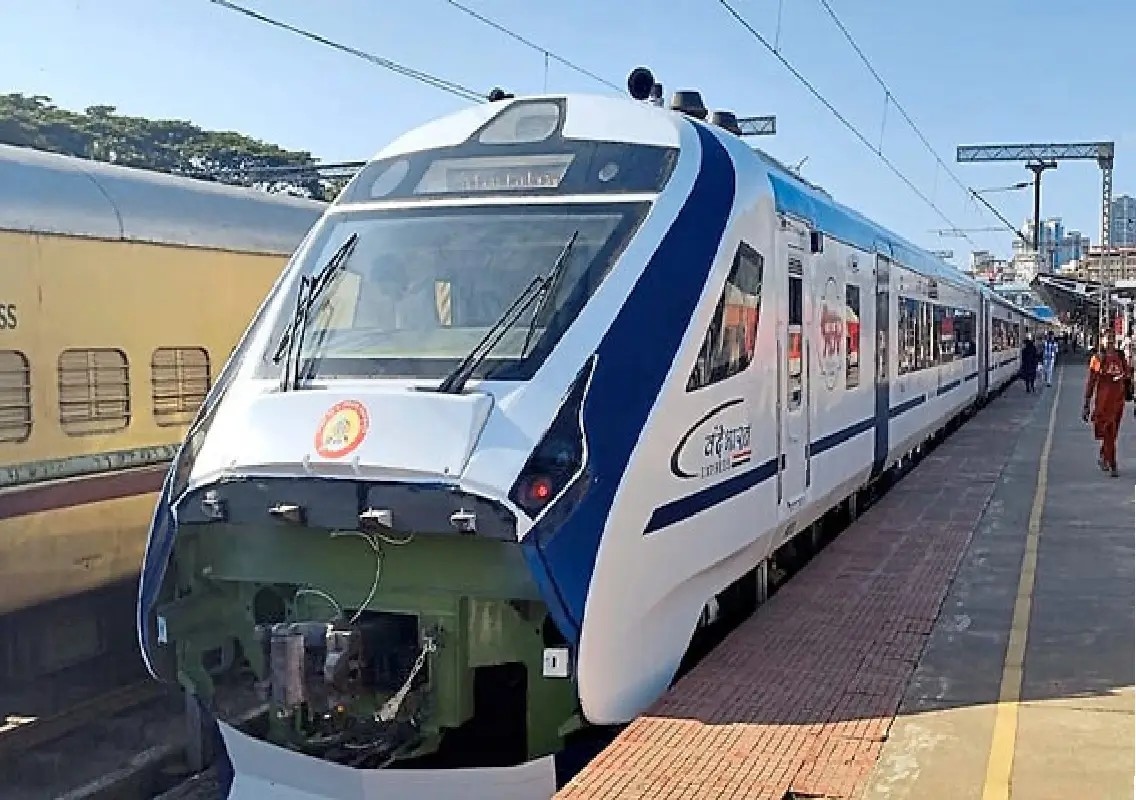


Mangaluru: The proposed Vande Bharat Express connecting Bengaluru and Mangaluru Central has completed a crucial full-route trial run, with railway officials assessing its speed, sectional timings and operational performance across one of Karnataka’s most challenging railway stretches.
The trial train departed Yeshwantpur Junction at 6.05 am and travelled through Hassan, Sakleshpur and Subrahmanya Road before reaching Mangaluru Central at 4.30 pm. The train carried only railway officials and technical personnel during the exercise.
The latest trial is an important step in evaluating the feasibility of introducing a Vande Bharat service on the Bengaluru-Mangaluru route. Particular attention was given to the ghat section, where steep gradients, sharp curves and existing speed restrictions can affect the train’s overall journey time.
Ghat section under close observation
According to railway sources, the primary objective of the trial was to determine the precise time required for the train to cover the complete route. Officials are especially examining its performance between Sakleshpur and Subrahmanya Road.
The ghat section presents several operational challenges because of its terrain and alignment. Trains operating through this stretch have to negotiate curves and gradients while adhering to prescribed speed restrictions.
The trial therefore provided railway officials with an opportunity to record the train’s actual performance under operational conditions. The data gathered will help determine realistic sectional timings rather than relying solely on theoretical journey calculations.
The timings recorded during the trial are expected to be studied by officials from various railway departments before a final decision is taken on the proposed service.
RDSO conducted technical trials
The latest full-route exercise follows a series of technical tests conducted in August under the supervision of the Research Designs and Standards Organisation (RDSO).
Those trials were intended to assess the Vande Bharat train’s technical performance in conditions specific to the route. Tests included the automatic emergency braking system, full-load operation and performance through the ghat section.
Testing the train under different operating conditions is particularly important before introducing a high-speed train service on a route involving significant gradients and curves.
The ghat trials were aimed at understanding how the train responds while negotiating the demanding terrain. Technical observations from these exercises, along with the latest full-route timings, will contribute to the overall assessment.
Journey timing remains a key factor
While Vande Bharat trains are designed to offer faster travel between major cities, the achievable journey time depends on the infrastructure and operating conditions along an individual route.
On the Bengaluru-Mangaluru corridor, the Sakleshpur-Subrahmanya Road section is expected to be one of the most important factors in determining the final timetable.
Officials are consequently analysing the speed achieved in different sections and comparing the results with existing speed restrictions. The exercise will help establish how quickly the train can realistically operate without compromising operational safety.
The train’s arrival at Mangaluru Central at 4.30 pm after departing Yeshwantpur at 6.05 am also gives railway authorities a complete set of observations from the route. However, the trial timing should not be treated as the final commercial timetable, as further assessment and scheduling decisions are still required.
Halts yet to be finalised
The stopping pattern for the proposed Vande Bharat service has not yet been officially finalised.
Stations identified during the trial are being considered as part of the assessment of travel times and operational feasibility. The number and location of commercial halts will have a direct bearing on the eventual journey time.
Railway authorities are expected to consider several operational factors before finalising the stopping pattern. These include passenger demand, route timings, operational requirements and the ability to maintain an efficient schedule.
As a result, passengers should wait for an official announcement before assuming that the stations covered during the trial will necessarily become scheduled commercial stops.
Several railway departments involved
Officials from traction operations, traction distribution, engineering and mechanical departments are overseeing arrangements connected with the trial.
The involvement of multiple departments reflects the need to examine the proposed service from both technical and operational perspectives. Apart from train performance, railway infrastructure, electrical systems, track conditions and mechanical aspects have to be assessed before regular operations can begin.
The trial also provides an opportunity to identify operational constraints that may need to be addressed before the service is introduced for passengers.
Report to be submitted to higher authorities
Railway officials are expected to prepare a comprehensive report based on the latest trial run. The report will include observations on speed, sectional timings, the ghat stretch and other operational aspects of the journey.
The findings will then be submitted to higher authorities for further consideration.
The completion of the trial represents a significant stage in the evaluation of the proposed Bengaluru-Mangaluru Vande Bharat service. However, the trial itself does not mean that regular passenger services have been formally announced.
A final decision will depend on the technical assessment, timetable considerations, halt pattern and approvals from the competent railway authorities.
For passengers travelling between the coastal city and Bengaluru, the proposed service could potentially provide a faster and more convenient rail connection. The latest trial, particularly the detailed assessment of the ghat section, is expected to provide railway authorities with crucial data before they take the next step towards deciding the future of the service.