







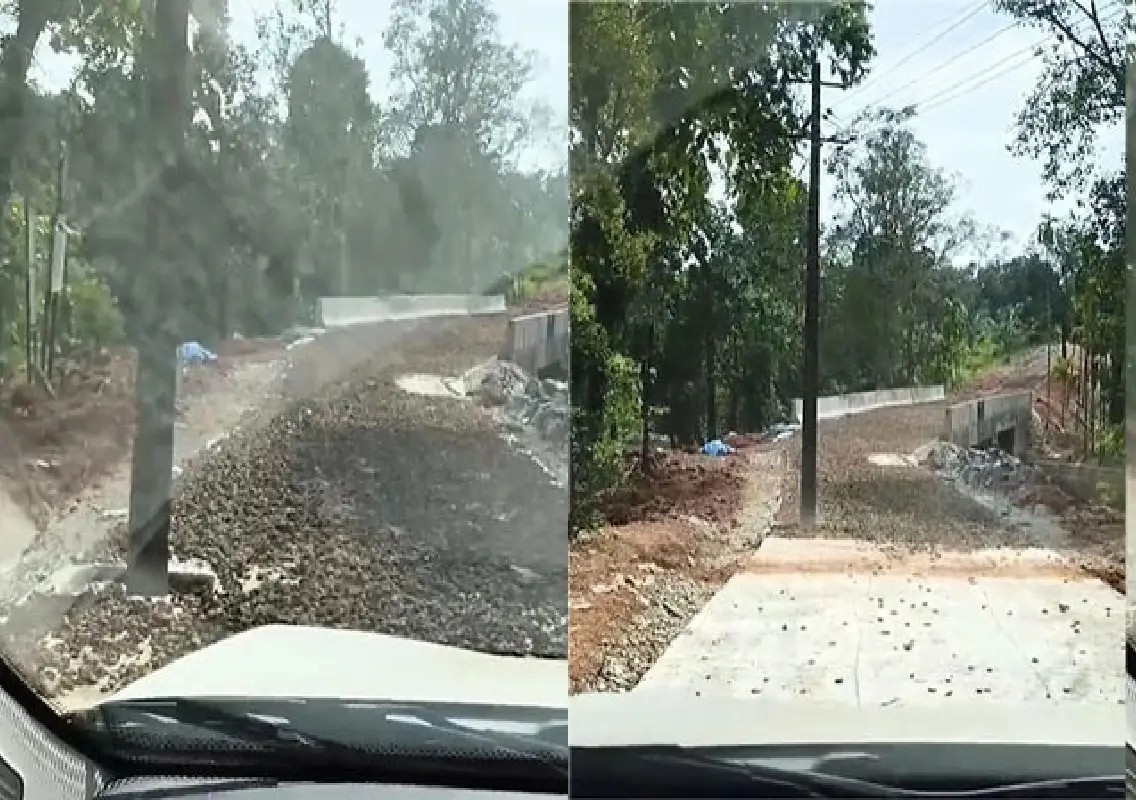


Beltangady: A newly concreted road in Sukkeri has triggered public criticism after an electric pole was left standing in the middle of the paved stretch, raising questions over planning and coordination between the agencies involved in the infrastructure work.
The incident has surfaced shortly after a similar controversy in Sullia, where five electric poles were reportedly left standing on a newly concreted road. The recurrence of a comparable lapse in Beltangady has intensified concerns among residents about the execution and supervision of public infrastructure projects.
The affected road is located near the bridge on the route connecting Sri Rama School in Sukkeri with the Atrinje Koraga Colony. The road serves as an important access route for residents of the colony, making the condition of the newly completed stretch a matter of particular concern for the local community.
Pole left standing on concreted stretch
The road concreting work was undertaken along the route near the bridge, but an existing electricity pole was not removed or relocated before the concrete was laid.
As a result, the pole now stands directly in the middle of the newly paved road, creating an obvious obstruction for vehicles and other road users.
Residents who had been looking forward to improved connectivity on the route have expressed dissatisfaction over the manner in which the work was carried out. The road provides access to the Atrinje Koraga Colony and is considered an important link for the local population.
The presence of the pole at the centre of the completed road has also raised questions about whether the site was properly inspected and whether the utility-shifting requirement was taken into account before the concreting work began.
KRIDL executed the project
The infrastructure work was carried out by Karnataka Rural Infrastructure Development Limited (KRIDL) using funds released under the comprehensive tribal development programme.
The project was intended to improve connectivity to the Atrinje Koraga Colony, with residents expecting a smoother and more convenient road after the completion of the work.
However, the failure to relocate the electricity pole before concreting has resulted in an unusual situation in which the newly developed road itself is obstructed by a utility installation.
For residents, the issue is not merely about the appearance of the road. The location of the pole could interfere with the movement of vehicles and create difficulties for emergency and essential services using the route.
Pole relocation approval obtained in 2025
What has further raised questions is that the process for shifting the electricity pole had reportedly been initiated well before the road concreting work.
According to the information available, official clearance for relocating the pole was granted on June 9, 2025. The tender process for the pole-shifting work had also reportedly been completed.
Despite the approval and completion of the tender process, the road concreting proceeded without the obstruction being removed.
The sequence of events has led to questions over coordination between the agencies responsible for the road project and electricity infrastructure. If the requirement to shift the pole had already been identified and the necessary process completed, residents are questioning why the road work was allowed to proceed before the relocation.
The issue has also raised questions about supervision at the work site and whether officials inspected the road alignment before the concrete was laid.
Residents question accountability
Local residents have reacted strongly to the development, particularly because the road was being constructed under a programme intended to improve infrastructure in a tribal settlement.
The route connecting Sri Rama School and the Atrinje Koraga Colony is an important local link, and residents had anticipated that the project would improve access to the colony.
Instead, the stranded pole has become a visible example of what residents describe as poor coordination and inadequate planning.
The controversy also comes at a time when a similar road-related issue in Sullia has attracted public attention. In that case, five electricity poles were reportedly left standing in the middle of a newly concreted road. The appearance of another similar case has prompted renewed discussion about the need for utility relocation to be completed before road construction begins.
Need for corrective action
The immediate concern is whether the pole will now have to be removed or relocated and whether doing so will require additional expenditure or damage to the newly laid concrete.
Ideally, utility-shifting work is coordinated with road construction so that electricity poles, pipelines and other obstructions are dealt with before the final surface is laid. When such work is carried out afterwards, it can potentially involve additional public expenditure and disruption to a recently completed road.
In the Sukkeri case, the fact that the pole-shifting approval and tender process had reportedly been completed in advance makes the sequence particularly significant.
Residents are now seeking clarity from the authorities on why the approved relocation was not completed before the road was concreted and who will be responsible for rectifying the situation.
Questions remain unanswered
The episode has brought attention to the importance of coordination between infrastructure agencies, electricity authorities, contractors and local officials. Proper site verification before construction and timely completion of utility-shifting work could help prevent such situations.
As the road serves the Atrinje Koraga Colony, residents are also keen that the issue be resolved without further delay and that the completed road can be used safely and effectively.
The incident has consequently become a fresh test of administrative accountability in the execution of rural infrastructure projects, particularly those funded to improve basic facilities for tribal communities.