







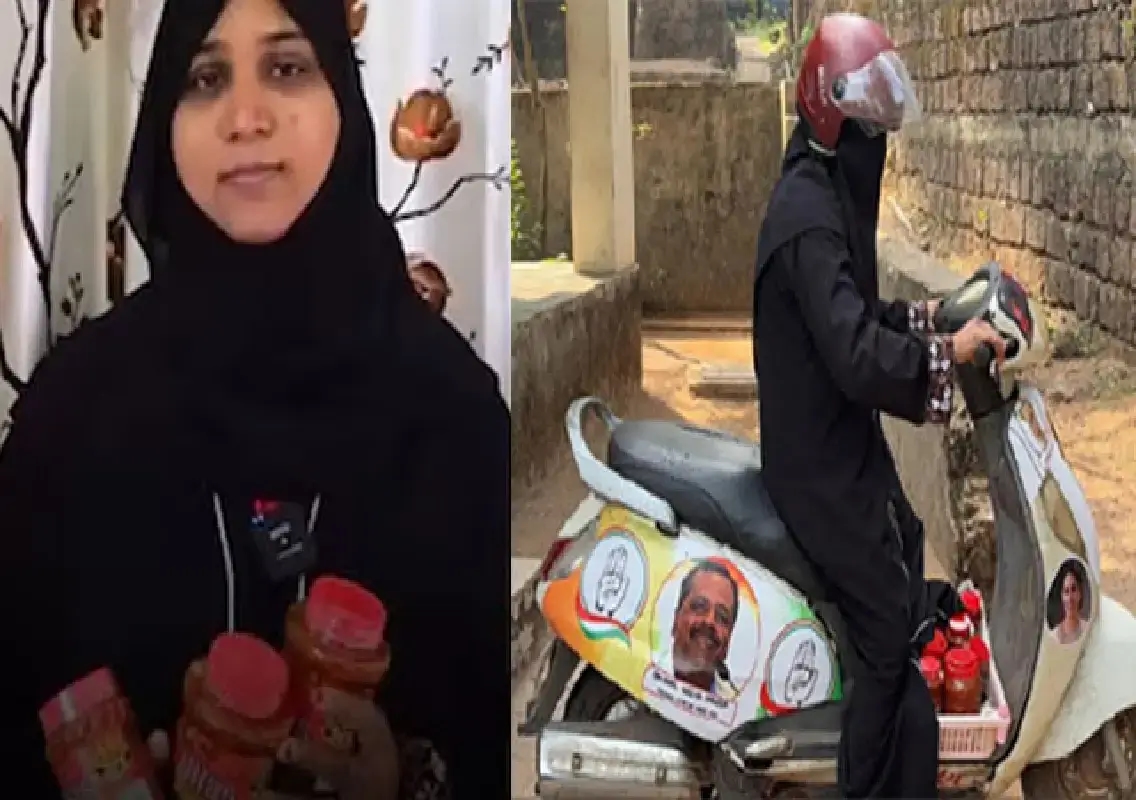


Mangaluru: Zeenat, a 39-year-old widow from Kallapu village in Ullal taluk, has transformed her humble homemade pickle-making activity into a steady source of income, earning around Rs 900 a day. Through a blend of traditional recipes, a modest two-wheeler investment and timely government support, she has achieved financial independence and emerged as a symbol of grassroots women entrepreneurship.
What began as a routine household practice gradually evolved into a livelihood opportunity. Initially, Zeenat prepared pickles mainly for family use and occasionally shared them with neighbours. Encouraged by their positive feedback on taste and quality, she began taking small orders, though her reach remained limited due to lack of mobility and market access.
Support from self-help groups
The turning point came when members of her local Self-Help Group (SHG) recognised her potential and encouraged her to formalise the activity into a micro-enterprise. Through the SHG network, she was introduced to government-supported micro-enterprise schemes aimed at empowering women from economically weaker sections.
Under these schemes, she received guidance on basic business practices such as pricing, packaging and maintaining daily accounts. The structured support helped her understand how small enterprises could be run sustainably rather than informally.
Mobility as a game changer
A small loan combined with a government subsidy enabled Zeenat to purchase a scooter, which proved to be a critical investment. With improved mobility, she could travel daily to nearby markets and retail outlets to sell her products directly.
Earlier, buyers had to visit her home, which limited sales. The scooter allowed her to expand her customer base significantly, resulting in consistent orders and predictable income. This change helped stabilise her finances and reduce the uncertainty she faced in the early stages.
Consistent income and improved stability
With regular market access and a growing customer base, Zeenat now earns approximately Rs 900 per day. For her household, this income has brought much-needed financial stability and reduced dependence on external support.
Officials associated with the micro-enterprise schemes note that such outcomes demonstrate the importance of combining access to credit with mentorship and market linkage. Along with financial assistance, beneficiaries are provided basic training in business management, customer interaction and scaling up operations.
Recognition within the community
Customers at local markets have praised the authentic taste, freshness and hygiene of Zeenat’s homemade pickles. Neighbours and fellow SHG members say her success has inspired other women in the community to consider starting small businesses based on traditional skills.
Several women have reportedly approached SHGs seeking information about similar schemes after witnessing the steady income she has managed to generate. Her journey highlights how visible success stories can encourage wider participation in entrepreneurship programmes.
Growing trend of grassroots entrepreneurship
Zeenat’s story reflects a broader trend of grassroots entrepreneurship emerging across coastal Karnataka. Traditional skills such as food processing, tailoring and handicrafts are increasingly being converted into income-generating ventures with institutional backing.
While challenges such as fluctuating raw material prices and competition persist, targeted government support and strong SHG networks continue to play a crucial role in sustaining such initiatives.
Conclusion
Zeenat’s journey from a home kitchen to a steady micro-enterprise underscores the transformative impact of small but well-directed interventions. By combining traditional knowledge with modern support systems, she has created a sustainable livelihood for herself.
Her success stands as an example of how economic empowerment at the grassroots level can be achieved through perseverance, community support and effective policy implementation.