







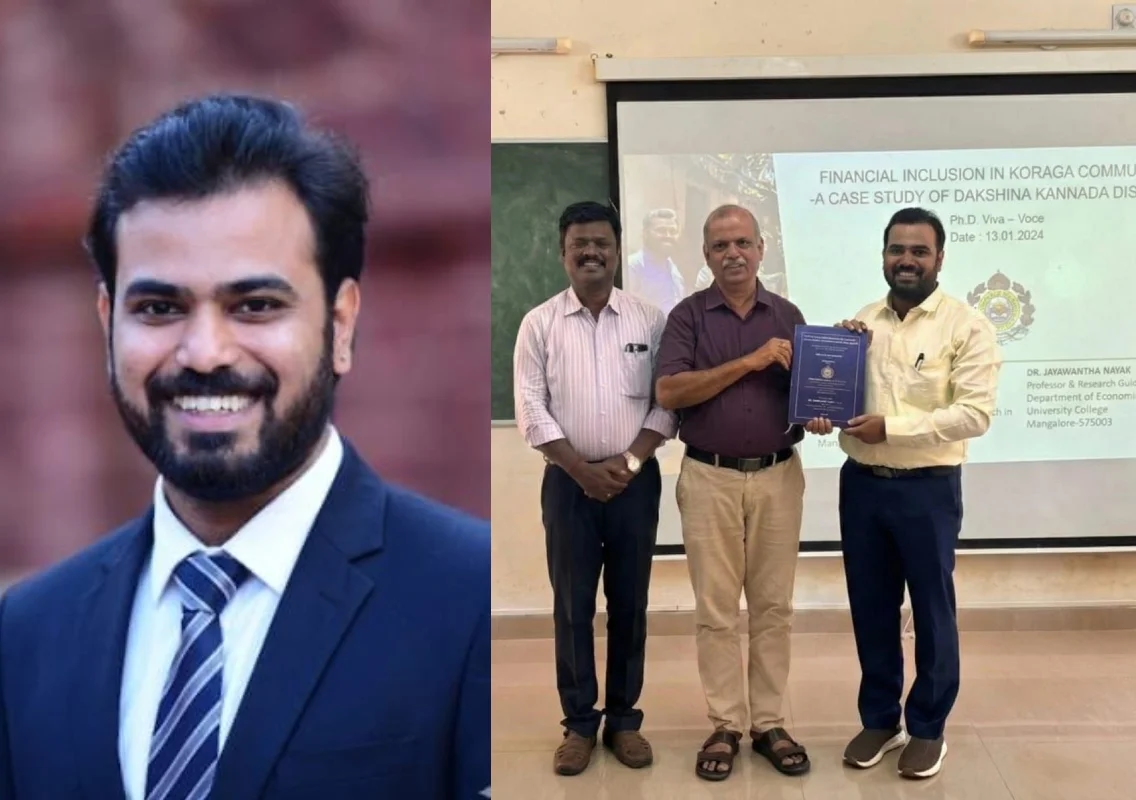


Mangaluru: Mangalore University has conferred the Doctor of Philosophy (PhD) degree upon Venkatesha Nayak for his significant research contribution in the field of Economics, with a focused study on financial inclusion among tribal communities in coastal Karnataka.
Venkatesha Nayak’s doctoral thesis, titled “Financial Inclusion in Koraga Community – A Case Study of Dakshina Kannada District”, presents an in-depth academic analysis of the reach, effectiveness, challenges, and outcomes of financial inclusion initiatives among the Koraga community, a Particularly Vulnerable Tribal Group (PVTG). The research offers evidence-based insights that are expected to inform inclusive development policies in Dakshina Kannada district and similar socio-economic contexts.
Focus on financial inclusion and tribal development
The study critically examines how formal banking, credit access, government welfare schemes, and financial literacy programmes have reached the Koraga community, traditionally regarded as one of the most marginalised groups in Karnataka. By analysing both quantitative data and qualitative experiences, the research highlights systemic gaps, implementation challenges, and socio-cultural barriers that continue to limit meaningful financial participation.
Financial inclusion, widely recognised as a key driver of equitable economic growth, plays a crucial role in improving livelihoods, reducing vulnerability, and enabling access to state support mechanisms. The thesis situates the Koraga community within the broader discourse on financial inclusion, a concept discussed extensively in economic policy literature and global development frameworks, including those outlined on Wikipedia’s overview of financial inclusion.
Academic guidance and evaluation
The doctoral research was carried out under the guidance of Dr Jayavantha Nayak, Professor of Economics, University College, Mangaluru, whose mentorship supported the academic rigour and policy relevance of the study.
The thesis was evaluated by a panel of distinguished external examiners. The viva voce examination was conducted by Dr S. N. Yogish, Professor and Chairman, Department of PG Studies in Economics, Kuvempu University. Another external examiner was Dr Rajendran, Senior Professor and Head, Department of Economics, Gandhigram Rural Institute, Tamil Nadu. Both examiners commended the research for its empirical grounding and relevance to contemporary development challenges.
Viva voce and academic presence
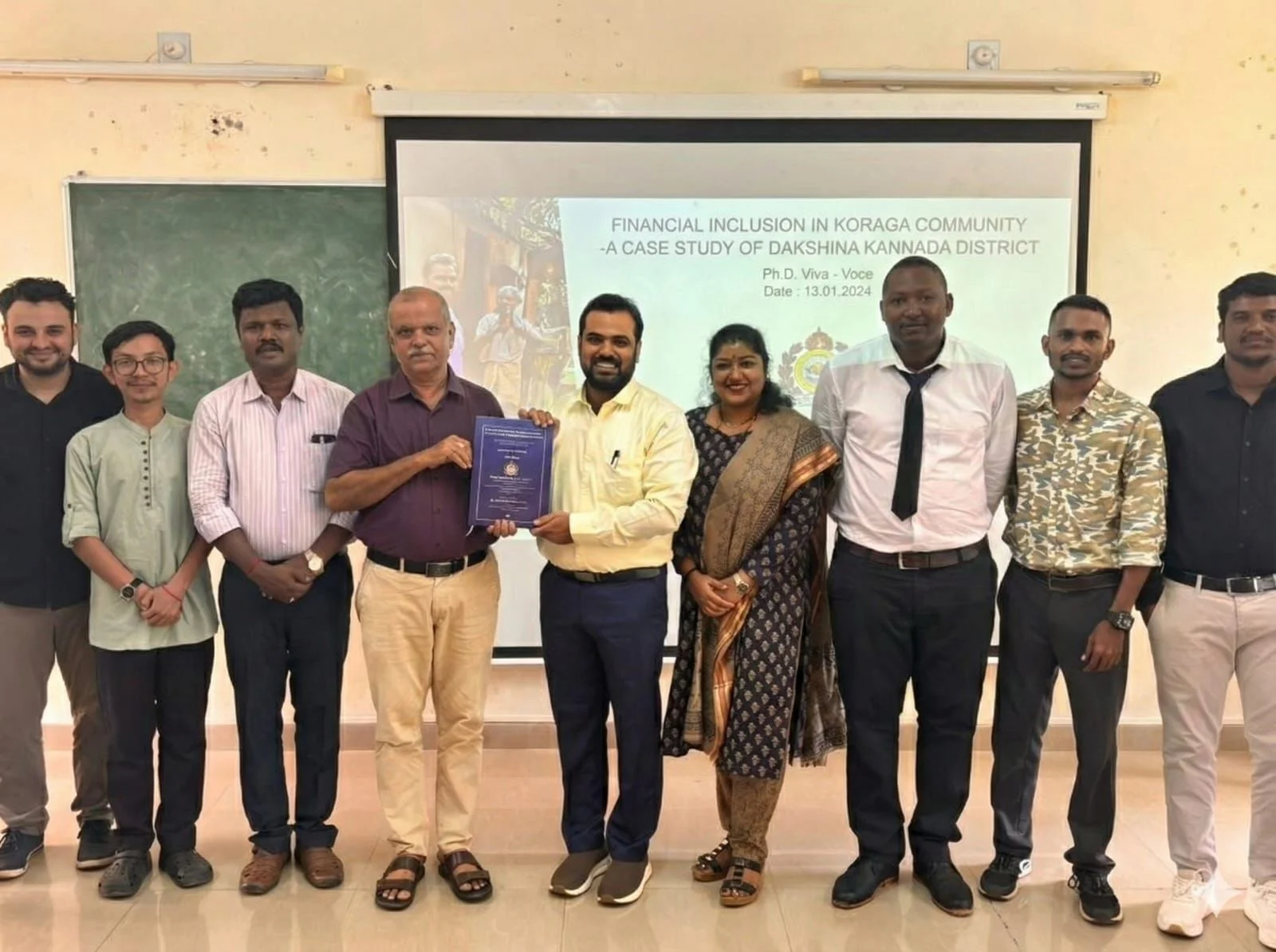
The successful viva voce examination was held in the presence of senior academicians from Mangalore University and University College, Mangaluru. Those present included Dr Jagadeesh T, Professor and Chairman, Department of Economics, Mangalore University; Dr Muniraju Y, Professor and former Dean of Commerce and Management, Mangalore University; Dr Ramakrishna B. M., Professor and Head, Department of Economics, University College, Mangaluru; Dr Subhashini Srivatsa, Professor; Dr Jagadeesh, Professor, Department of Commerce, University College; Dr Madhava, Associate Professor, Department of Kannada; Rajesh Kumar, along with other faculty members and research scholars.
Their presence reflected the academic importance of the research and its relevance to interdisciplinary discussions on economics, social development, and public policy.
Personal milestones and family support
Venkatesha Nayak is the son of Sri Gopalakrishna Nayak and the late Smt Jyothi Nayak. His wife, Kavya P. Hegde, Assistant Professor, Department of Commerce and International Studies, Central University of Kerala, Kasaragod, was also present during the doctoral award proceedings, marking the occasion as a significant personal and professional milestone.
Policy relevance and future impact
The doctoral research is expected to contribute meaningfully to academic literature on tribal economics and inclusive growth, while also serving as a valuable reference for policymakers, administrators, and development practitioners. By focusing on a PVTG such as the Koraga community, the study aligns with national and state-level priorities on social justice and inclusive development.
Research-based insights of this nature complement ongoing discussions on tribal welfare and regional development regularly highlighted on platforms such as Newskarnataka.com, where issues related to education, social equity, and policy implementation in coastal Karnataka are frequently covered.
Conclusion
With the award of his PhD, Venkatesha Nayak joins the growing community of scholars contributing research-driven perspectives to development economics. His work underscores the importance of targeted, culturally sensitive financial inclusion strategies in addressing long-standing inequalities among vulnerable communities in Karnataka.