







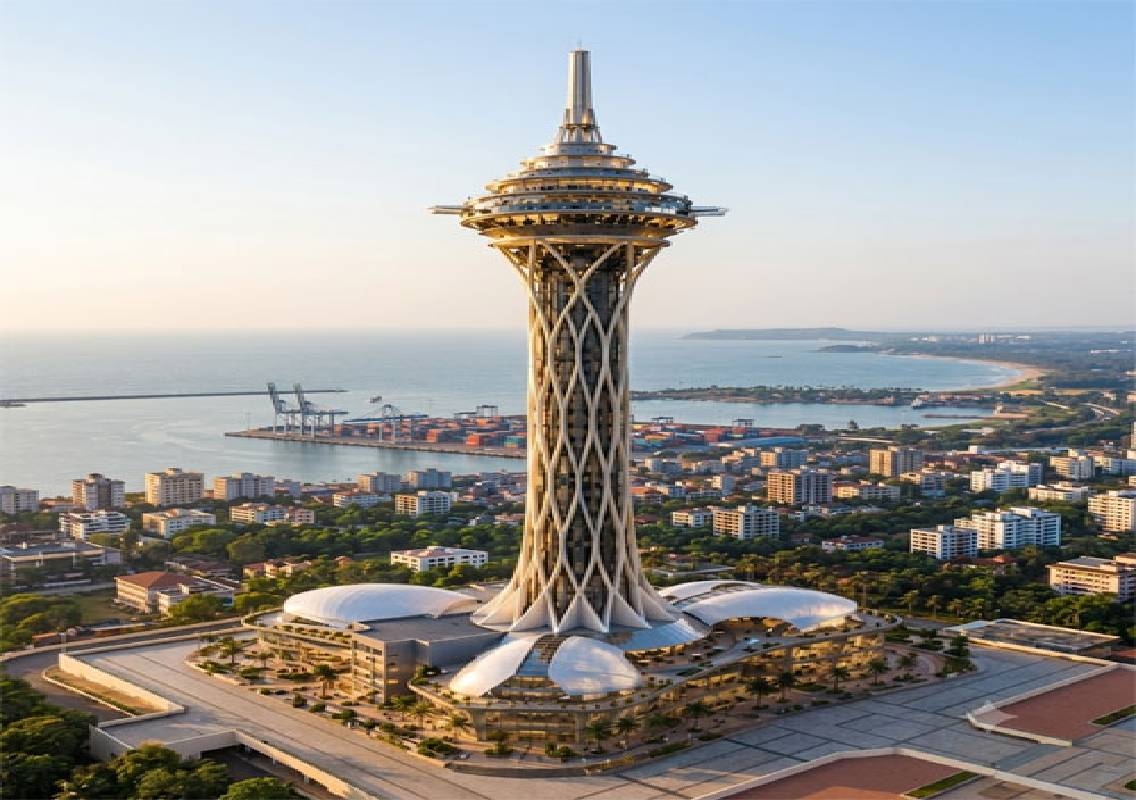


Mangaluru: The Karnataka Government has approved the proposed ‘Mangaluru Eye’, a 200-metre tower planned as a major tourism and commercial landmark in the coastal city. The project is part of the state’s wider coastal development package announced after the special Cabinet meeting held in Mangaluru on September 18.
The ambitious tower is proposed to be developed under the public-private partnership (PPP) model, with viability gap funding (VGF) support. The project is intended to strengthen Mangaluru’s tourism infrastructure while creating a new landmark offering panoramic views of the city and the surrounding coastal landscape.
The ‘Mangaluru Eye’ is planned to include three community halls, a revolving restaurant and a two-storey observation gallery. The gallery is expected to provide visitors with a 360-degree view of Mangaluru.
200-metre tower planned as tourism landmark
The proposed structure is expected to become one of the prominent additions to Mangaluru’s urban skyline. Unlike a conventional commercial building, the project has been conceived with tourism and visitor experience as important components.
The two-storey observation gallery is expected to be one of the major attractions, giving visitors an elevated view of Mangaluru. A revolving restaurant is also planned, adding a hospitality component to the tower.
Three community halls are part of the proposed complex, indicating that the development is intended to serve functions beyond tourism.
The Karnataka Government has approved the project as part of a larger effort to promote coastal tourism and attract private investment into the region.
PPP model with viability gap funding
The Mangaluru Eye will be developed under the PPP model, with the government proposing viability gap funding to support the project.
Under a PPP arrangement, the government and a private developer can share responsibilities for developing and operating infrastructure. Viability gap funding is generally used to support projects that have public or economic value but may require financial assistance to become commercially viable.
The proposed model is therefore aimed at combining government support with private-sector participation.
The Cabinet’s approval places the project within Karnataka’s broader strategy of using tourism infrastructure to attract investment and improve visitor facilities along the coast.
Part of Karnataka’s wider coastal tourism push
The Mangaluru Eye is not an isolated proposal. It forms part of a much larger package of coastal development initiatives approved at the special Cabinet meeting in Mangaluru.
The Cabinet cleared 61 proposals covering tourism, ports, healthcare, education, roads, water supply and other sectors. The overall coastal development package was reported at around ₹32,611 crore.
Tourism emerged as one of the central areas of focus. The government approved the Coastal-Malnad Karnataka Tourism Policy 2026, which aims to encourage investment and develop tourism infrastructure across the coastal and Malnad regions.
The policy proposes treating tourism projects as infrastructure projects, allowing investors to access incentives and longer loan repayment periods. The government has also discussed measures to facilitate tourism-oriented development along the coast.
Coastal islands to receive tourism infrastructure
The Cabinet also approved plans to develop 12 coastal islands across Dakshina Kannada, Udupi and Uttara Kannada.
The projects are proposed under the PPP model on a Design-Build-Finance-Operate-Transfer (DBFOT) basis, with a proposed lease period of 30 years, including the construction period, subject to statutory approvals.
In Dakshina Kannada, the northern and southern islands of the Gurpur river in Mangaluru taluk are among the locations identified for development. The estimated cost for the Gurpur River project has been put at around ₹125.43 crore.
Other coastal tourism locations, including areas around Mangaluru, Udupi and Uttara Kannada, have also been included in the wider package.
Ferry system and major port projects
The coastal development plan also includes infrastructure intended to improve connectivity.
The government has given in-principle approval for a 343-km coastal ferry system connecting 12 coastal centres. The proposal is aimed at strengthening water-based connectivity while also creating another tourism and transport option along the Karnataka coast.
A ₹6,925-crore multipurpose harbour and shipyard at Monkey Port in Uttara Kannada has also received approval under the PPP model.
The Cabinet has additionally approved the expansion of Karwar Airport, subject to clearance from the Indian Navy, with the proposed expansion intended to allow civilian aircraft operations involving larger aircraft such as the Airbus A320.
These projects indicate that the government’s coastal strategy extends beyond tourism to ports, aviation, maritime infrastructure and connectivity.
Mangaluru gets major infrastructure allocation
Mangaluru city itself is also set to receive additional infrastructure investment.
The Cabinet has sanctioned around ₹400 crore for roads and infrastructure in Mangaluru, alongside several tourism-related projects.
The wider package includes proposals involving the Lighthouse area, Gurupura River, Kodikal and Thannirbhavi, among other destinations. Water supply and urban infrastructure projects have also been included.
The government has said the overall objective is to position coastal Karnataka as a major tourism and blue-economy destination.
Fisheries and blue economy also in focus
The Cabinet decisions also place significant emphasis on fisheries and marine-related sectors.
The College of Fisheries, Mangaluru, is proposed to be upgraded into a Fisheries and Blue Economy University. Student intake is expected to increase from 60 to 200, with an allocation of ₹11.5 crore and plans to appoint a special officer for the transition.
The government has also directed the Electronics, IT and BT Department to prepare a blueprint for a Karnataka Institute of Marine Biotechnology and Blue Economy in Udupi district.
The combination of tourism, fisheries, maritime infrastructure and marine biotechnology forms part of the state’s broader blue-economy strategy for the coastal belt.
Healthcare projects included in coastal package
The Cabinet package also contains significant healthcare proposals.
In-principle approval has been given for units of Kidwai Memorial Institute of Oncology and Jayadeva Institute of Cardiovascular Sciences in Mangaluru. The government has also approved an additional 200 beds for Wenlock Hospital.
Infrastructure funding of around ₹425 crore has been approved for Puttur Medical College, covering buildings, hostels and quarters, according to reports.
These projects are intended to expand specialised healthcare capacity in coastal Karnataka and reduce the need for residents to travel to Bengaluru or other cities for certain advanced treatments.
What the Mangaluru Eye could mean for tourism
The proposed tower could add a new dimension to Mangaluru’s tourism infrastructure by creating a dedicated high-rise attraction rather than relying primarily on beaches, religious sites, heritage locations and natural destinations.
The observation gallery could offer visitors an elevated perspective of the city, while the revolving restaurant could become a hospitality attraction in its own right.
However, the project’s eventual tourism and commercial impact will depend on factors such as construction, investment, statutory clearances, operational planning and visitor accessibility.
The government has so far announced the approval and proposed PPP structure. Further details regarding the project’s construction timeline, private partner, final design, investment structure and opening date will be important as the proposal progresses.
Mangaluru gets a new proposed landmark
The approval of the 200-metre Mangaluru Eye places the proposed tower among the most visible projects in Karnataka’s latest coastal development push.
With an observation gallery, revolving restaurant and community halls, the project combines tourism, hospitality and commercial functions. Its PPP structure and proposed viability gap funding are intended to facilitate private participation.
For Mangaluru, the project could eventually add a distinctive landmark to the city’s tourism landscape. But the next stage will be implementation, including project structuring, clearances, investment and construction.
For now, the Cabinet approval marks the beginning of a proposed development that the state government hopes will contribute to Mangaluru’s ambitions as a major coastal tourism destination.