







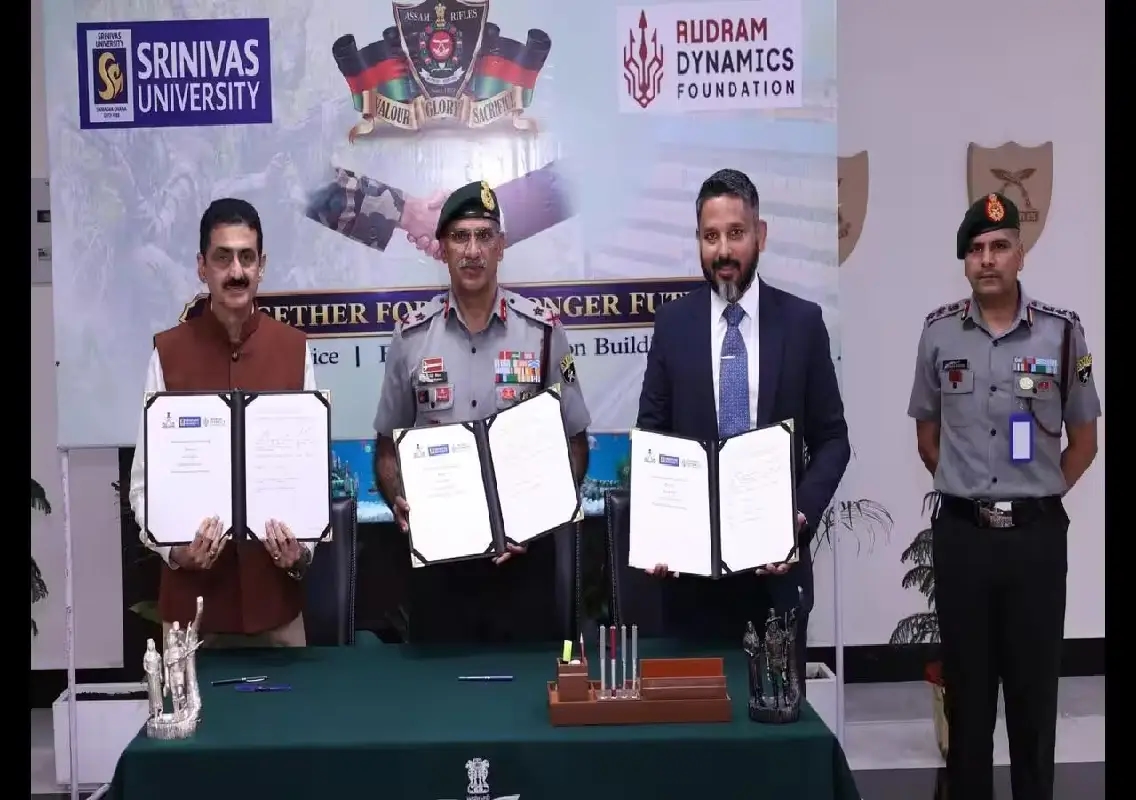


Mangaluru: Students and faculty members from Srinivas University in Mangaluru will collaborate with Assam Rifles and Rudram Dynamics Foundation to develop practical technological solutions for challenges faced by security personnel in difficult field conditions.
The initiative aims to turn innovative ideas and improvised solutions developed by soldiers into functional prototypes through academic research, engineering expertise and industry collaboration. The three organisations recently signed a memorandum of understanding (MoU) at the headquarters of the Directorate General of Assam Rifles in Shillong to strengthen cooperation in academics, research, innovation and training.
Under the partnership, Assam Rifles will identify operational challenges encountered by its personnel, while students and faculty members from Srinivas University, working with Rudram Dynamics Foundation, will develop and refine possible solutions. The prototypes will be tested and improved based on feedback from the personnel expected to use them.
The collaboration is expected to give students in Mangaluru an opportunity to apply their technical knowledge to real-world problems while helping security forces explore practical innovations.
Turning soldiers’ ideas into practical solutions
Soldiers stationed at remote locations often face challenges that require immediate and resourceful solutions. In difficult terrain and demanding operational environments, personnel may devise improvised methods to address equipment-related or other practical problems.
However, such solutions may require further engineering, testing and refinement before they can be developed into reliable products for wider use.
Konark Rai, managing director of Rudram Dynamics Foundation, said the partnership seeks to bridge this gap by combining the operational experience of security personnel with academic research and industry capabilities.
Technologies such as additive manufacturing and laser cutting will be used to convert ideas into functional prototypes. These prototypes can subsequently be tested under relevant conditions, with improvements made based on feedback from the intended users.
The approach is intended to ensure that product development begins with clearly identified operational needs rather than relying solely on ideas generated in classrooms or laboratories.
By involving soldiers in the development and testing process, the partners hope to create solutions that address practical requirements and can potentially be developed further for field applications.
Bridging the gap between research and end-users
Kritika, research associate at Rudram Dynamics Foundation, highlighted the disconnect that can sometimes arise between academic product development and the needs of end-users.
She said students may develop products without fully understanding the requirements of personnel working on the ground. The collaboration seeks to bring researchers and developers closer to the people who will ultimately use their innovations.
The initiative will connect academic research, industry expertise and the operational experience of security forces. This arrangement is expected to help students identify relevant problems, understand the constraints faced by personnel and develop solutions that are practical to implement.
For Srinivas University, the partnership also provides an opportunity to expand experiential learning by exposing students to challenges beyond conventional academic projects.
Rather than limiting their work to classroom assignments, laboratory exercises or competitions, students will be encouraged to explore how their ideas can be adapted for practical use.
The process of developing prototypes, testing them and incorporating feedback could also help students understand the requirements involved in taking an idea from the conceptual stage towards a usable product.
Internship opportunities for students
The MoU also envisages internship opportunities for students from different academic disciplines.
The partner organisations are exploring arrangements under which students could spend one or two months understanding field conditions and identifying problems that might benefit from technological interventions.
Such exposure would allow students to gain a better understanding of the operational environment in which their proposed solutions could be used.
Direct interaction with personnel would also help students assess whether their ideas address genuine requirements and whether the proposed technologies are suitable for the conditions involved.
The internships could bring together students with different specialisations, encouraging interdisciplinary approaches to problem-solving. Engineering students, researchers and those with expertise in emerging technologies could contribute different perspectives to the development process.
The partners intend to use this engagement to strengthen the connection between academic learning and practical innovation, while giving students experience in working on challenges identified by an operational organisation.
Training in emerging technologies
Beyond prototype development, the collaboration will focus on training and upskilling Assam Rifles personnel in emerging technologies.
Areas under consideration include cybersecurity, data analytics, drone technology and geographic information systems (GIS).
These fields have applications across a range of activities, including information management, digital security, mapping and technology-assisted operations. Training initiatives in these areas could help personnel build familiarity with evolving technological tools and their potential uses.
The proposed cooperation will combine the university’s academic resources with the foundation’s role in connecting innovation to practical requirements.
The specific training programmes and implementation arrangements are expected to develop through the partnership.
Opportunities for innovation beyond major institutions
Shrinivasa Mayya D, registrar (evaluation) of Srinivas University, said the initiative could help students take their projects beyond competitions and classroom assignments towards practical applications and potential startups.
The partnership is also expected to highlight the contribution that students from tier-II and tier-III cities can make to research and innovation.
Kritika noted that considerable talent exists in colleges outside the country’s most prominent institutions, with fresh ideas emerging from smaller cities as well.
For students in Mangaluru, the initiative offers a chance to work on challenges faced by security personnel and explore how their technical skills can be applied to meet operational requirements.
The collaboration could also help identify ideas with potential for further product development, subject to testing, evaluation and the requirements of the end-users.
Connecting academic talent with field requirements
The partnership between Assam Rifles, Srinivas University and Rudram Dynamics Foundation establishes a framework for cooperation between security forces, academia and industry.
By identifying problems from field conditions and involving students in developing and testing solutions, the initiative seeks to make innovation more responsive to practical needs.
Its success will depend on the ability to translate identified challenges into workable prototypes, incorporate feedback from personnel and determine which solutions are suitable for further development.
For Mangaluru’s academic community, the initiative creates an opportunity to contribute to applied research while giving students exposure to real-world problem-solving. For Assam Rifles, it offers a structured way to explore engineering support for ideas that emerge from the experience of personnel working in demanding environments.