







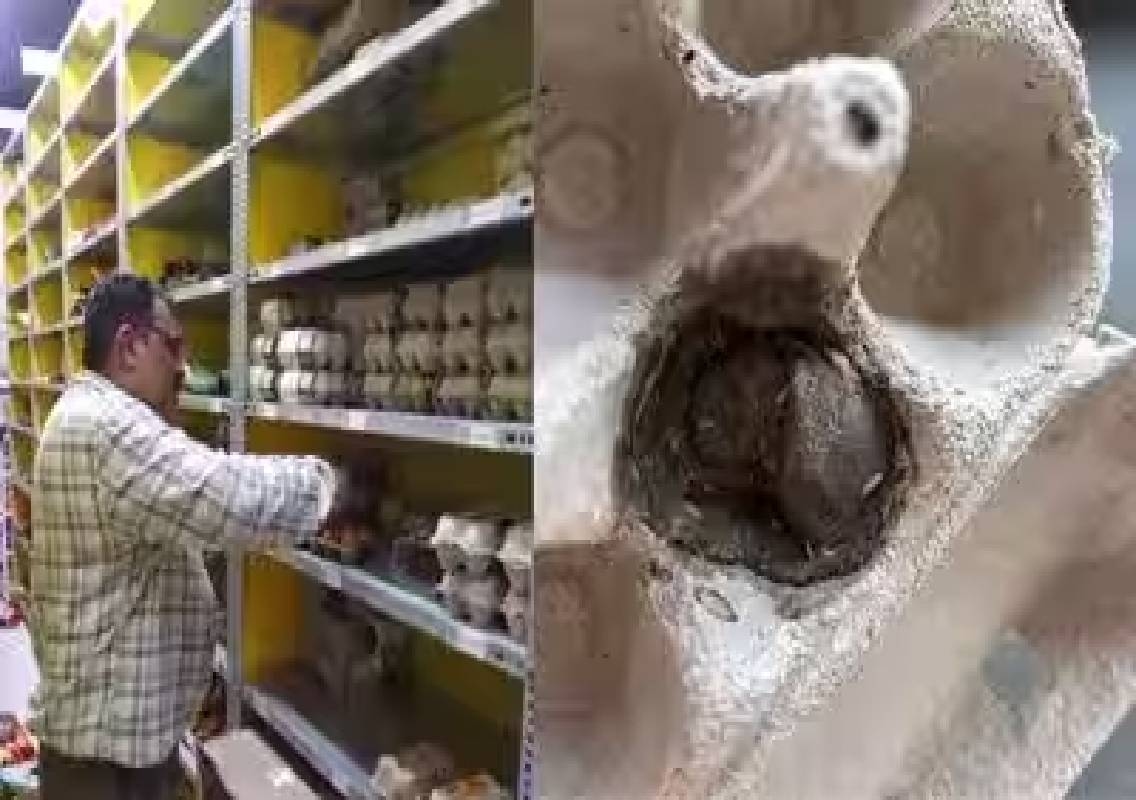


Mangaluru: A complaint from a customer who reportedly found a worm inside an egg delivered through a quick-commerce platform has prompted a food safety inspection at a retail facility in Mangaluru. Following the complaint, officials inspected the facility from where the egg was reportedly sourced and temporarily sealed its storage room as part of the investigation.
The incident has brought attention to food safety checks in the rapidly expanding quick-commerce sector, where eggs, dairy products, meat and other perishable items are delivered to consumers within a short period.
According to the report, the complaint was made after the customer discovered the worm inside an egg that had been purchased online. The food safety authorities subsequently traced the product to the quick-commerce facility and carried out an inspection.
Complaint triggers immediate inspection
The discovery of the worm in the egg led the authorities to examine the facility from which the product had originated.
Food safety officials inspected the premises to assess the storage and handling conditions of the products kept there. As a precautionary measure, the storage room was temporarily sealed following the inspection.
The action is significant because eggs and other perishable food products require appropriate storage and handling conditions to maintain their quality and safety. Quick-commerce warehouses and dark stores typically hold products for short periods before they are dispatched to customers, making proper inventory management and storage an important part of food safety compliance.
The inspection will help authorities determine whether there were any lapses in the handling or storage of the affected product.
Storage room temporarily sealed
Officials sealed the storage room at the facility following the inspection, according to the Times of India report.
The precautionary action is intended to prevent potentially affected products from being distributed while officials examine the circumstances surrounding the complaint.
The sealing of the facility’s storage area does not by itself establish that all products stored there were contaminated or unsafe. The exact cause of the reported problem will have to be established through the food safety investigation.
Officials are expected to examine the source of the eggs, their storage conditions and the manner in which the products were handled before being delivered to customers.
Quick-commerce food safety under scrutiny
The incident comes as quick-commerce services have become an increasingly common way for consumers to purchase groceries and other everyday food products.
Unlike traditional supermarkets, quick-commerce facilities are primarily designed for online order fulfilment. Customers generally do not see the storage conditions or inspect products before placing an order.
This makes food safety compliance at warehouses and fulfilment centres particularly important. Products such as eggs can be vulnerable to quality issues if they are not properly stored, handled or transported.
The Mangaluru incident highlights the importance of maintaining proper food safety protocols throughout the supply chain, from procurement and storage to packing and delivery.
Authorities examine source of egg
The food safety investigation is expected to focus on how the affected egg reached the customer.
Since the product was reportedly purchased through a quick-commerce platform, officials inspected the facility where the egg was stored before delivery. The investigation could help determine whether the issue was associated with the product before it reached the facility or whether any handling or storage-related factor contributed to the reported condition.
Establishing the source and condition of the egg is important before drawing conclusions about the broader safety of products sold through the facility.
The authorities’ inspection is therefore likely to form part of a wider assessment of compliance with food safety requirements.
Importance of proper handling of eggs
Eggs are commonly consumed in households and are widely sold through both physical retail outlets and online grocery platforms.
Proper handling is important to prevent food quality and safety concerns. Retailers and delivery platforms are expected to maintain appropriate conditions and ensure that products reaching consumers meet applicable food safety requirements.
For consumers, the incident also underlines the importance of checking food products after delivery. Customers who notice unusual appearances, odours, damaged packaging or other concerns can report them to the retailer or the relevant food safety authorities.
In the Mangaluru case, the customer’s complaint resulted in an official inspection, demonstrating the role consumer complaints can play in identifying potential food safety concerns.
Investigation will determine further action
The temporary sealing of the storage room allows authorities to examine the facility while preventing further distribution from the affected storage area.
Further action will depend on the findings of the inspection and any subsequent investigation. If officials identify violations of food safety requirements, appropriate regulatory measures may follow.
At present, the reported discovery of a worm in a single egg should not automatically be interpreted as evidence that all eggs or other food products handled by the facility were unsafe.
The investigation will be important in determining the circumstances of the incident and whether any systemic food safety lapse occurred.
Focus on consumer safety
The Mangaluru incident highlights a growing challenge for the food retail sector as consumers increasingly rely on quick-commerce platforms for groceries and other perishable products.
Speed of delivery is a key feature of the sector, but it cannot come at the expense of food safety. Retailers and delivery platforms must ensure that products are appropriately sourced, stored and handled before they reach consumers.
The inspection following the customer’s complaint is expected to provide authorities with more information about the condition of the facility and the handling of the affected eggs.
For now, the storage room remains the focus of the food safety action, while authorities investigate the reported discovery. The incident serves as a reminder that strong food safety monitoring is essential as online grocery delivery becomes an increasingly important part of urban food retail.