









Mysuru: Opposition to the proposed Dasara Kambala has intensified, with more than 400 activists from farmers’ organisations, environmental groups, Dalit organisations, Kannada groups and progressive organisations staging a protest at the Kambala venue in Sathagalli on October 6.
The protesters demanded that the Karnataka Government cancel the two-day buffalo race scheduled for October 18 and 19, citing drought, water scarcity and environmental concerns. They carried black flags, wore black bands and displayed empty pots and brass pitchers to highlight what they described as the prevailing water crisis.
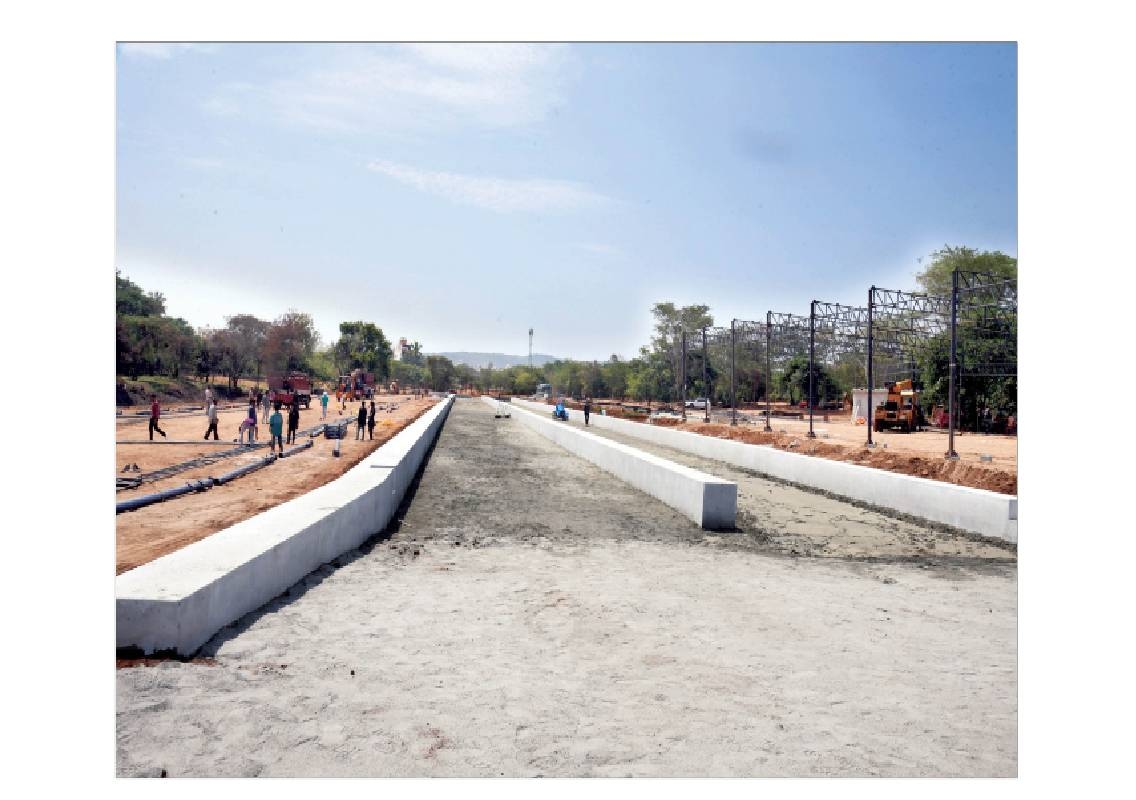
The protest came as preparations for the event continued at the Mysuru Development Authority (MDA) grounds near the VTU Regional Centre on the Outer Ring Road, where the racing tracks named ‘Vijaya’ and ‘Dashami’ are being prepared.
Protesters cite drought and water scarcity
The protesters argued that organising Kambala in Mysuru during a drought was inappropriate when several parts of the State were facing water shortages.
They raised slogans including “No Kambala in drought”, “No Kambala when drinking water is scarce” and “No Kambala when crops are drying”.
The groups also criticised the proposed use of water for preparing the Kambala racing tracks. They demanded greater protection for lakes, tanks, forests, hills, birds and animals and questioned the environmental impact of preparations at the venue.
The protesters also argued that public funds should instead be directed towards drought relief and support for farmers affected by water and fodder shortages.
More than 400 activists participate
More than 400 people participated in the protest, representing several organisations.
Those present included members of farmers’ organisations, Dalit Sangharsha Samiti, Parisarakkaagi Naavu, Kannada organisations and other progressive groups.
The protest was held under tight police security, with four units of the District Armed Reserve deployed at the venue.
Parisarakkaagi Naavu General Secretary Parashuramegowda addressed the protesters and said the organisation opposed the Kambala event particularly because of the drought situation.
He argued that environmental protection should take priority and questioned the need to bring large numbers of buffaloes, handlers and spectators from coastal Karnataka for the event while drought conditions were prevailing in several parts of Karnataka. These were the protesters’ views and have not been independently established as government findings.
Protesters allege tree cutting at venue
Environmental concerns were also raised over the preparation of the Kambala venue.
Parashuramegowda alleged that more than 50 large trees and hundreds of smaller saplings had been cut at the venue to facilitate construction of the racing track.
The protesters said the preparation of the site had raised questions about the ecological impact of the event and called for protection of vegetation and water bodies around the area.
The allegation regarding the number of trees and saplings cut was made by the protesters and should be distinguished from independently verified figures.
The groups also questioned the spending involved in organising the event, arguing that resources could instead be used to assist farmers and address water-related problems.
October 12 deadline set for cancellation
The opposition has now acquired a further political and organisational dimension.
According to separate coverage of the protest, the organisations have given the State Government October 12 as a deadline to withdraw the decision to conduct Kambala during Dasara.
The protesters have said they will intensify their agitation if the event is not cancelled by the deadline. An 18-member committee has reportedly been formed under the leadership of former MLA and Parisarakkaagi Naavu State president A.T. Ramaswamy to decide the next course of action.
The groups are also planning to submit a memorandum to Chief Minister D.K. Shivakumar through the Deputy Commissioner.
Kambala preparations continue
Despite the protests, preparations for the event are continuing at the Sathagalli venue.
The racing tracks, named ‘Vijaya’ and ‘Dashami’, are under preparation and a large spectators’ gallery is being constructed at the site.
The proposed Kambala is part of this year’s Mysuru Dasara programme and is intended to bring the traditional coastal Karnataka buffalo race to the Dasara celebrations.
The inclusion of Kambala has itself generated debate, with opponents questioning whether a sport strongly associated with the coastal districts should be introduced as a major attraction during Mysuru’s traditional festival.
Supporters reject environmental criticism
The opposition to Kambala has also been challenged by groups supporting the event.
Members of the Dalit Mahasabha staged a separate protest in Mysuru, rejecting the argument that organising Kambala would necessarily harm the environment. They called for the event to be conducted on a grand scale and described Kambala as a traditional sport associated with Karnataka’s cultural heritage.
The contrasting protests indicate that the debate is not simply about the use of water but also concerns the cultural place of Kambala within the Mysuru Dasara programme.
Debate over cost and priorities
The protesters have questioned the expenditure involved in staging the event at a time when farmers are facing difficulties related to drought, water and fodder.
They argued that government spending should prioritise drought-hit communities and agricultural needs.
Earlier reports have also highlighted the expenditure associated with adding Kambala to this year’s Dasara programme. However, the exact amount spent and the quantity of water that will ultimately be used for the event should be based on official figures rather than estimates made during protests.
The debate therefore involves both immediate resource concerns and a wider question about government priorities during a drought.
Drought remains central to opposition
The drought argument remains the central point raised by groups opposing the event.
The protesters referred to the large number of drought-hit taluks in Karnataka and argued that water-intensive preparations for a sporting event were inappropriate under the circumstances.
They also pointed to the condition of farmers and livestock, saying that water and fodder availability should receive priority.
The government has not, based on the reports reviewed, announced cancellation of the event. Preparations are continuing while the opposition groups are seeking a withdrawal of the decision.
Government faces competing demands
The controversy places the State Government between competing demands.
On one side are organisations seeking cancellation on environmental and drought-related grounds. On the other are groups supporting Kambala as a cultural and sporting event and calling for its inclusion in the Dasara programme.
The October 12 deadline set by the protesting organisations could become an important point in the dispute, particularly if preparations continue without any change in the government’s position.
For now, the proposed October 18-19 event remains part of the Dasara programme, while activists have indicated that their campaign will intensify if their demand is not accepted.
Conclusion
More than 400 activists protested in Mysuru against the proposed Dasara Kambala, demanding its cancellation over drought, water scarcity and environmental concerns.
The protesters displayed empty pots and black flags at the Sathagalli venue and criticised the use of resources for the event while farmers and residents face water-related difficulties. They have set October 12 as a deadline for the government to withdraw the decision and have warned of intensified protests.
Meanwhile, preparations for the October 18-19 Kambala continue, and supporters have rejected the environmental objections raised by the protesters.