







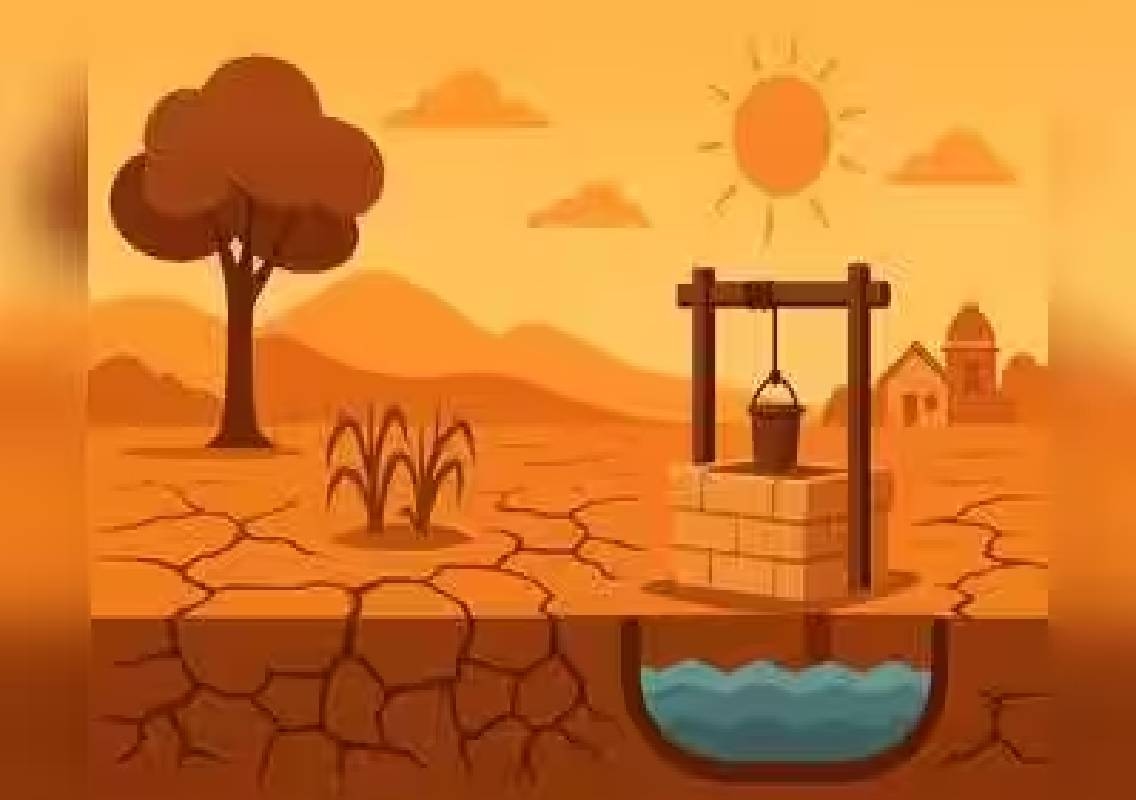


Mysuru: A sharp fall in the groundwater table following a weak monsoon has left thousands of farmers in distress across Mysuru district, with borewells yielding less water and irrigation costs rising.
Data from the Groundwater Directorate cited by The Times of India shows that the groundwater level in the district had fallen to 13.4 metres below ground level (mbgl), or nearly 44 feet, by the end of August. During the corresponding period last year, the level was recorded at 8.4 metres below ground level.
The decline of about five metres has affected farmers who depend heavily on borewells and irrigation pump sets for cultivating crops such as sugarcane, vegetables, ginger, tobacco and paddy.
Mysuru records 59% rainfall deficit
The sharp decline in groundwater levels has been linked to the rainfall deficit recorded during the crucial agricultural season.
According to the Agriculture Department, Mysuru district recorded a 59% rainfall deficit between June 1 and September 15. Against the normal rainfall of around 350 mm during the crucial kharif period, the district received only 144 mm.
The shortage has reduced natural groundwater recharge and placed additional pressure on borewells used for irrigation. Farmers who depend almost entirely on groundwater are now facing uncertainty over the availability of water for standing crops.
The situation is particularly concerning in areas where agriculture is heavily dependent on irrigation rather than rainfall.
Borewells begin yielding less water
Mysuru district has a large network of borewells and irrigation pump sets.
According to the data cited in the report, the district has 17,157 domestic borewells and 43,757 irrigation pump-set connections.
With the groundwater table receding, several borewells have either stopped yielding water or are producing significantly less than before. This has raised concerns about reduced crop yields and possible crop losses during the current agricultural season.
Farmers who invested in borewells expecting a reliable source of irrigation are now facing additional expenditure to maintain water supply.
Irrigation costs rise as groundwater recedes
A lower groundwater table means farmers need to pump water from greater depths. This increases electricity consumption and can require the installation of higher-capacity pumps.
Farmers may also have to spend money on deepening existing borewells, adding another financial burden at a time when crop prospects remain uncertain.
Small and marginal farmers are particularly vulnerable because many may not have the financial capacity to deepen borewells or purchase more powerful pumps.
Those who received borewells under government schemes such as the Ganga Kalyana Scheme are also among the affected farmers, according to the report.
Farmers raise concerns over power supply
The groundwater crisis has also coincided with concerns over electricity supply for irrigation.
Farmers have alleged that erratic power supply from Chamundeshwari Electricity Supply Corporation (CESC) during the past month has affected their ability to operate irrigation pump sets.
The government has promised seven hours of uninterrupted three-phase electricity supply for irrigation pump sets. However, farmers cited in the report said they were not consistently receiving the assured supply.
For farmers dependent on borewells, electricity availability is directly linked to their ability to draw the increasingly deeper groundwater needed to sustain crops.
Sugarcane and vegetable growers among those affected
A significant number of farmers in Mysuru depend on irrigation for crops including sugarcane, vegetables, ginger and tobacco.
Some farmers also grow paddy using borewell irrigation.
As groundwater levels fall, farmers cultivating water-intensive crops face additional pressure because insufficient irrigation at critical stages can reduce yields and affect crop quality.
The combination of poor rainfall, declining borewell output, higher electricity consumption and rising cultivation costs is therefore creating multiple challenges for the farming community.
Farmers face a difficult cycle
Farmer Mahadevaiah, quoted by The Times of India, said falling groundwater levels require farmers to use more powerful pumps and consume more electricity to draw water.
He also pointed to the problem of borewell concentration in certain areas. When several farmers depend on groundwater in the same locality, continued extraction can put further pressure on the underground water resource.
This creates a difficult cycle for farmers: falling water levels require deeper extraction, deeper extraction requires more powerful equipment and electricity, and the resulting higher costs add to the financial pressure on cultivation.
Groundwater Directorate links decline to weak monsoon
Senior geologist Prasannakumar of the Groundwater Directorate told The Times of India that the groundwater table had declined to 13.4 metres below ground level because of the weak monsoon.
He also linked the weak monsoon to the El Niño effect and said the decline had significantly affected farmers dependent on irrigation pump sets across Mysuru district.
The groundwater figures underline the impact of deficient rainfall beyond the immediate absence of rain. When rainfall is insufficient during the monsoon, recharge of underground water sources can fall, increasing dependence on existing borewells.
Wider concerns over water and power
The situation in Mysuru comes amid broader concerns over water availability and agricultural losses in Karnataka following deficient rainfall.
Karnataka Chief Minister D.K. Shivakumar had earlier warned that declining groundwater levels and inadequate rainfall could contribute to water and power shortages, while also pointing to extensive crop losses across the State.
For agricultural districts such as Mysuru, the groundwater situation has implications not only for individual farmers but also for crop production and rural livelihoods.
Rainfall remains crucial for recovery
A sustained improvement in groundwater levels will depend partly on rainfall and natural recharge, particularly as farmers continue drawing water for irrigation.
The immediate concern for farmers is the availability of sufficient water to protect existing crops. A further decline in borewell output could increase cultivation costs and reduce yields.
For small and marginal farmers, the additional expense of deepening borewells or installing higher-capacity pumps may be particularly difficult to absorb.
The fall from 8.4 metres below ground level last year to 13.4 metres this year highlights the scale of the change in Mysuru’s groundwater situation.
With rainfall significantly below normal during the crucial kharif period, farmers now face the combined challenge of protecting their crops while managing higher irrigation costs and declining groundwater availability.