







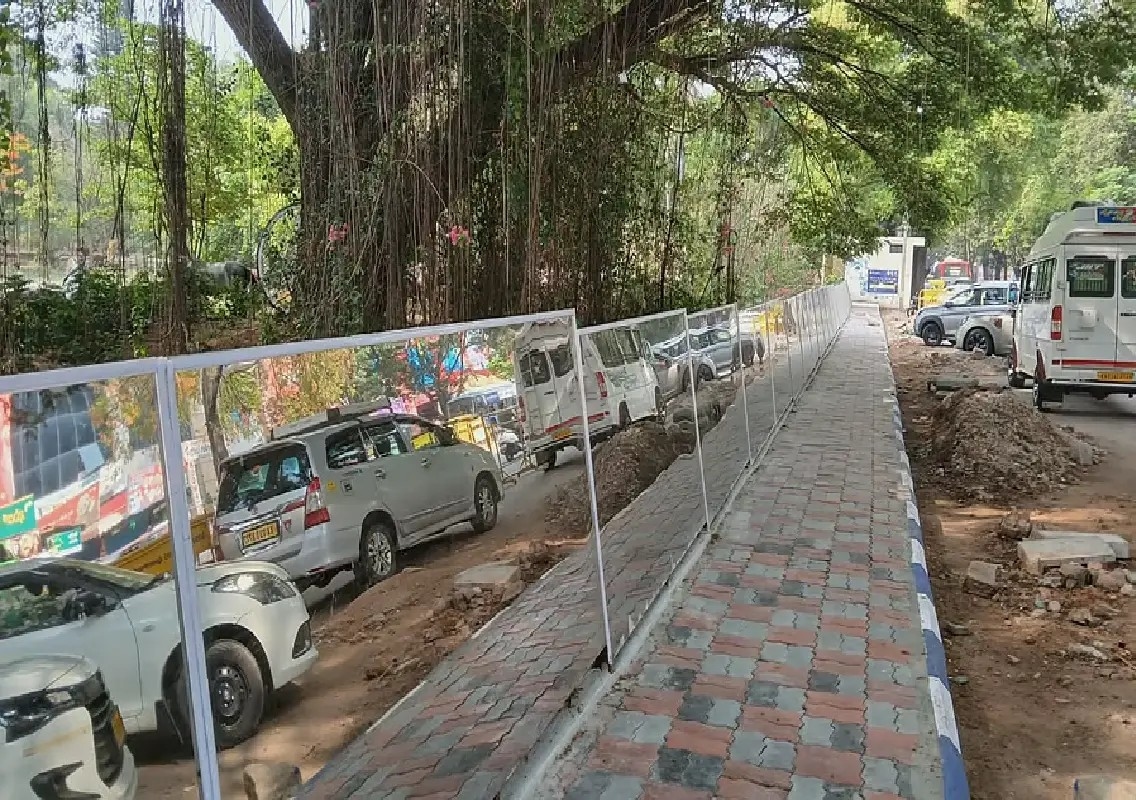


While some residents have described the initiative by the Mysuru City Corporation (MCC) as an innovative method to discourage public urination, others believe it merely offers a temporary solution to a much deeper urban infrastructure problem.
The mirrors were installed along a wall near the busy suburban bus stand where people had reportedly been urinating openly for years, causing foul smell and inconvenience to commuters, shopkeepers, and visitors arriving in the city.
Residents pointed out that despite Mysuru being one of Karnataka’s major tourist destinations, the city has only 78 public toilets serving a population of more than 15 lakh people along with thousands of daily visitors.
Residents highlight lack of civic sense
Local shopkeeper Manohar, whose establishment is located behind the wall where the mirrors have been installed, said the issue has persisted for nearly three decades.
According to him, passengers arriving at the bus stand are immediately greeted by the unpleasant stench of urine, creating a poor first impression of Mysuru, which is internationally known as a heritage and tourism city.
Several residents argued that the issue reflects not only inadequate public infrastructure but also the failure to instil basic civic responsibility among citizens.
Fruit juice vendor Samsher said that despite the availability of toilets nearby, many people continue to urinate in public spaces to avoid paying nominal usage charges.
He pointed out that there are two toilets close to the mirror installation area, including a newly built washroom. However, many people still choose to use the wall instead of the facilities.
Auto driver Naveen Kumar echoed similar concerns and stated that at least four toilets are available within walking distance of the bus stand, yet open urination continues, particularly among men.
Citizens said such behaviour undermines cleanliness campaigns and damages the city’s image among tourists and visitors.
Concerns raised over poor toilet maintenance
While many blamed the public for lacking civic sense, others argued that poor maintenance of public toilets is equally responsible for the issue.
V S Jagadish, a lecturer from Mandya who commutes daily through Mysuru, criticised the condition of toilets at the KSRTC Suburban Bus Stand.
He said many public toilets remain unhygienic despite users paying charges for usage. According to him, the authorities responsible for transport and bus stand management should personally inspect the facilities to understand the poor conditions faced by commuters.
Jagadish stated that if authorities provide more clean and accessible toilets, especially considering Mysuru’s high floating population, people may gradually stop resorting to public urination.
Auto driver Nandish highlighted another practical problem faced by drivers and commuters — the lack of parking near public washrooms.
He said many drivers avoid using toilets because parking vehicles near such facilities often results in traffic fines issued by police authorities.
Nandish also pointed out that several Swachh Bharat Mission toilets in the city operate under the Public-Private Partnership (PPP) model, where maintenance standards vary depending on water supply and management quality.
According to him, inadequate water supply frequently makes the facilities unusable, forcing commuters to delay using washrooms for long periods.
Limited night access adds to commuter difficulties
Another concern raised by residents and transport workers relates to the operating hours of public toilets in the city.
Auto driver Mahadeva said that toilets inside the KSRTC Suburban Bus Stand remain accessible throughout the day and night, but many other public toilets in the city close by 9 pm.
He said travellers arriving late at night often struggle to find accessible washrooms, especially near transport hubs and commercial areas.
Fruit seller Ramesh, referring to a Swachh Bharat Mission toilet on Chandrashekar Road in Mandi Mohalla, said maintenance quality changes frequently depending on the contractor managing the facility.
According to him, the toilets are currently cleaned only twice a day, resulting in unhygienic conditions during peak usage hours.
Mirrors reduce urination but larger issues remain
Despite the criticism, residents acknowledged that the mirror installation has shown visible results.
Samsher claimed that public urination near the wall has reduced by nearly 90 per cent after the mirrors were installed, as people feel embarrassed seeing their own reflections while attempting to urinate.
However, he pointed out that similar problems continue across many other walls and public spaces in Mysuru.
Residents argued that the civic body cannot rely on mirrors alone to solve the issue and must instead focus on building adequate, clean, and accessible public toilets across the city.
Several citizens also demanded stricter enforcement and heavier penalties for public urination to improve civic discipline until awareness and education create long-term behavioural change.
The debate has once again highlighted the growing need for improved sanitation infrastructure and stronger civic awareness in Mysuru as the city continues to attract large numbers of tourists and daily commuters.