







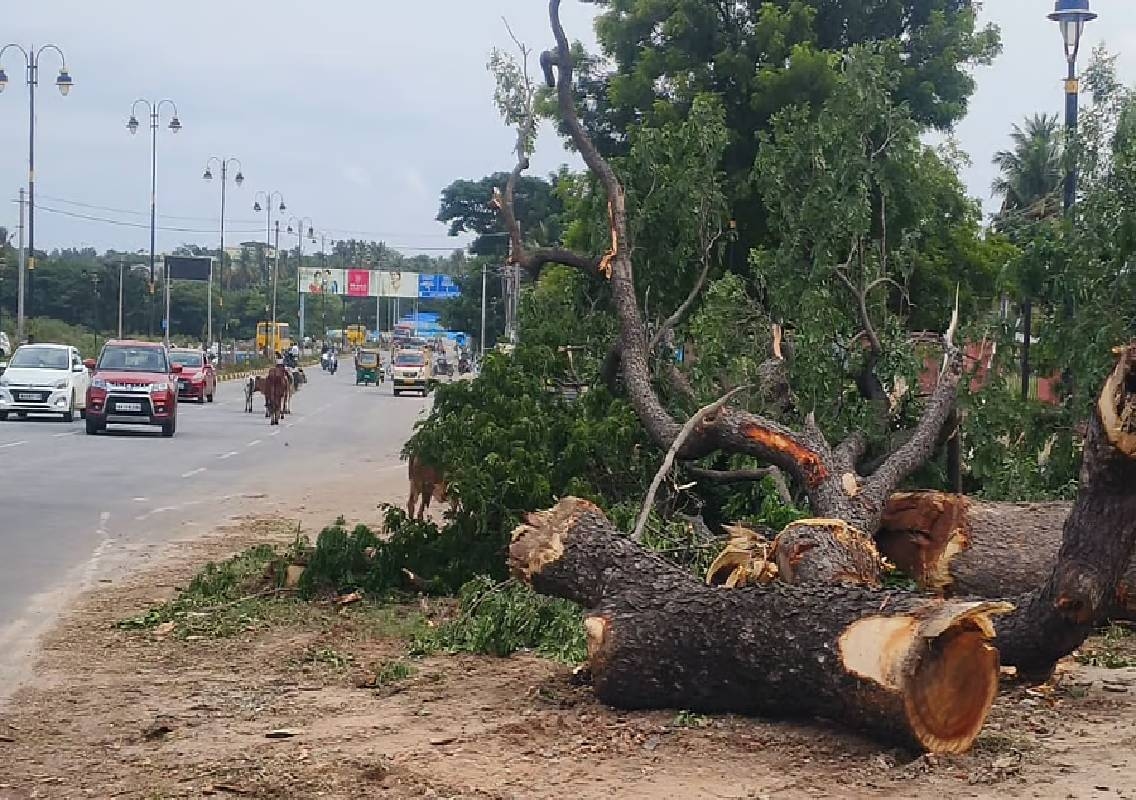


Mysuru: The National Highways Authority of India (NHAI) has begun clearing trees at a key junction connecting the Bengaluru-Mysuru Highway and the Outer Ring Road in Mysuru, paving the way for a major grade separator project aimed at easing traffic congestion. The move has renewed attention on the environmental cost of infrastructure development in the city, with hundreds of trees identified for removal for various highway and road projects.
The work is linked to a ₹63.67-crore flyover and underpass project planned at the junction of the Mysuru-Bengaluru Highway, or NH-275, and the Outer Ring Road. The junction is an important traffic point for vehicles travelling between Bengaluru, Mysuru and other parts of the city. (Facebook)
The commencement of tree clearing marks a significant step towards the execution of the project. However, the move is also expected to draw scrutiny from environmentalists and residents concerned about the loss of mature trees in Mysuru.
NHAI starts clearing trees at key junction
The tree-clearing activity has begun at the junction where the Bengaluru-Mysuru Highway meets Mysuru’s Outer Ring Road. The location experiences considerable traffic movement and has been identified for infrastructure improvements intended to separate traffic flows and reduce congestion.
The proposed project includes a flyover and an underpass, with an estimated cost of ₹63.67 crore. The infrastructure is expected to improve the movement of vehicles through the junction by allowing traffic to pass with fewer interruptions.
For motorists, the junction is important because NH-275 connects Bengaluru with Mysuru and continues towards parts of coastal and southern Karnataka. The highway has become a major inter-city route following its development as an access-controlled corridor between Bengaluru and Mysuru.
The grade separator project is therefore being viewed as an infrastructure measure intended to address traffic pressure at an increasingly busy urban junction.
Project requires removal of trees
The infrastructure work requires trees to be removed from portions of the project area. The tree-clearing activity has raised concerns because Mysuru is known for its extensive green cover and tree-lined roads.
Earlier, NHAI had sought permission to remove 561 trees in Mysuru for several infrastructure projects. The proposals covered the Bengaluru-Mysuru highway, Nanjangud road and the T. Narasipur road corridor.
Of the 561 trees identified in those proposals, 350 trees were associated with works along the NH-275 corridor and the flyover project around the old tollgate and other junction areas.
The proposed removal included trees in and around Bannimantap Park, stretches towards Fountain Circle, the Outer Ring Road and roads leading towards Hunsur and Mahadevapura.
The Forest Department had earlier invited objections from the public before taking a final decision under the Karnataka Tree Preservation Act.
Earlier proposal covered 350 trees
The earlier tree-removal proposal for the NH-275-related works covered several locations in Mysuru.
According to details reported in May, the proposal included 19 trees along the Siddiquinagar-Fountain Circle stretch, 256 trees and saplings within Bannimantap Park, 52 trees along the Outer Ring Road divider towards Hunsur and 20 trees along the Ring Road towards Mahadevapura.
Among the trees identified for removal were three sandalwood trees, while the remaining trees belonged to various other species.
The proposal had triggered concerns among environmental groups and residents, who questioned whether alternative engineering solutions could reduce the number of trees that need to be removed.
The debate reflects a wider challenge faced by growing cities such as Mysuru, where road infrastructure has to expand to accommodate increasing traffic while preserving established green spaces.
Environmentalists prepare response
The latest tree-clearing activity is likely to intensify the environmental debate surrounding the project.
Environmentalists had earlier indicated that they would discuss their response after permission was granted to clear trees for the Bengaluru-Mysuru Expressway and related works.
The concern is not limited to the number of trees being removed. Environmental campaigners have also questioned the ecological value of mature trees, arguing that replacement saplings cannot immediately provide the same shade, carbon absorption, habitat and environmental benefits as established trees.
Mysuru’s reputation as a green city has made tree-felling for road projects a particularly sensitive issue.
At the same time, authorities have maintained that infrastructure projects are necessary to improve road safety and traffic movement as the city grows.
₹63.67-crore grade separator project
The proposed grade separator at the Bengaluru-Mysuru Highway and Outer Ring Road junction has an estimated cost of ₹63.67 crore. The project is intended to improve traffic flow at the intersection by providing grade-separated movement.
A flyover can allow through traffic to bypass the signalised junction, while an underpass can provide an alternative movement for vehicles travelling in another direction.
Such infrastructure is increasingly being used at major junctions where traffic volumes have grown beyond the capacity of conventional intersections.
For Mysuru, the project is particularly relevant because the city has experienced increased traffic on major radial roads and ring-road connections. The Bengaluru-Mysuru highway has also increased the volume of vehicles entering and leaving the city.
The effectiveness of the project will ultimately depend on its design, execution and integration with the existing road network.
Bengaluru-Mysuru Highway has transformed regional connectivity
The Bengaluru-Mysuru corridor has undergone major infrastructure development in recent years.
NH-275’s Bengaluru-Mysuru section was upgraded into an access-controlled highway, significantly improving connectivity between the two cities. The corridor has reduced travel time and become one of Karnataka’s most important inter-city road links.
The highway connects Bengaluru with Kengeri, Bidadi, Ramanagara, Channapatna, Maddur, Mandya, Srirangapatna and Mysuru. It also forms part of the broader Bengaluru-Mangaluru economic corridor. (Wikipedia)
While the upgraded highway has improved long-distance connectivity, it has also increased the importance of junctions where high-speed traffic meets city roads.
The planned grade separator at the Outer Ring Road junction is therefore part of a larger effort to improve traffic movement as vehicles transition between the highway and Mysuru’s urban road network.
Traffic management remains a concern
The junction of the Bengaluru-Mysuru Highway and the Outer Ring Road is strategically important because it handles traffic moving between the city and the highway.
Vehicles entering Mysuru from Bengaluru and those travelling towards different parts of the city converge around the junction. During peak periods, traffic volumes can result in delays and queues.
A grade separator is expected to reduce conflict points between through traffic and vehicles using the local road network.
The project could therefore benefit daily commuters, commercial vehicles and inter-city travellers once completed.
However, construction itself could temporarily affect traffic movement around the junction. Authorities will need to manage diversions and construction activity carefully to prevent prolonged disruption.
Mysuru faces a wider tree-felling challenge
The current project is part of a larger infrastructure push that has raised questions about the number of trees being removed across Mysuru.
Earlier proposals covered not only the Bengaluru-Mysuru highway but also roads towards Nanjangud and T. Narasipur. In total, NHAI had sought permission for the removal of 561 trees for multiple projects.
The Nanjangud stretch included 15 trees, while another 196 trees were identified along the T. Narasipur road corridor.
These projects involve road widening, flyovers and other infrastructure improvements.
The cumulative impact has therefore become a matter of concern for environmentalists. While each project may have a specific engineering justification, the combined loss of mature trees can have a larger effect on the city’s green cover.
Balancing infrastructure and environmental concerns
The development highlights the difficult balance between improving urban infrastructure and protecting the environment.
Mysuru’s population and vehicle numbers have grown over the years, increasing pressure on roads. Junction improvements can reduce congestion, improve travel times and potentially enhance road safety.
At the same time, mature trees provide environmental services that are difficult to replace quickly. They provide shade, absorb carbon dioxide, support birds and insects and contribute to the city’s overall climate resilience.
The challenge for authorities is therefore to minimise tree removal wherever technically possible while ensuring that essential infrastructure projects can proceed.
Environmentalists have called for greater consideration of alternative designs and alignments in infrastructure projects where tree removal is proposed.
Public objections were invited earlier
The Karnataka Forest Department had previously followed the statutory process for the proposed removal of trees. Public objections were invited before the government took a final decision on the proposals.
The process was carried out under the Karnataka Tree Preservation Act, 1976, as amended in 2014.
The involvement of the Forest Department is significant because tree removal for major infrastructure projects requires compliance with applicable tree-protection regulations.
The earlier objection process allowed residents and environmental groups to raise concerns regarding individual trees and proposed project alignments.
With clearing activity now underway at the junction, attention is likely to shift towards how the project implements compensatory planting and other environmental safeguards.
What the project could mean for motorists
For motorists, the proposed grade separator could eventually make the junction easier to navigate.
A flyover and underpass arrangement can separate different traffic movements and reduce the need for vehicles to stop at signal points. This can be particularly useful at junctions where highway traffic mixes with local traffic.
The project may also improve the movement of heavy vehicles and long-distance traffic using NH-275.
However, motorists could face temporary inconvenience while construction and tree-clearing activities continue. Traffic management measures will be important during the construction phase.
The long-term benefit will depend on whether the grade separator successfully addresses the specific congestion patterns at the junction.
Wider infrastructure expansion around Mysuru
Mysuru is witnessing several infrastructure projects aimed at improving connectivity and accommodating future urban growth.
The city’s Outer Ring Road serves as an important link between different parts of Mysuru and connects with major highways. As traffic increases, junctions along these corridors are increasingly being targeted for flyovers, underpasses and road improvements.
The Bengaluru-Mysuru highway has also changed travel patterns between the two cities, making efficient connections at the Mysuru end increasingly important.
The current project therefore reflects a broader trend of upgrading infrastructure around major urban gateways.
Conclusion
NHAI has begun clearing trees at the Bengaluru-Mysuru Highway and Outer Ring Road junction in Mysuru, paving the way for a ₹63.67-crore flyover and underpass project aimed at improving traffic movement at the busy intersection.
The work has also renewed concerns over tree loss in Mysuru. Earlier NHAI proposals had sought permission to remove 561 trees across several infrastructure projects, including 350 trees linked to works along the NH-275 corridor.
While the grade separator is expected to improve connectivity and reduce congestion, the project has highlighted the continuing challenge of balancing infrastructure requirements with Mysuru’s environmental interests. The implementation of tree-protection measures and compensatory plantation will now be closely watched as the work progresses.