







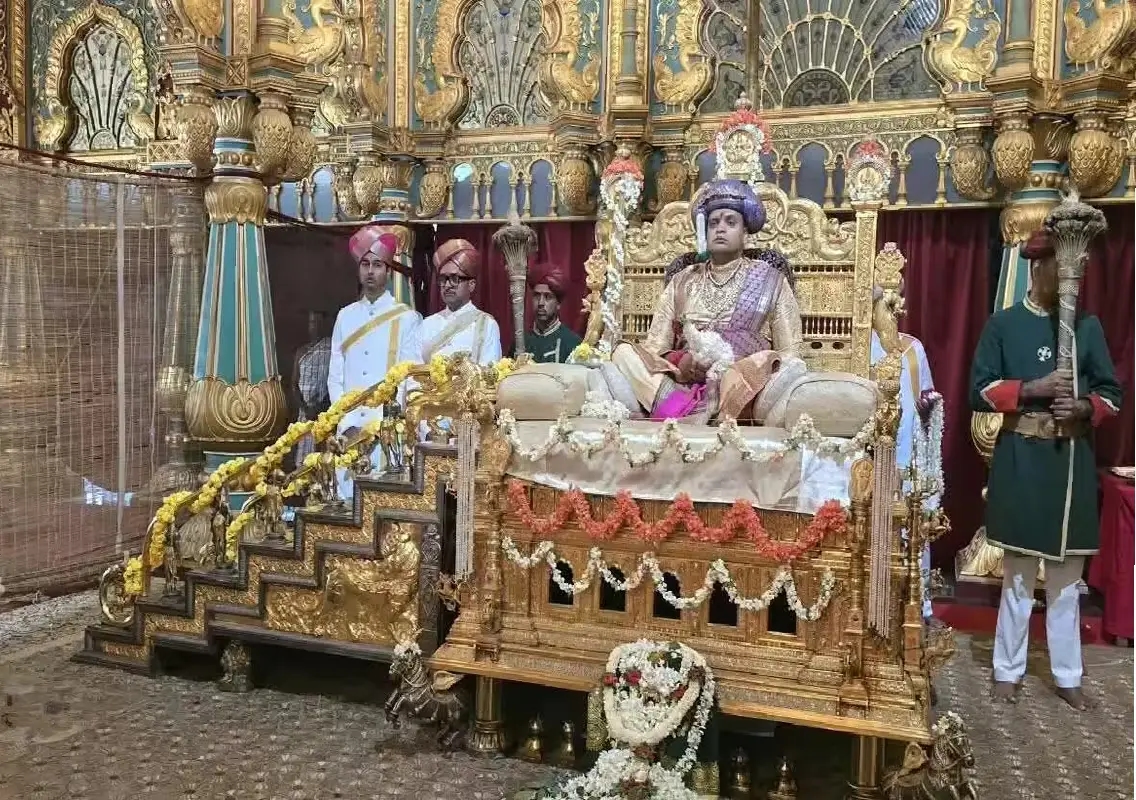


Mysuru: The Mysuru royal family began its private Dasara celebrations at Mysuru Palace on Sunday, with scion Yaduveer Krishnadatta Chamaraja Wadiyar ascending the bejewelled royal throne and holding the traditional Khas Durbar.
The rituals began at 5.30 am with royal priests performing ceremonies according to tradition. The lion-face ornaments were fixed to the ratna khachita simhasana, the royal bejewelled throne, between 6 am and 7.12 am.
The ceremonies continued with Kankanadharana, a ritual in which a sacred thread is tied around the wrist of the royal scion. The ritual was performed between 8.35 am and 9.05 am. Teertha, or sacred water brought from 23 temples, was also sprinkled on Yaduveer as part of the religious observances.
Yaduveer ascends royal throne
Dasara elephants Srikanta and Ekalavya arrived at the palace after a puja at Someshwara Temple, forming part of the traditional proceedings.
Yaduveer ascended the royal throne during the auspicious period between 11.45 am and 12.05 pm, dressed in traditional royal attire. He then conducted the private durbar, which concluded at 12.15 pm.
The ceremony marked Yaduveer’s 12th private durbar since he first held the ritual in 2015. The Mysuru royal family continues to observe these traditional ceremonies as part of its private Dasara celebrations, preserving rituals associated with the former royal household.
Royal family matriarch Pramoda Devi Wadiyar, Yaduveer’s wife Trishikha Kumari Wadiyar and other members of the family were present during the proceedings.
Palace entry restricted during rituals
Entry to Mysuru Palace was prohibited for tourists from 10 am to 2 pm on Sunday to facilitate the private Dasara ceremonies.
The palace will remain closed to visitors on October 20 and 21 in view of the Mahanavami, Ayudha Puja and Vijayadashami celebrations.
The traditional throne dismantling ritual is scheduled to be held on November 19, marking another important ceremony associated with the royal family’s Dasara observances.
The private durbar remains a distinctive feature of Mysuru’s Dasara traditions, reflecting the continuity of ceremonial practices maintained by the royal family even after the end of princely rule.