


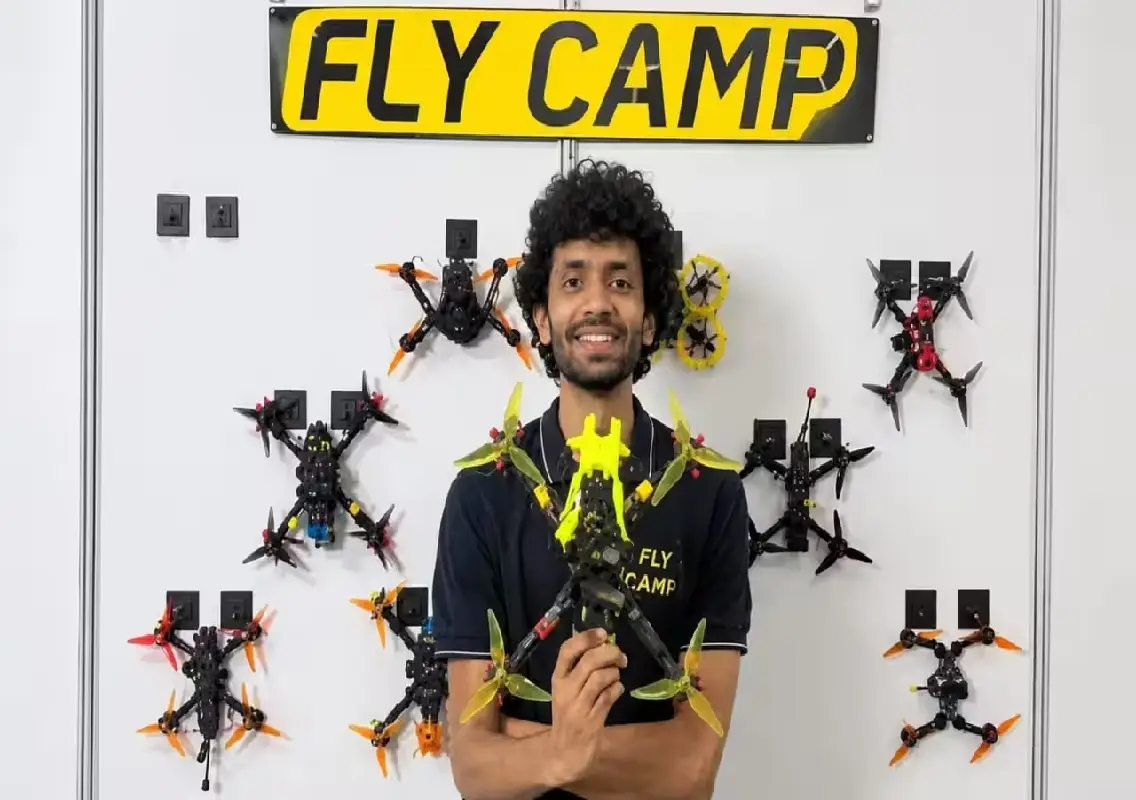


Bengaluru: Flying a drone may soon become as simple as waving a hand, thanks to an innovative gesture-controlled technology developed by Bengaluru-based entrepreneur Devesh K Hedge. The 31-year-old drone enthusiast and founder of Flycamp has created an experience that allows users to control a drone through hand movements, without operating a conventional remote controller.
The technology attracted attention at the Bengaluru Tech Summit, where visitors had an opportunity to experience the system firsthand. Participants were asked to move their hands over a mirror, with the drone responding by moving to corresponding positions on a mat. The unusual experience gave visitors the impression of controlling a flying machine through gestures, much like the futuristic technology associated with Iron Man.
According to a report by The Times of India (TOI), the concept aims to make drone flying accessible to people who have little or no experience operating such devices.
How gesture-controlled drone technology works
The system developed by Flycamp uses a camera to recognise and track the movements of a user’s hands. The detected gestures are translated into commands, which guide the drone towards specific positions.
Sensors also play an important role in the system. They help ensure that the drone remains within a designated arena, reducing the possibility of it flying beyond the permitted area or losing control.
Unlike conventional drones, which require users to understand remote controllers, joysticks and flight commands, the gesture-controlled experience relies on natural hand movements.
This makes the technology particularly suitable for beginners, children and visitors attending public demonstrations. People who have never operated a drone can try the experience without having to undergo extensive training.
At the Bengaluru Tech Summit, several visitors reportedly found the concept fascinating. Even those who were initially hesitant became interested after trying it. One nervous participant described the experience as something similar to magic.
The larger objective is to remove the initial learning barrier associated with drone technology and introduce more people to the possibilities of flying machines.
Elon Musk’s first-principles thinking inspires the idea
The concept emerged from Devesh’s experience of organising drone workshops, public events and corporate social responsibility programmes through Flycamp.
The company had conducted activities in states such as Odisha and Andhra Pradesh, introducing participants to drones and their applications. During these programmes, Devesh noticed that although people were excited about drones, many found operating them difficult.
Traditional controllers required users to understand instructions and practise handling the devices. This often discouraged first-time participants from exploring the technology further.
Devesh began considering whether drone flying could be made much simpler. Drawing inspiration from entrepreneur Elon Musk’s first-principles thinking, he questioned whether operating a drone really needed to involve complicated controls.
He explored the possibility of allowing someone with no previous experience to learn the basics of flying a drone within just five seconds.
That question eventually led to the development of Flycamp’s gesture-based drone experience.
The idea also received support from the Karnataka government. Through its ITBT Elevate programme, Flycamp received a grant of Rs 35 lakh to develop its concept of making drone flying more accessible through games.
The support provided an opportunity to take the idea beyond workshops and demonstrations and work towards creating an engaging technology-based experience.
Childhood fascination with electronics and flying machines
Devesh’s interest in technology and flying machines dates back to his childhood. Growing up around electronics through his father’s electronics business, he developed an early fascination with gadgets, machines and how they worked.
Remote-control cars were among his first interests. However, his curiosity gradually shifted towards drones.
Around 2014-15, he purchased his first drone. Watching it fly alongside a friend’s drone left a lasting impression on him. He recalled being so fascinated by the experience that the excitement continued for weeks.
His enthusiasm was so strong that he once washed his father’s car and polished his shoes to earn Rs 500. He wanted the money to purchase a motor for his hobby.
What began as a childhood interest gradually developed into a serious engagement with drone technology.
A college professor later introduced him to the institution’s chairman, who helped fund his participation in India’s first drone race at IIT Gandhinagar in 2016.
The opportunity gave Devesh exposure to the emerging drone-racing community and encouraged him to explore the technology further.
Fire-surveillance drone swarm project
During his final year of college, Devesh worked on a fire-surveillance drone swarm project. The initiative was supported through a World Bank-funded programme.
The project involved exploring the use of multiple drones for surveillance purposes, demonstrating how the technology could be applied beyond recreation and hobby flying.
A patent application related to the project was filed in 2017, although it was not ultimately granted.
Despite pursuing computer science, Devesh continued to devote considerable time to experimenting with drones and understanding their technological possibilities.
His early experiences with drone racing, surveillance applications and public demonstrations helped shape his eventual approach to making the technology more accessible.
How Flycamp took shape
Interestingly, Flycamp did not begin with a conventional startup plan or a detailed business strategy.
When Devesh’s parents encouraged him to look for a job, he decided to organise drone workshops instead. One of the early opportunities came from a college in Yeshwanthpur, Bengaluru.
The college principal agreed to host a workshop but wanted participants to receive certificates after completing the programme.
Issuing certificates required Devesh to have a registered company. This requirement eventually prompted him to establish Flycamp.
What started as an effort to share his enthusiasm for drones gradually developed into a business focused on drone education, technology and interactive experiences.
The company went on to conduct workshops and programmes for different audiences, helping introduce drones to people who might otherwise have had little opportunity to experience them.
The gesture-controlled system represents another stage in that journey.
Making drone technology accessible to everyone
With its latest innovation, Flycamp is attempting to move drone flying beyond the community of enthusiasts and trained operators.
By replacing conventional controllers with hand gestures, the company hopes to make the experience intuitive and enjoyable for beginners.
The technology also demonstrates how interactive experiences and gaming can help introduce people to emerging technologies. Instead of learning through lengthy instructions, participants can understand the basic idea by trying it themselves.
Devesh’s journey from experimenting with remote-control cars and building drones as a student to developing a gesture-controlled flying experience highlights the possibilities that can emerge when personal curiosity is combined with innovation.
If the concept gains wider acceptance, waving a hand to control a drone could become a familiar experience at educational institutions, public events and technology centres.
For now, the Bengaluru entrepreneur’s innovation offers a glimpse of a future in which operating a drone may no longer require mastering a remote controller.