







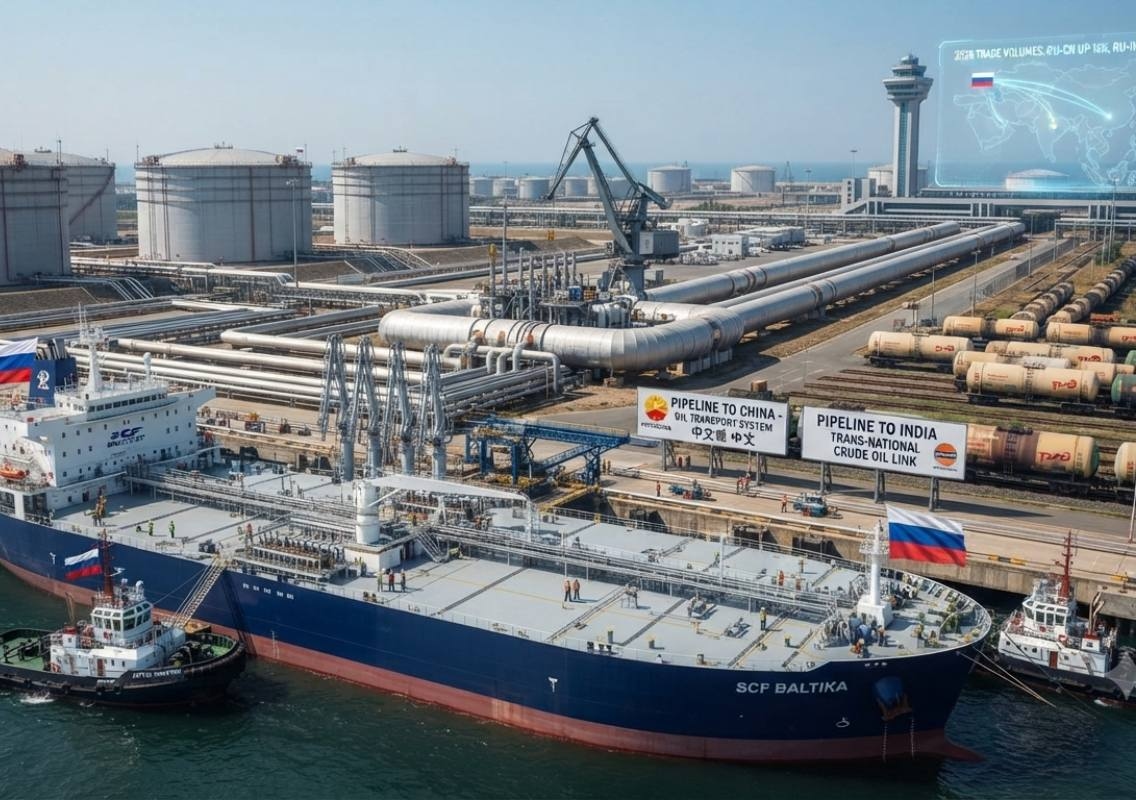


New Delhi: India and China are set to import record volumes of Russian crude oil in 2026 as disruptions to Middle Eastern supplies triggered by the Iran war reshape global oil trade. Temporary US sanctions waivers have also facilitated purchases, allowing refiners in both countries to increase their reliance on Russian barrels.
However, the surge in imports may not last. Traders and industry analysts expect Russian oil demand from the two major Asian buyers to weaken in 2027 if supplies from the Gulf recover and alternative crude becomes more readily available.
According to tanker data and industry sources, seaborne Russian crude shipments to India and China averaged around 3.4 million barrels per day (bpd) through mid-November, approximately 530,000 bpd higher than the corresponding period last year.
The increase has provided Moscow with a significant boost to its oil revenues, particularly as Ukrainian drone attacks have disrupted Russian refinery operations, pushing more crude towards export markets.
Iran war reshapes global oil trade
The disruption of Middle Eastern oil supplies following the Iran war has altered crude purchasing patterns across Asia. Reduced Iranian oil flows and concerns over the availability of supplies from the Gulf have prompted India and China to increase their purchases of Russian crude.
Temporary US sanctions waivers targeting Russian oil have also eased some restrictions on shipments, broadening the pool of vessels and suppliers available to refiners.
India and China together accounted for more than 80 per cent of Russia’s crude exports, according to estimates, underlining the importance of the two countries to Moscow’s oil trade.
Russia’s crude exports are also expected to increase this year. The country’s Ministry of Economic Development has forecast a 6 per cent rise in exports to 244.7 million metric tonnes, equivalent to approximately 4.9 million bpd.
The export increase has come despite repeated Ukrainian drone attacks on Russian refineries, which have disrupted processing operations and affected domestic refining capacity. Brent crude prices have also reportedly climbed nearly one-third since the beginning of the war.
India increases Russian crude purchases
India, which has emerged as the largest buyer of seaborne Russian crude, has significantly increased its imports amid the supply disruptions.
Kpler data showed that India’s Russian crude imports averaged 1.99 million bpd through early November, approximately 250,000 bpd higher than the same period last year.
The increase follows a period during which Indian refiners had scaled back purchases amid concerns over potential higher US tariffs and the broader implications of trade negotiations.
Between January and October, India’s imports of Russian crude rose by around 10 per cent to 1.87 million bpd, accounting for approximately 38 per cent of the country’s total crude imports, according to trade sources.
Indian refiners are reportedly expecting the average imports for the full year to reach approximately 1.9 million bpd.
The increase in purchases has largely been driven by the changing availability and economics of crude oil. With supplies from the Middle East facing disruptions following the Iran war, Russian oil has become an important source for Indian refiners seeking to maintain steady feedstock supplies.
India’s dependence on Russian crude has also been shaped by the need to balance supply security, refining costs and the availability of alternative grades in the global market.
China also boosts Russian oil imports
China has also increased its purchases of Russian crude as the Iran war disrupted oil flows from the Middle East.
Chinese customs data showed that imports of Russian oil rose 17 per cent to 2.34 million bpd between January and October. The shipments were valued at approximately $59.6 billion, with Russian crude accounting for around a quarter of China’s total oil imports during the period.
The increase came even as China’s overall crude imports declined by 15 per cent.
According to Muyu Xu, an analyst with tanker tracker Kpler, lower shipping risks and greater supply reliability have been key reasons behind China’s increased purchases of Russian crude since the war began.
However, analysts believe China’s dependence on Russian oil may have reached a level that could prove difficult to sustain if market conditions change.
Michal Meidan, head of China Energy Research at the Oxford Institute of Energy Studies, expects Chinese demand for Russian crude to weaken in 2027 as Middle Eastern supplies become more readily available.
The pricing dynamics have also changed. Russian crude is no longer consistently available at the discounts that previously made it attractive to Chinese refiners.
Meidan said Russian oil was increasingly trading at higher premiums to Brent crude than Gulf oil, making it less attractive for smaller independent Chinese refiners, commonly known as teapots, which rely heavily on discounted crude.
Why Russian oil demand may fall in 2027
The outlook for Russian oil exports will largely depend on whether Middle Eastern supplies recover in 2027 and how crude prices evolve.
If Gulf oil supplies return to normal levels, Indian refiners are expected to have more purchasing options. Sources at Indian refiners told that Russian crude imports could return to pre-Iran war levels, with future purchases depending largely on pricing and availability.
China is also expected to reconsider its reliance on Russian oil if Middle Eastern crude becomes more competitive and shipping conditions improve.
The potential shift could create challenges for Moscow, which has benefited from increased purchases by its two biggest customers during the supply disruptions.
With India and China absorbing record volumes of Russian crude in 2026 partly because of reduced alternatives, a recovery in Gulf supplies could intensify competition among oil exporters.
Russian crude may then have to compete more directly with Middle Eastern and other international supplies, potentially putting pressure on export volumes and prices.
The current surge in Russian oil imports therefore reflects a market shaped by geopolitical disruptions rather than necessarily a permanent shift in purchasing patterns. If the situation in the Middle East stabilises next year, the demand that has supported Russia’s oil exports in 2026 could begin to recede.