







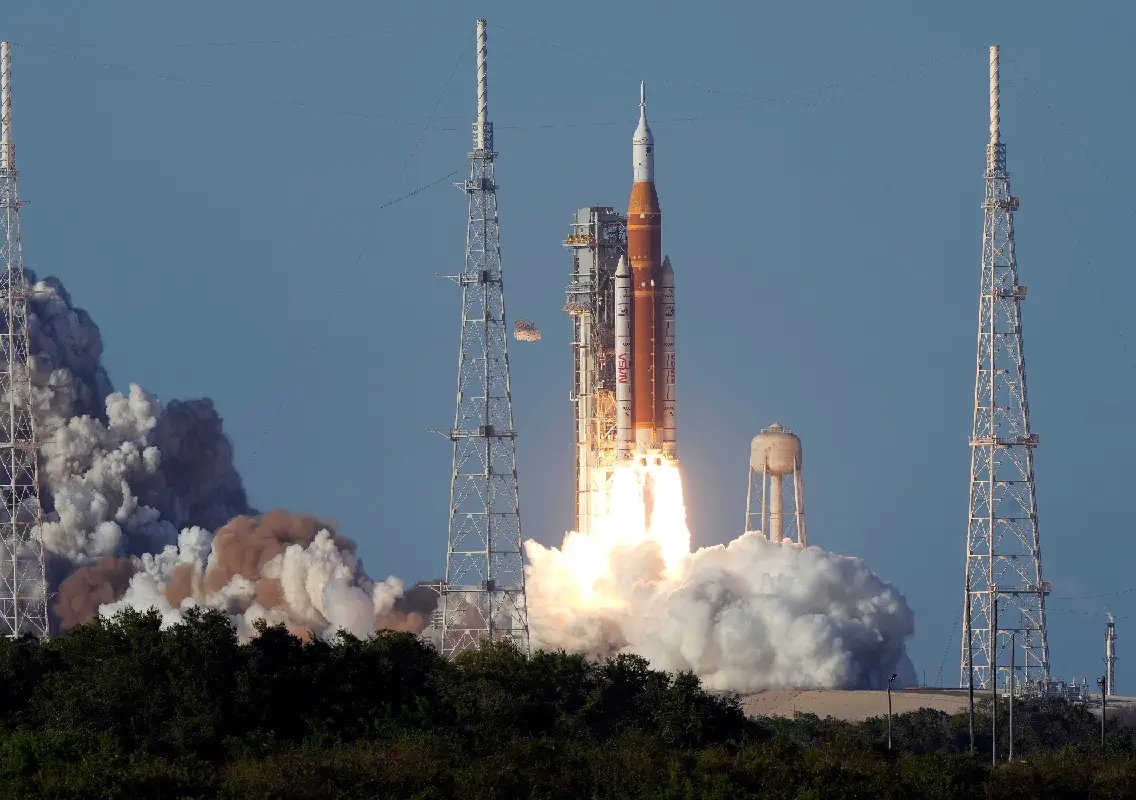


In a landmark moment for space exploration, NASA successfully launched the Artemis II rocket from the Kennedy Space Center, sending astronauts on a historic journey towards the Moon for the first time in over 50 years.
Historic launch draws massive crowds
Tens of thousands gathered along Cocoa Beach and surrounding areas to witness the launch, echoing scenes from the Apollo era. The powerful Space Launch System rocket carried four astronauts into space, marking a significant milestone since the last human mission to the Moon in 1972.
Mission to test deep-space capability
The Artemis II mission will test the Orion spacecraft, which is designed to carry astronauts to the Moon and back. The crew—three Americans and one Canadian—will travel around the Moon and return, without landing.
This 10-day mission aims to validate critical systems, including life support, navigation, and communication, while also allowing astronauts to manually control the spacecraft during parts of the journey.
Meet the crew
The mission includes astronauts Christina Koch, Victor Glover, Reid Wiseman, and Canadian astronaut Jeremy Hansen.
Their journey will take them approximately 406,000 kilometres from Earth—the farthest distance humans have travelled in space.
Global collaboration and future goals
A key component of the Orion spacecraft, the European Service Module, was developed by Airbus in collaboration with the European Space Agency, highlighting international cooperation in the mission.
Artemis II is part of NASA’s broader Artemis programme, which aims to return humans to the Moon—particularly the lunar south pole—by 2028, and eventually pave the way for crewed missions to Mars in the coming decades.
A new era of exploration
While Artemis II will not land on the Moon, it represents a crucial step towards establishing a sustained human presence beyond Earth.
As global space ambitions intensify, including plans by other nations to reach the Moon, the mission signals the beginning of a new chapter in human space exploration.