


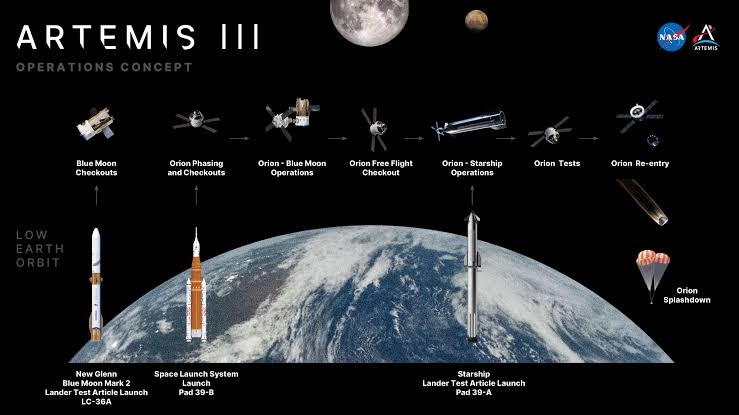


Washington: NASA is preparing for one of the most complex human spaceflight missions in its history as it works towards returning astronauts to the Moon. Scheduled for 2027, Artemis III will send four astronauts into low Earth orbit for a series of tests involving three spacecraft, three rockets and two critical docking demonstrations.
The 14-day mission will bring together NASA’s Orion spacecraft, Blue Origin’s Blue Moon Mark 2 lunar lander test vehicle and SpaceX’s Starship Version 3 test vehicle. Unlike earlier Artemis missions, the flight will focus on demonstrating the technologies and procedures required for future crewed lunar landings rather than taking astronauts to the Moon itself.
NASA has identified Artemis III as a major risk-reduction mission ahead of Artemis IV, which is planned to take astronauts to the lunar surface in 2028. The tests will help engineers evaluate how Orion works with commercial lunar landers, including their communications, software, life-support systems and docking mechanisms.
The four-member crew will comprise NASA astronauts Randy Bresnik, Frank Rubio and Andre Douglas, along with European Space Agency astronaut Luca Parmitano. NASA says the mission will provide operational experience that cannot be fully replicated through ground-based testing.
Why Artemis III is different from earlier missions
Previous Artemis missions used NASA’s Space Launch System (SLS) rocket and Orion spacecraft as the primary launch and crew transportation systems. Artemis III will introduce a more complicated sequence involving commercial spacecraft developed by two different companies.
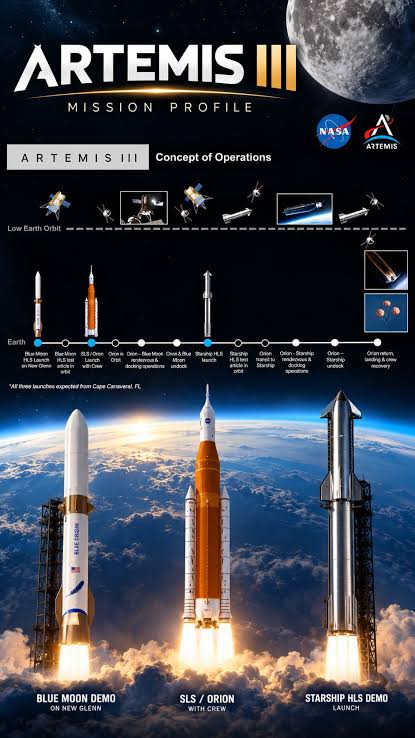
Blue Origin will launch its Blue Moon Mark 2 test vehicle first. NASA will then launch Orion and its crew aboard the SLS rocket from Kennedy Space Center in Florida. After the first docking demonstration, Orion will separate from Blue Moon and prepare to meet SpaceX’s Starship test vehicle.
The mission’s three launches will need to be carefully coordinated because each spacecraft has different orbital requirements and operational limitations.
NASA must also ensure that the vehicles are ready before the next phase begins. Blue Moon’s test vehicle is designed to remain in orbit for up to 30 days, offering flexibility in the launch schedule. Starship, by comparison, is designed for a shorter orbital lifetime, so its launch will be scheduled later in the mission.
The overall objective is to test how Orion can safely rendezvous and dock with both commercial lander designs during a single crewed flight.
First docking: Orion meets Blue Origin’s Blue Moon
The mission will begin with Blue Origin launching a test version of its Blue Moon Mark 2 lunar lander into low Earth orbit, approximately 273 miles above Earth.
A few days later, NASA will launch Orion and its four astronauts aboard the SLS rocket. Following launch, the crew will check Orion’s systems and carry out manoeuvres to position the spacecraft for its first major objective: rendezvous and docking with Blue Moon.
Orion will initially enter an elliptical orbit before using its service module to move into a circular orbit at approximately 345 miles above Earth. These orbital manoeuvres will help prepare the spacecraft for the planned rendezvous.
Once the two vehicles dock, the astronauts are expected to spend approximately two days evaluating the Blue Moon test article.
Unlike a demonstration limited to connecting two spacecraft, this phase will allow crew members to open the hatch and enter the lander. They will assess its cabin environment, controls, atmosphere, pressure and life-support systems.
The test vehicle incorporates technologies intended for future crewed lunar missions, including avionics, software, flight-control systems and crew-cabin equipment. Evaluating these systems together in space will help NASA understand how the lander performs as an integrated vehicle.
The exercise will also provide valuable experience in operating Orion alongside a commercial lunar lander, with engineers assessing communications, guidance systems and software interfaces.
Second docking: Testing SpaceX’s Starship
After completing the Blue Moon demonstration, Orion will undock and reposition itself for the mission’s second major rendezvous.
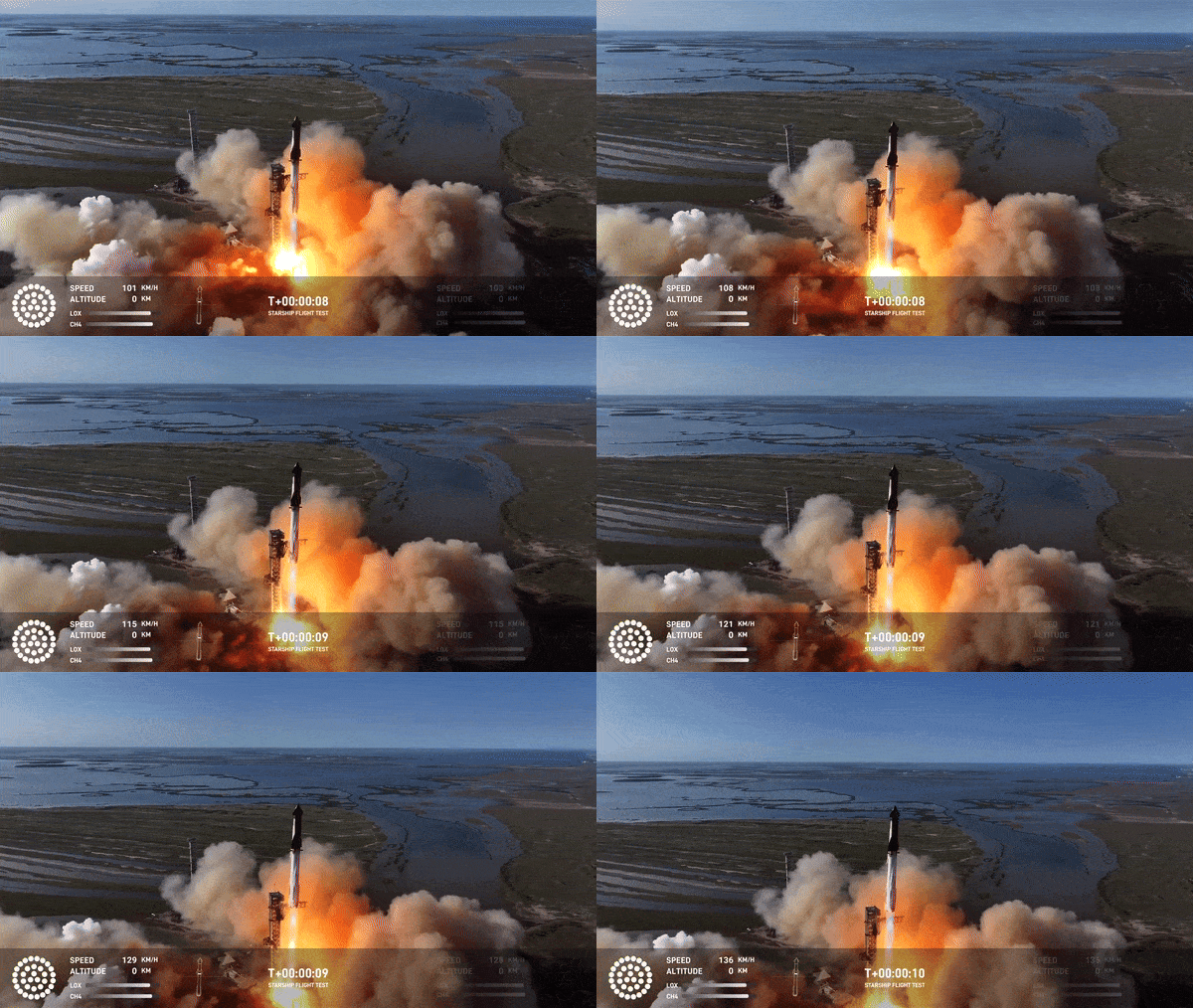
SpaceX will launch a Starship Version 3 test article from Florida into a lower Earth orbit, approximately 206 nautical miles above Earth. The vehicle will carry an additional docking system mounted at its forward end.
Orion will then approach Starship and attempt to dock with it in a demonstration expected to last up to two hours.
The astronauts will not enter Starship during this exercise. Instead, the test will focus on how the two spacecraft interact when connected in orbit.
NASA and SpaceX plan to evaluate spacecraft controllability, communications, integrated software performance and the dynamics of docking and undocking. Engineers will also assess the different docking arrangements used by the two commercial lander designs.
The Blue Moon test involves Orion connecting to a docking port beside the lander’s crew cabin, while the Starship demonstration will use a forward docking system.
Testing both approaches during the same mission will give NASA a better understanding of how Orion can interface with different spacecraft architectures. The results will help engineers refine procedures for future missions in which astronauts transfer between their crew spacecraft and a lunar lander.
The astronauts will test more than docking systems
Artemis III will continue beyond the two docking demonstrations. NASA has planned additional tests and scientific activities to gather information needed for future deep-space missions.
The crew will evaluate Orion’s Crew Survival System suits, conduct docking sensor tests and collect thermal and acoustic measurements. Human-factors assessments will also help engineers understand how astronauts interact with the spacecraft and its equipment during an extended mission.
Another important activity will examine how astronauts could perform health-related assessments when they cannot communicate directly with mission control. Such capabilities could become increasingly important during future lunar surface expeditions and other missions farther from Earth.
The mission will also include a cellular biology experiment, Earth and solar observations, and investigations related to the transportation and return of lunar samples.
NASA plans to use the flight to test concepts for receiving, transporting and moving future lunar samples into curation facilities after their return to Earth. The agency will also assess Orion’s environment to better understand potential contamination issues associated with future lunar exploration.
These activities are intended to develop the technical knowledge and operational experience required for longer and more demanding missions.
Why the mission matters for the 2028 Moon landing
NASA’s broader Artemis programme aims to establish a sustained human presence on the Moon and prepare for future exploration beyond Earth’s immediate neighbourhood.
The planned lunar landing in 2028 is associated with Artemis IV, following the redesign of Artemis III into an Earth-orbit demonstration mission.
The change allows NASA to test the interaction between Orion and commercial lunar landers before attempting a crewed landing. It also provides an opportunity to evaluate spacecraft systems and procedures under actual spaceflight conditions.
The two docking demonstrations are particularly important because future lunar missions will require astronauts to transfer between Orion and a lander designed to travel to and from the lunar surface.
A failure involving docking, communications, software or life-support systems could have serious consequences during a lunar mission. Identifying problems in Earth orbit gives engineers an opportunity to address them before astronauts undertake the more difficult journey to the Moon.
NASA is working with both Blue Origin and SpaceX to develop commercial human landing systems. The Artemis III tests will help the agency assess how the two designs operate alongside Orion, although the precise role of each system in future missions will depend on programme requirements and technical readiness.
What happens after the tests?
After completing the Starship docking demonstration, Orion and its crew could have up to five additional days available in orbit to complete further tests and investigations, depending on how the mission progresses.
Once the planned objectives are complete, the spacecraft will prepare for its return to Earth. Orion will re-enter the atmosphere and splash down in the Pacific Ocean off the coast of California.
NASA personnel and the United States Navy will recover the spacecraft and crew.
The mission’s findings will then help engineers assess the performance of Orion, the lander test vehicles and the systems that connect them. The results will contribute to preparations for Artemis IV and later missions.
Three launches, two dockings and a safer path to the Moon
Artemis III will test NASA’s ability to coordinate several spacecraft and commercial partners during a single crewed mission. Its three-launch sequence and two docking demonstrations represent a major step towards integrating commercial lunar landers with Orion.
The planned 14-day flight will also provide opportunities to evaluate life-support systems, astronaut operations, communications, software and scientific investigations in low Earth orbit.
Although Artemis III will not land astronauts on the Moon, its role is central to preparing for the next stage of lunar exploration. By testing critical systems before a crewed landing, NASA hopes to identify technical challenges early and improve mission safety.
With four astronauts, three spacecraft and two docking demonstrations planned for 2027, Artemis III is designed to turn essential lunar mission procedures into proven operations before astronauts attempt to return to the Moon’s surface in 2028.