







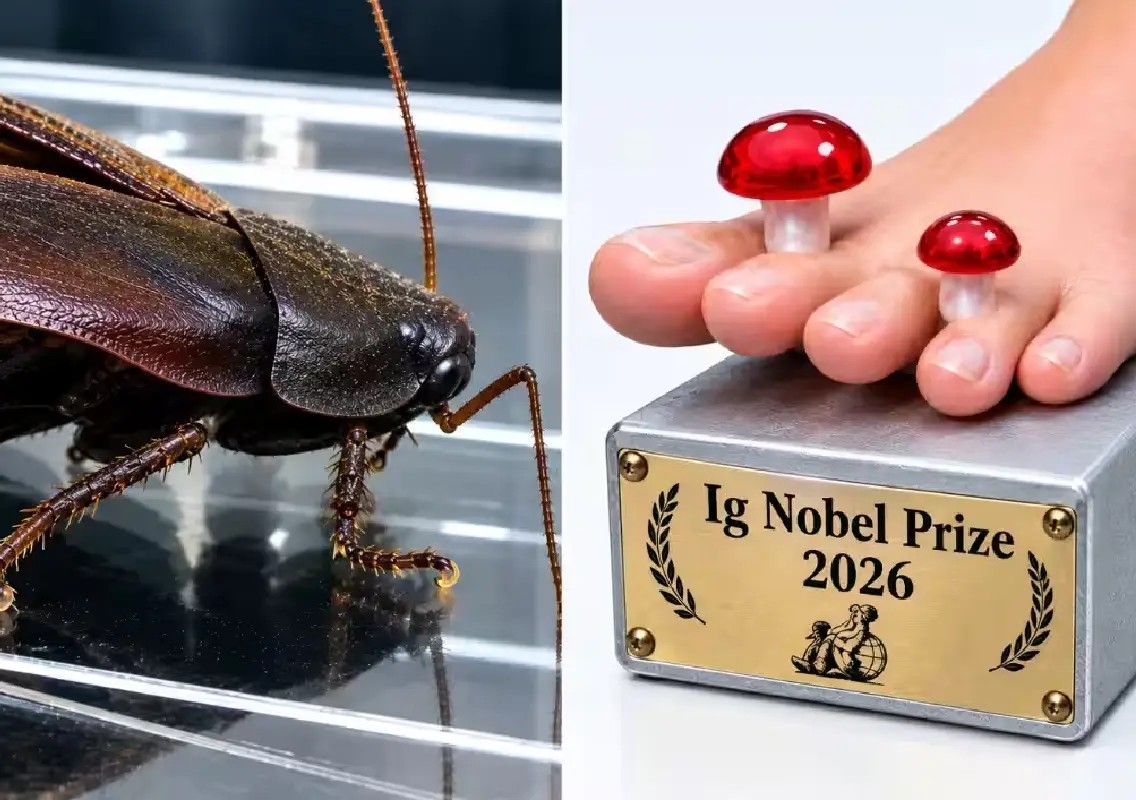


Cockroaches may rarely be associated with scientific breakthroughs, but an unusual discovery about their milk-like nourishment has now earned international recognition.
Three researchers from an 11-member international team involving scientists from India, France, Japan and the United States have won the 2026 Ig Nobel Prize in Chemistry for research showing that milk proteins produced by a viviparous cockroach can contain around three times the energy of an equivalent amount of dairy milk.
A cockroach unlike most others
The research focuses on Diploptera punctata, the only known viviparous cockroach. Unlike most cockroaches, it gives birth to live young, with embryos developing inside the mother.
The species produces a milk-like substance to nourish its developing offspring. Researchers found that the milk proteins form crystals inside the embryos’ midgut, creating a highly concentrated source of nutrients.
The award-winning researchers are Ramaswamy Subramanian of Purdue University, structural biologist Leonard “Leo” Chavas and Nathan Coussens of the Frederick National Laboratory for Cancer Research.
Tiny crystals hold an unusual secret
Using advanced X-ray crystallography, the team determined the structure of the proteins at atomic resolution.
The 2016 study found that the crystals contain glycosylated proteins that bind lipids and form a tightly packed structure. This arrangement provides developing embryos with a concentrated nutritional supply.
Despite being popularly called “cockroach milk”, the material is not milk in the conventional sense. It consists of milk proteins that crystallise inside the developing embryo.
A discovery that took years
The research began more than two decades ago when Coussens encountered the unusual crystals while working as an undergraduate in Subramanian’s laboratory.
When the crystals were examined using an X-ray beam, researchers discovered that they were proteins. It took more than a decade to determine their atomic structure.
The work later developed into an international collaboration and opened new questions about protein stability and biomolecular design.
Not the next superfood
The findings have understandably attracted attention, but researchers caution against treating cockroach milk as a future health food.
The material is extremely difficult to obtain, is not commercially produced and has limited evidence regarding its benefits for human consumption. Its high energy density also does not automatically make it suitable as a food source.
The Ig Nobel recognition highlights the unusual nature of the discovery while drawing attention to the serious science behind it. What began as a strange biological question could ultimately help researchers understand and design proteins with useful new properties.