









Astronomical ‘fratricide’ nearing violent end
Astronomers have identified a distant star system that is on course for a catastrophic supernova explosion, so bright that it could be visible from Earth even during the daytime.
The system, known as V Sagittae, lies about 10,000 light-years away and has puzzled scientists for more than a century due to its extreme brightness. A new study published in Monthly Notices of the Royal Astronomical Society in August has finally explained the mystery — revealing a dramatic case of stellar destruction.
A white dwarf feeding at record speed
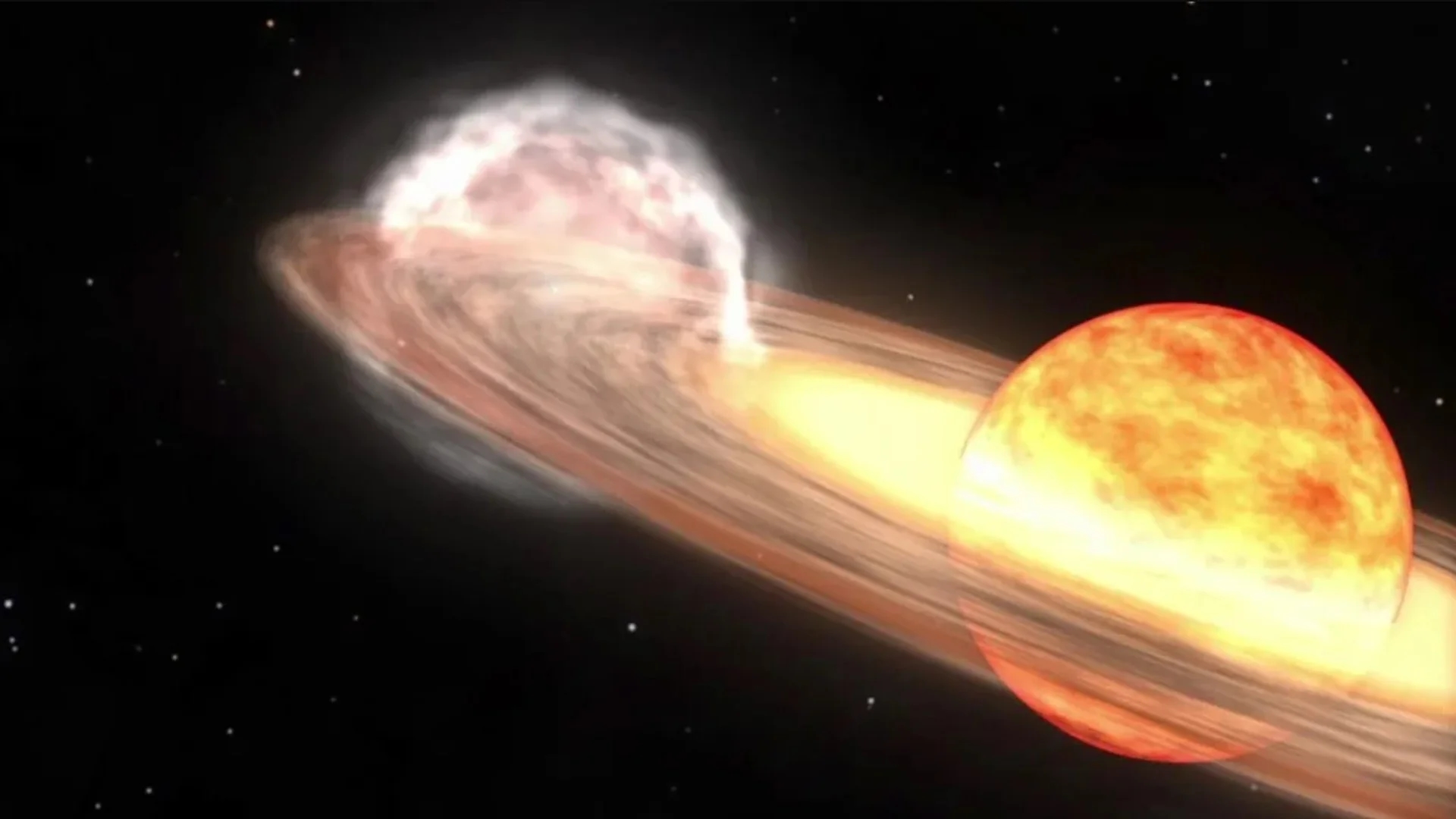
Researchers found that V Sagittae consists of two stars locked in a tight orbit of just 12.3 hours. One of them is a white dwarf, an ultra-dense stellar remnant, which is violently stripping material from its larger companion at an unprecedented rate.
“This system is no ordinary binary,” said Phil Charles of the University of Southampton, a co-author of the study. “The white dwarf is essentially sucking the life out of its companion star. The process is so extreme that it triggers thermonuclear reactions on the white dwarf’s surface, making it shine like a cosmic beacon.”
This intense feeding explains why V Sagittae has appeared unusually luminous since its discovery in 1902.
Giant ring of gas reveals ongoing destruction
Using the European Southern Observatory’s Very Large Telescope in Chile, the team also detected a vast ring of gas encircling the star system. This ring consists of material that the white dwarf cannot fully absorb, flung outward by the immense energy being released.
According to Pasi Hakala of the University of Turku, the system’s unstable motion and surrounding debris are clear signs that it is nearing a violent end. “The white dwarf cannot consume all the transferred mass, so it creates this glowing ring. The system’s erratic behaviour suggests it is approaching its final stages,” he explained.
A supernova visible in daylight
Before the final collision, scientists expect a nova outburst, an explosive event that could make V Sagittae visible to the naked eye at night. But the ultimate fate is far more dramatic.
“When the two stars finally merge, the resulting supernova will be so bright that it could be seen from Earth during the day,” said co-lead author Pablo Rodríguez-Gil of the Instituto de Astrofísica de Canarias.
A rare cosmic opportunity
While the explosion poses no threat to Earth, astronomers say it represents a rare opportunity to study the life cycle of stars in real time. Events of this intensity are extremely uncommon in our galaxy.
If predictions hold true, humanity may soon witness one of the brightest stellar explosions ever recorded, offering fresh insights into how stars are born, evolve and ultimately die.