







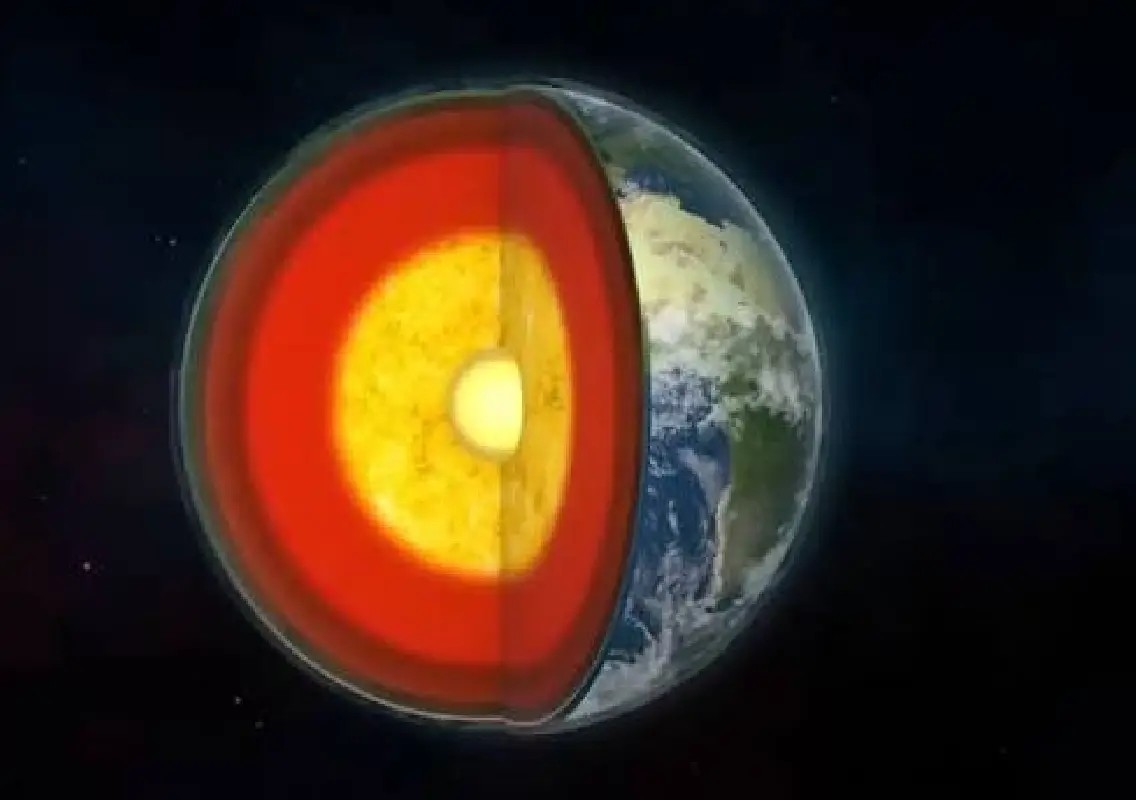


Zurich : Scientists have found evidence that Earth’s core may contain far more hydrogen than previously estimated, potentially holding an amount equivalent to the hydrogen in 9 to 45 oceans of water.
The finding comes from a study published in Nature Communications, in which researchers used high-pressure, high-temperature laboratory experiments to recreate conditions similar to those during the formation of Earth’s core.
Researchers estimated that hydrogen could account for between 0.07% and 0.36% of the core’s mass. Although the percentage appears small, the enormous size of the core means the total quantity of hydrogen could be extraordinary.
Hydrogen is not stored as oceans
The finding does not mean that 45 oceans of liquid water are sitting inside Earth.
Hydrogen is believed to be incorporated into metallic material deep within the core. If hydrogen were later released and reacted with oxygen in the mantle, it could contribute to the formation of water.
The researchers used laser-heated diamond-anvil experiments and atom-probe tomography to examine how hydrogen behaves in iron under extreme conditions. Their observations found hydrogen associated with silicon- and oxygen-rich structures inside the iron alloy.
The finding may reshape Earth’s water story
The study also offers clues about how Earth obtained its water. The researchers suggest that a substantial amount of hydrogen may have been incorporated into the planet during its main stages of formation, rather than arriving mainly through later comet impacts.
Scientists caution that the estimate remains uncertain because conditions inside Earth’s core cannot be measured directly and laboratory experiments require assumptions about the planet’s early composition.
Nevertheless, the discovery could improve understanding of Earth’s formation, deep-water cycle and even the processes that helped power its ancient magnetic field.